To Tetsunosuke’s surprise, Genshichirō had rented an entire storehouse belonging to Ozu-ya, a wealthy cotton merchant. That building was Genshichirō’s private training hall.
“Renting an entire warehouse like this, protected by this kind of thick earthen walls, wow, … isn’t that terribly expensive?” Tetsunosuke asked.
“Of course it is,” Genshichirō replied. “Renting a storehouse in Horidome-chō, Nihon-bashi, costs an exorbitant amount of money. Nobody imagines such a Dojo is hidden in this downtown area.”
“And yet, Master, you live in a modest mansion…”
“That tenement? Calling that a ‘mansion’ is absurd! I receive more than enough stipend from the Shogunate. I simply spend it on renting this earthen storehouse. There is no sense in throwing money away on the house one lives in.”
“I see…”
Receiving a generous stipend meant that Genshichirō was still an active manslayer—an undercover operative for the Shogunate. In fact, given the nature of his duty, being unassigned to any formal office was better for remaining inconspicuous. Naturally, Tetsunosuke was destined to inherit this very duty from his father-in-law.
“As I told you before, my swordsmanship must never be seen by anyone,” Genshichirō said. “If we lock the door from inside this storehouse, there is not the slightest chance of being watched. Well, no one would think to peek inside such a warehouse anyway. I told Denbei, the landlord, that I was having trouble disposing of ancestral antiques left in a will, and asked him to lend me a storehouse. That is why I deliberately stacked junk near the entrance as a screen. Ironically, he seems to believe it completely.”
“Ah…”
It was cramped, yet perhaps just the right size for a single man to swing a sword.
“Light the candles at the four corners.”
Following Genshichirō’s order, Tetsunosuke used a flint to ignite one of the candle stands set in the corners, then transferred the flame to the remaining three.
“Next, climb the ladder to the roof rafters, tie a string around this cucumber, and hang it down to the level of my chest.”
Tetsunosuke once again did as he was told.
“Good. Now, try cutting it.”
For Tetsunosuke, who had practiced test-cutting repeatedly at Zen’in-ji, this was nothing. With a single fluid movement, he neatly sliced it diagonally, and then slashed through it horizontally on the way.
“That was merely an opening diversion,” Genshichirō said. “Now, lay out that straw mat.”
Tetsunosuke unrolled the straw mat from the corner of the storehouse and spread it in the center of the dirt floor.
“Now, hang another cucumber so that it reaches exactly eye level when sitting.”
Genshichirō sat on the straw mat and waited for Tetsunosuke to finish before speaking.
“What I am about to demonstrate is a technique called Kasumi (霞)—the Mist.”
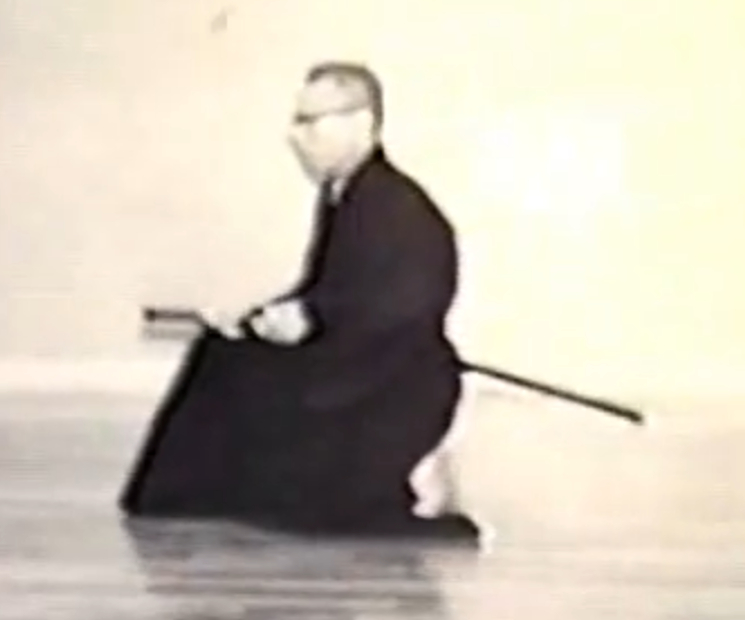
Sitting in a half-kneeling stance (立膝; tate-hiza) facing the cucumber, Genshichirō drew his sword in a flash. After three rapid horizontal sweeps, he brought the blade down vertically, cleaving it in two.
“Kasumi is a technique designed to bring down an opponent facing you in a half-kneeling position.
In iaijutsu, drawing the sword, raising it overhead, and bringing it down is far too slow. You must strike the enemy in the very act of drawing the blade. That is fundamentally different from ordinary swordsmanship, where you assume a guard and exchange blows.
The initial horizontal sweep uses the momentum of the draw to blind the opponent. If you can slice them in a single strike, fine; if you miss, flick your wrist in small, rapid motions to graze their eyes with the tip of the blade, quickly and surely blinding them. There is no need for large swings. Once they are blinded, split their skull straight down the middle. That is the whole theory—utterly simple. Yet, actually cutting a cucumber this way is difficult. Try it yourself.”
Indeed, trying it proved surprisingly difficult. From the initial sitting position, one steps forward with the lead foot while making a horizontal sweep, then steps forward again, raising the sword high to strike down. However, swinging a sword from a half-kneeling position offers far less freedom of movement than standing. It required extensive training to get used to it. Moreover, cutting a suspended cucumber from a seated posture was harder than expected. The more one tensed up to cut it, the less it would cut. Eventually, Tetsunosuke managed to land the first strike, but the impact caused the cucumber to sway wildly. Performing the continuous sequence—the second strike, the third strike, and the finishing fourth strike—proved terrifyingly difficult.
“If the cucumber sways, you cannot cut it!” Genshichirō barked. “Strike fast and cleanly so it does not sway!”
On another day, instead of a cucumber, it was a pear.
“I obtained a fine pear today,” Genshichirō said.
This time, the posture was not half-kneeling, but formal sitting (seiza).
“What we shall do now is a technique called Imagoi (暇乞)—Taking One’s Leave.”
Genshichirō first addressed the pear: “Well then, allow me to take my leave now.”
He then slid the sword resting beside him into his sash.
“You must not let the enemy sense any hostility. Since this technique can only be used at extremely close range, if necessary, you must edge closer until you enter striking distance—saying things like, ‘Ah, I almost forgot to present you with a gift for your household,’ while holding a box of sweets with your sword already sheathed.
Then, you bow to the opponent. In that split second, you draw the blade, raise it overhead, and strike them down. The enemy would never expect you to draw from a formal seated position in a moment of parting, so you will almost certainly cut them down.
If the enemy is completely off-guard, strike immediately after a light nod. However, if the opponent senses something amiss, bow deeply to hide your hands from their view. Place your hand on the hilt, draw the blade straight forward, raise it, and slash down. Because this technique requires three distinct steps before the cut, it demands even greater speed than other moves.”
Genshichirō demonstrated the three variations using the single pear. First, after a light nod, he sliced off the right side. Next, with a moderate bow, he sliced off the left side. Finally, after a deep bow, he split the remaining center straight down the middle.
What a treacherous technique! Tetsunosuke shuddered.
“Are you shocked?” Genshichirō asked. “This is what assassination swordsmanship truly is.
Why do you think there are three variations? Because you must alter your drawing method according to the situation. If there is no opening in the enemy’s guard, do not force it. Simply bow and leave. If the opponent knows anything about iaijutsu, they will sense your intent before you draw, grab your arms, and prevent you from unsheathing your sword. Like this.”
Genshichirō grabbed both of Tetsunosuke’s arms and shoved the sword back into its scabbard.
“What should I do in that situation?”
“If your arms are grabbed, it is over. While you are trapped and grappling, the enemy’s men will gather, and you will die. Before they can grab you, step back and reset your posture. Adapt to the circumstances.”
“It is… extraordinarily difficult.”
“Of course it is. You are killing a man, after all.
This technique is also called Jōi-uchi (上意討ち)—striking by lord’s command—because it was frequently used when executing someone by order of a master.
In the Warring States period, it was commonplace for a lord to send assassins to execute his own retainers. That, too, was Jōi-uchi. But once peace was established under heaven and the storms of rebellion faded, war-like treasons and family feuds gradually disappeared. Yet seeds of conflict never cease in any era; instead, many disputes came to be judged secretly through covert orders.
Consider when such a technique might be used. Suppose a chief retainer of a domain takes advantage of his lord’s absence to sleep with a favored concubine, murders the legitimate heir, places the concubine’s child as successor, and schemes to become the power behind the throne. Such a man must be executed without debate, but usually, his tight guard makes it impossible to get close.
So, at a tea gathering or poetry recital, when the enemy lowers his guard, you strike him down—and by showing those present that it was by the lord’s order, you settle the matter on the spot.
Or perhaps you are sent to deliver a Shogunate decree to a certain official: ‘Due to misconduct, your lands are confiscated and you are ordered into home confinement.’ If the man obeys quietly, fine. But if he resists or tries to flee, you must execute him on the spot. These techniques from half-kneeling or formal sitting—that is, iaijutsu—are designed precisely for such situations.”
Iaijutsu… I see. This is no dojo swordsmanship. It is secret assassination fencing. And since one deliberately walks into the enemy’s residence, there is no guarantee of returning alive. It was truly a matter of life or death.
“Now, you try it.”
When Tetsunosuke tried it, cutting the pear itself was easy, but—
“Suppress your killing intent! Your spoken line is too stiff—the enemy will be put on guard!”
“Too slow! Far too slow! The enemy will sense it, flee, or strike you back! Draw faster, cut faster!”
On another occasion, there was a standing technique called Shinobu—the Stealth.
Sneaking up behind the enemy, one would draw the sword and tap the ground gently with the tip of the blade. While the opponent’s attention was diverted toward the sound, one would strike them down from the opposite side.
Now, Tetsunosuke fully realized: these techniques had all been used in actual battle at least once before. They were skills gathered and refined by the Tokugawa clan during the Warring States period, or during the reigns of Iemitsu and Ietsuna when the embers of war still lingered. Some who handled these techniques were called kōgi onmitsu—shogunate spies—while others were known as ninja.
Though the world now seemed at peace, jōi-uchi—execution by order of the lord—had not ceased entirely. Without a doubt, somewhere in secret, someone was still being struck down.
Another standing technique, Yukizure (行連)—the Companions—was designed to fell two enemies at once.
Two enemies are walking in a line down a narrow alley. Overtaking them from behind until positioned between the two, one first turns around to strike down the enemy in the rear, then immediately turns to fell the enemy in front.
“Why the front one second and the rear one first?” Tetsunosuke asked.
“If you think about it, the reason is obvious,” Genshichirō replied. “If you try to strike the front enemy first, the one behind will notice immediately. But the front enemy has no eyes in the back of his head. Therefore, take out the rear enemy by surprise first. Then, without losing a split second, cut down the front enemy before he can adopt a fighting stance.”
It was a terrifying form of swordsmanship. If an ordinary samurai were to learn such techniques, there was no telling if he might go about cutpurses or innocent townsfolk just for the sport of it.
“In my style of battōjutsu (抜刀術; sword-drawing technique), there are nine seated techniques and nine standing techniques—eighteen in total. Train every day, day and night, until you can execute them all flawlessly.”
In the storehouse—where morning, noon, night, and the four seasons were all lost—Tetsunosuke swung his sword relentlessly.
Before long, the year drew to a close. Tetsunosuke went to assist Osato with her shopping at the year-end market (Toshi-no-Ichi) held in the precincts of Senso-ji Temple in Asakusa. However, they were not there to buy auspicious decorations like sacred ropes or pine gate posts. His father-in-law had told them that such things were unnecessary to purchase. They would display no ceremonial rice cakes (kagami mochi), nor drink spiced New Year’s sake (お屠蘇; otoso).
Since all shops would close during the first week of the New Year, they only stocked up on long-lasting preserved foods—salted salmon, kelp, simmered herring roe, and dried Pacific herring. Aside from food, they walked about purchasing secondhand clothes and fabric scraps to endure the winter cold.
In the Tachibana household, as the old year ended and the new year began, they did not offer prayers to the first sunrise, nor did they visit shrines or pay New Year’s courtesy calls.
“Osato,” Tetsunosuke asked. “Does your father dislike the gods and Buddhas?”
“Well… I don’t think he particularly likes or dislikes them,” she replied.
“Why then, when it is the New Year, do we not drink otoso or make New Year’s visits?”
“I asked him once as well,” Osato said. “He merely said, ‘It is only natural for a new year to arrive and for people to grow older. There is no need to go out of one’s way to celebrate it.’ And, ‘There is no need for a manslayer to live like ordinary people.’”
Tetsunosuke could not understand his father-in-law’s stubborn obsession. Surely it would be alright if at least he and his wife, Osato, lived an ordinary, human life. Taking advantage of his father-in-law’s absence, they bought skewered dango dumplings—something they would never be allowed to eat at home—and sat side by side on a wooden bench at a tea house to eat them.
How many people in this world felt a pang of guilt while eating dumplings at an Asakusa festival?
“Do we not go cherry-blossom viewing in the spring either?”
“No, we don’t.”
“Osato… do you not feel lonely?”
“Of course… up until this age, I have always felt lonely. I had no mother, either. But now that you have come to our house, I am happier than I have ever been.”
Startled by something, a flock of pigeons burst into flight all at once from the roof of the main hall.
As far as the eye could see, stalls lined the grounds endlessly. People passed back and forth without pause. How many hundreds of thousands of people were visiting Asakusa right now? Why am I in a place like this? Why did I become husband and wife with Osato? Why, in the first place, am I a samurai?
Suddenly, such thoughts welled up inside him. Tetsunosuke was shocked to realize that the spirited resolve he had possessed when he first became Genshichirō’s disciple had completely withered, leaving him feeling drained and hollow. If only he were an ordinary retainer, living peacefully with Osato—that would be enough. Yet Tetsunosuke could no longer escape his duty to the Shogunate. As Genshichirō’s son, he had to act as a manslayer. He lived with the constant knowledge that death might part him from Osato at any moment.
Tetsunosuke continued his solitary practice of the forms in the storehouse as usual. One day, however, his father-in-law took him to a farm house in Itabashi, saying they were going to perform test cuts on live beasts.
“Moving targets are difficult to cut,” Genshichirō explained. “When they are covered in fur or feathers, it becomes harder still. However, chickens are relatively easy. First, try cutting a chicken.”
Following his instructions, Tetsunosuke struggled desperately, flailing about before finally killing the bird.
“Well? Hard to cut, isn’t it?” Genshichirō mocked. “Did you think cutting a chicken would be simple? A grave mistake. The opponent is alive. It is desperate. It will not let you cut it easily. Striking like that is useless. Off with its head in a single stroke, in one flash!”
In that manner, he slaughtered about five chickens that day.
On another day, news arrived that a wild boar piglet (urabō) had been caught alive in a trap after raiding the fields.
“When cutting a boar piglet, you must not chase after it from behind to strike,” Genshichirō instructed. “Even if you try, you won’t land a cut. Wait for the moment when the piglet charges straight toward you, then slice open its back from the base of the neck down toward its hindquarters. That is how you cut it. If you think to chop off its head, forget it—it is fighting for its life, too. It will never let you cut it.”
Sure enough, after much chaos, Tetsunosuke dispatched all three boar piglets. He was left utterly exhausted.
“Next time, I’ll have you cut a deer or a full-grown boar,” Genshichirō said. “I’ll have them let us know when one is caught. Deer and boars are formidable. If you mess up, you’ll be gored by horns or tusks, the wound will rot, and you’ll die.”
Tetsunosuke had grown completely reckless and desperate. Let a bear or a wolf come at me for all I care!
“Even if it is for training… is it truly necessary to commit such slaughter?” Tetsunosuke protested.
“It is,” Genshichirō replied coldly. “As the one who inherits my house, you will eventually have to cut down human beings. This is practice for that time. A human being will resist with a sword in hand. They are far more dangerous and ferocious than any beast.”
It was truly an underworld of Asura. Yet he had chosen to accept this fate of his own free will. Do not agonize. Do not think. This is what it means to be a samurai. Tetsunosuke tried desperately to convince himself.
One day, Osato asked him:
“I wish to know more about Hita, the place where you were born and raised.”
“The land is nothing but mountains,” Tetsunosuke replied. “Even the rice paddies are just long, narrow terraced fields tucked into winding valleys. When fog envelops the peaks, the whole landscape looks like an ink-wash painting.”
Osato gazed intently at Tetsunosuke.
“Was there someone you loved in Hita, Tetsunosuke-sama?”
The face of Otaki floated into Tetsunosuke’s mind.
“Come to think of it… there was one person.”
“What kind of person was she?”
“A woman named Otaki. But it no longer matters. I am now a member of the Tachibana family. Tachiki Tetsunosuke no longer exists in this world. He is as good as dead.”
“In your case, you are still alive,” Osato said softly. “Was it not simply that you had a fling while traveling? Won’t you return to Hita again someday?”
“What’s this? Are you jealous?”
“I simply wish to know everything about you.”
“There’s nothing worth telling that will change anything, but if it eases your mind, I shall tell you.
I was born in Hita. At that time, my father was the Shogunate Deputy (Saigoku Gundai) of Hita. Under his command were tedai—local farmers and townsfolk recruited alongside the Shogunate retainers (tetsuke). Those people worked under the Deputy’s direction, but separately, chief retainers (karō) from tozama domains across Kyushu came to Hita on rotating duty. People called them ‘Deputy Retainers,’ though no official post bore that title. Among them, the Kuroda domain of Fukuoka with 500,000 koku and the Hosokawa domain of Kumamoto, also with 500,000 koku, vied fiercely for power in Hita.
Otaki was the daughter of the Takagashi family, who served as hereditary domain retainers for the Kuroda domain.”
“Was this Otaki-san a beautiful person?”
“Ah… yes. She was said to be the most beautiful woman in Hita at the time. Everyone had their eyes on her. But Otaki seemed to prefer my elder brother, Kikunosuke, over me. Marrying the eldest son of the Deputy meant she could leave Kyushu and live in Edo or Kyoto. But as for me, the second son, even if I went to Edo, I might spend my whole life as a dependent dependent without an official post. I even thought once that if no male heir was born to the Takagashi family, I wouldn’t mind becoming Otaki’s adopted husband.”
“You were terribly in love with her, weren’t you?”
“I wonder… Looking back now, I’m not really sure.”
“Did anything happen between you and Otaki-san? Were you deeply intimate?”
“Hahaha! We were childhood friends of the same age. We were together for fifteen years, ever since we could remember. I was in love with her, and she certainly didn’t dislike me. That was all.”
Though he said that, somewhere deep down, Tetsunosuke felt certain that if he had strongly insisted, Otaki would surely have become his wife. They had both been young. They certainly needed a little more time to think things through. Otaki, for her part, had no shortage of marriage proposals. Before his resolve could solidify to brush aside those proposals and make Otaki his own at all costs, Tetsunosuke had become Genshichirō’s disciple—and everything had been left in limbo.
“Did you ever wish to return to Edo?” Osato asked.
“Back then, I didn’t really think about it,” Tetsunosuke replied.
“Why, I wonder?”
“Why what?”
“Your elder brother lived in Nagasaki with your father, while you and your mother stayed behind in Hita, right?”
“Ah, yes.”
“Why was that?”
“Well… it wasn’t for any grand reason,” he said with a faint smile. “My mother lost her wits when she saw the bateren (Christian missionaries) in Nagasaki eating blood-dripping beef and drinking wine the color of blood. She was equally horrified watching the Chinese merchants selling pig faces, sausages, and hooves on the roadside. She swore she didn’t want to live in Nagasaki alongside such Nanban foreigners and Chinese merchants. So she begged the newly appointed Hita Deputy to let the two of us live in the Hita official residence instead. My mother was close friends with the Hita Deputy’s wife, you see. Thanks to that, I ended up living in Hita for fifteen whole years, ever since I was born.”
“Is that so…”
“For my part, I actually wanted to try living in Nagasaki for a bit,” Tetsunosuke added. “Though, to be honest, I suspect all that talk about missionaries, Dutchmen, and Chinese was just an excuse—my father and mother simply wanted to live apart. After living together for so long, they grew tired of each other, or perhaps just grew weary of the strain.”
“Hmm… I wonder if that’s how married life becomes.”
Before long, Osato became pregnant.
“I had no idea the two of you were so diligently trying for a child in such a cramped, shared tenement,” Genshichirō teased the young couple.
The two flushed beet red. They could never, till the day they died, admit that they had frequently held secret trysts inside the storehouse rented from Ozuya—their sacred training grounds.
Genshichirō’s house consisted of nothing more than an earthen floor leading up from the entrance to a four-and-a-half-tatami room, a six-tatami room beyond that, and then the neighboring unit. That was all.
Their meals were the epitome of austerity. While they could eat their fill of barley rice, side dishes were always limited to pickled vegetables or salted plums, with cold tofu or simmered small fish appearing only on rare occasions. Tetsunosuke could not help but recall the lavish three meals a day he had enjoyed when living with the Tachiki family. Their comforters and futons had hardly any cotton stuffing and were paper-thin; during winter, no matter how many layers they piled on, it remained bitterly cold.
“Why must we live so frugally?” Tetsunosuke once asked. “Are our household finances tight? I could take on side work. And Osato stopped working at Sakaeya after she conceived…”
“Fool!” Genshichirō snapped. “It is not a matter of money!”
“Then why?”
“If you eat your fill and sleep under warm bedding, you will lose the ability to cut down a man! Having Osato work at Sakaeya was training for her to become the wife of a samurai family. If you have time to waste on side jobs, spend it devoting yourself to your training!”
In due course, Osato gave birth to a baby girl. As his child grew day by day, Tetsunosuke found himself unable to help doting on her endlessly.
“I once arrogantly said that a samurai is one prepared to die,” Tetsunosuke confessed to his father-in-law one day. “Yet now that I have a wife and a child, I find I have no need for fame or wealth. I often think that I simply want to live a quiet life as a family of four in a tenement house, far removed from swordsmanship and slaughter. Is not such a life the true happiness of a human being? That is how I have come to feel lately. Do you reprimand me as a coward? Is it not possible to petition the authorities to make me an unassigned, office-less retainer?”
Genshichirō’s expression turned bitter.
“If you do not learn, inherit, and employ my swordsmanship, the secret transmission will die out with your generation. Do you not understand how unfilial that would be? It is not merely contrary to my wishes—it would deeply sadden the spirits of generations of Tachibana ancestors!”
On another day, Tetsunosuke sat alone as usual, sharpening his sword with a whetstone.
“If I grind it like this every single day, within a few years the blade will grow thin as a wire and eventually disappear altogether.”
Genshichirō replied plainly: “Nonsense. That is the nature of a sword. When it grows thin and short, simply replace it with a new one. I receive more than enough stipend to buy replacement blades.”
One evening at dinner, while bouncing her daughter on her knee as she served the meal, Osato spoke up:
“If possible, I would like us to hire a maidservant. This tenement is too cramped and inconvenient. Could we perhaps move to a slightly larger residence, Father?”
Genshichirō’s face hardened, but eventually, as if resigning himself, he barked: “Very well. More children may be born in the future. Let us move, then. We shall hire maidservants and manservants as well!”
Both Osato and Tetsunosuke were stunned by such unexpected generosity from the usually frugal Genshichirō. But Genshichirō simply added: “Tomorrow morning, we go to Edo Castle at first light. Tetsunosuke, you come with me. Go to sleep early tonight.”
With that, he promptly retired to the back room and went to sleep.
Waking before sunrise, Tetsunosuke donned a formal haori jacket that had been tailored to change the Tachiki family crest to the Tachibana crest. Genshichirō, also dressed in full formal attire, entered through the Ōte-mon Gate (大手門), passed through the Chūjaku-mon Gate (中雀門), entered from the Naka-no-kuchi (中之口; back door), and was escorted into the Senior Councilor’s (老中; Rōjū) chamber. As it happened, Senior Councilor Abe (阿部; a hereditary load dating back to the Mikawa era) was present at court that day and received them.
“It has been a long time, old friend,” Abe greeted him. “On what business have you come today?”
“Well, I am growing old,” Genshichirō replied. “And my adopted son, Tetsunosuke, will turn twenty next year. I have come to request permission to pass the family headship to my son.”
“Ho! Is this young samurai your son? He has good eyes. And what sort of post do you desire for him? Speak freely, do not hold back.”
“Yes, my Lord. This son is my sole disciple in the martial arts. I have taught him every technique I have used to serve the Shogunate until now. Therefore, I wish for him to be granted a post where he can put those martial arts to use.”
“What? You intend for him to succeed the very same duty as you, Sir Tachibana Genshichirō ?”
“Of course.”
“Hmm…”
“Furthermore, I intend to retire henceforth and take the name Kōgetsusai (鉤月斎; Moon-fishing hut). From now on, please address my son as the Fourth-generation Genshichirō in my place.”
“What?! You intend to take the name… Kōgetsusai, of all names?!”
“Yes.”
A murmur rippled through the shogunate officials present in the chamber, but Tetsunosuke had no idea what it meant. His father, Genshichirō—or rather, Kōgetsusai—merely smiled serenely.
“Well, very well,” Abe said. “If he is to perform the same duties as Sir Tachibana Kōgetsusai, we must grant him a fitting stipend. How much do you require? Do not be reserved.”
The new Genshichirō was bewildered and remained silent. Kōgetsusai deliberately refrained from speaking first.
“How would one thousand koku be? Is that insufficient?” Abe said.
One thousand koku! With one thousand koku, one was virtually a minor domain lord!
Abe went on. “As for an official residence… let us see. There is an opening outside Sujichigaibashi Bridge (筋違橋), and another in Fukagawa (深川) if you do not mind the distance. Name whichever you prefer.”
“One thousand koku is more than sufficient,” Kōgetsusai answered with a composed face. “As for the residence, either is fine, but if possible, please grant us one with an earthen storehouse. You see, due to a will, I have a warehouse full of ancestral antiques that I am unable to dispose of.”
“I see! That is a troublesome will indeed,” Abe chuckled. “I believe the residence in Fukagawa has an earthen storehouse on the premises. I shall arrange everything. Preparation funds should also be issued, so await further orders.”
Following Senior Councilor Abe’s words, the two withdrew.
Three days later, they moved to Fukagawa. Up until now, they had lived in a tiny tenement with hardly any furniture, yet suddenly the new Genshichirō was assigned two retainers and a horse. Having never learned how to ride a horse, Genshichirō walked alongside it, holding the reins. He would have to get used to riding gradually, as he might be dispatched to distant provinces in the future, in which case he would travel on horseback.
Kōgetsusai walked empty-handed; Osato cradled her baby daughter in her arms; and the manservants and retainers divided the luggage to haul on a large wooden cart. Needles to say, among that luggage, there were no “ancestral antiques” brought out from any warehouse.
When they arrived at the Fukagawa residence, perhaps because it was located on the outskirts of Edo, it was built like a suburban villa (下屋敷; shimoyashiki) with an extraordinarily vast site—spanning nearly three-quarters of an acre. The main house was not excessively grand, but it featured an artificial hill and a garden pond. It was more than spacious enough for a family of four. The retainers lived in a row house built on the same premises. There were stables, a barn, and, perfectly suited to their needs, an earthen storehouse.
After settling into Fukagawa, they hired local townsfolk as manservants and maidservants.
Genshichirō, the new master of the house, was utterly astounded by this drastic change in circumstances. And yet, their meals and bedding remained completely unchanged—for his father, Kōgetsusai, strictly forbade any form of luxury.