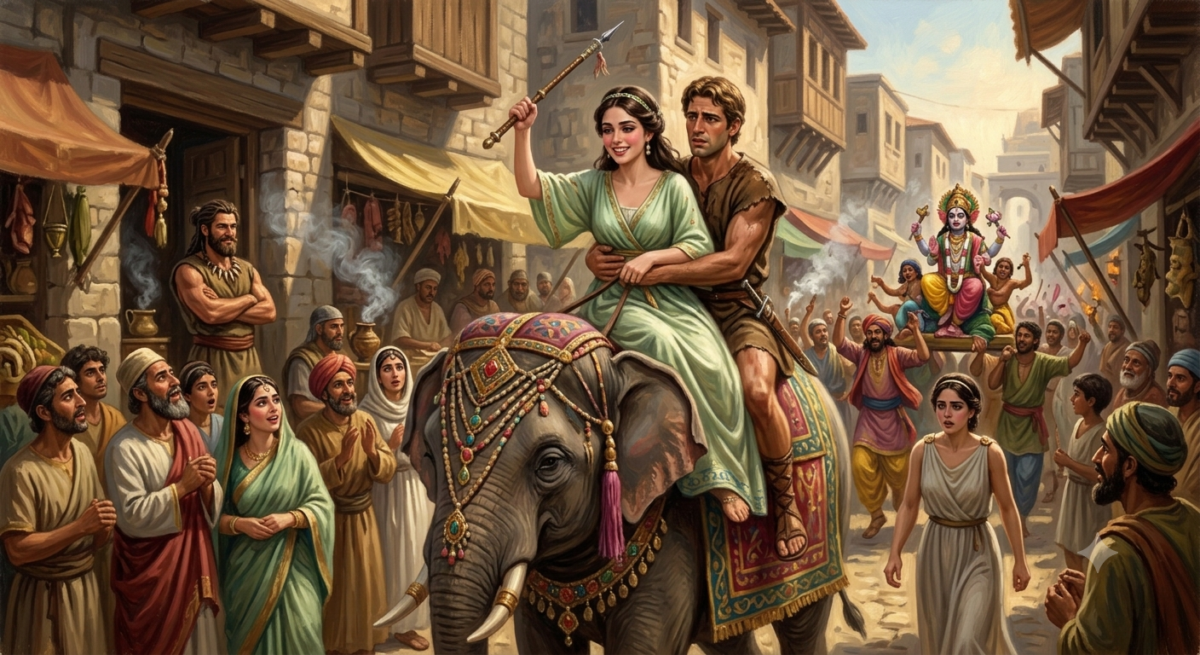
Book 1 : The Campaign to India
This is a chronicle of Alexander the Great’s eastern campaign, narrated from the perspective of his chief secretary, Eumenes.
Having overthrown the Persian Empire, the King entered Gandhara accompanied by the captured Persian princesses. There, he proposed a grand plan to his entire army: they would sail down the Ganges River to reach the eastern sea at the edge of the world, navigate those outer waters into the Caspian Sea, and finally return home to Greece. However, fiercely opposed by Ptolemy, the Commander of the Royal Guards, Alexander was forced to abandon his eastward march. Instead, he resolved to march down the Indus River to the Arabian Sea, and cross Gedrosia—the brutal land lying between India and Persia—to return to the Persian capital of Susa.
To cross Gedrosia, they would have to traverse a punishing desert almost entirely devoid of oases. While Gedrosia was a vital strategic corridor offering the shortest route between Persia and India, the Persian Great King’s famous “Royal Road” had not yet been extended into this region.
True to form, Alexander assembled a suicide squad and personally led them into the desert wastes. His vision was clear: once they successfully established new oasis cities and charted a secure caravan route, a grand mass wedding would be celebrated in the capital of Susa, uniting the Persian princesses with Macedonian nobles.
Little did they know that here, in the barren wastes of Gedrosia, the King and his men were about to encounter their most cruel and harrowing ordeal yet.
Book 2: The Battle of Granicus River
This is a chronicle of Alexander the Great’s eastern campaign, spanning from the destruction of Thebes to the Battle of the Granicus and the Siege of Halicarnassus.
Upon ascending the throne, Alexander first moved to crush the rebellion in Greece with ruthless efficiency, leveling the ancient city of Thebes to the ground to secure his rear. With Greece pacified, he finally crossed the Hellespont into Asia, launching his grand campaign to overthrow the Persian Empire.
His first major clash with the Persian satraps took place at the Granicus River. Charging into the fierce currents under a hail of arrows, Alexander and his Companion cavalry shattered the Persian lines in a daring, high-stakes victory that opened the gates to Asia Minor.
However, the path forward was far from easy. As the army advanced along the coast, they encountered fierce resistance at Halicarnassus, a heavily fortified coastal stronghold defended by the brilliant mercenary commander, Memnon of Rhodes. What followed was a brutal, protracted siege. Alexander’s forces clashed repeatedly with the defenders in bloody breaches and desperate night battles, testing the young king’s strategic brilliance and the sheer endurance of his Macedonian phalanx to their absolute limits.
Book 3: The Battle of Issus
This is a chronicle of Alexander the Great’s eastern campaign, spanning from his decisive victory over the royal Persian army at the Battle of Issus, to the siege of the island city of Tyre using a fleet equipped with catapults, and finally, to his ascension as Pharaoh in Egypt.
At the Battle of Issus, Alexander faced the grand royal army led personally by King Darius III. Despite being heavily outnumbered, Alexander executed a brilliant, daring cavalry charge aimed directly at Darius’s chariot. The Persian lines shattered in panic, resulting in a complete and overwhelming victory that forced Darius to flee, leaving his family and royal baggage train behind.
With the Persian heartland now vulnerable, Alexander turned south along the Mediterranean coast to secure his flanks. His greatest challenge arose at Tyre, a heavily fortified island city that refused to surrender. Refusing to bypass it, Alexander engineered an unprecedented seven-month siege. He constructed a massive earthen mole (causeway) through the sea to reach the island and assembled a formidable fleet mounted with heavy catapults and siege engines. Under a relentless bombardment from land and sea, the impenetrable walls of Tyre finally breached, and the city fell.
Following this grueling triumph, Alexander marched unopposed into Egypt, where the people welcomed him as a liberator from Persian rule. Embracing their ancient traditions, he traveled deep into the desert to the Oracle of Amun at Siwa, where he was declared the true son of God. He was crowned as Pharaoh, cementing his divine status and laying the foundations for his legacy as a living god-king.
Book 4: The Battle of Megalopolis
This fourth volume depicts the brutal clash between Antipater, the Regent of Macedonia, and King Agis III of Sparta, as they fought for control over Megalopolis, the strategic stronghold in Arcadia (331 BC).
Book 5: Dream of Babylon
Having deserted the army of Antipater, Eumenes obtained an audience with Olympias, the mother of King Alexander of Macedonia. Afterward, he attempted to escape to Crete but met with disaster at sea, eventually washing ashore on the island of Melos. He was rescued by Admiral Nearchus and sent to Issus.
Waiting for him there was the young Seleucus, who had just made his battlefield debut in the historic clash at Gaugamela. Accompanied by Seleucus and his entourage, Eumenes arrived in Babylon, a city that had previously opened its gates to King Alexander without a single drop of blood being spilled.
Eumenes sought to report back to duty and face the King, but found it impossible to secure an audience. It was then that the surrendered Persian general, Mazaeus, informed him of the truth: Alexander had already departed Babylon and made his triumphant entry into Susa.
Book 6: The End of A Banquet
In addition to the regular army established by Cyrus the Great, the founder of the Achaemenid Empire, Darius the Great organized Parang (The Spotted Ones, or The Leopards), a secret assassination order reporting directly to the King. Over time, the Parang came to wield immense influence within the imperial court, ultimately holding the power of life and death over the royal family itself.
Ariobarzanes, the commander who defended the Persian Gate, was a remnant of this very organization. Word arrives from Harpalus that the executed Ariobarzanes was merely a body double, and that the real commander is still alive, actively plotting to take Alexander’s life. Furthermore, it is revealed that Mazaeus, the Satrap of Babylonia, has also been assassinated by Ariobarzanes.
The decade-long eastern campaign has finally come to an end, and the deep-seated animosity between Persia and Macedonia is at last beginning to heal. In Susa, an unprecedented mass wedding is about to be celebrated—yet the shadow of the Parang still looms, a threat that has far from vanished.
This is an experimental machine translation with AI-generated illustrations of only the opening sections of the books from Japanese to English. You can read the original Japanese editions at Kindle Direct Publishing.


