Synopsis
The Lineage of the Holy Mother: From Isis to Mary, and Finally to Kaguya.
500,000 years ago, Homo sapiens were sampled and relocated to another planet that had been terraformed into a near-twin of Earth. 50,000 years ago, one of their descendants, Isis, returns to humanity’s ancestral home as part of a research expedition. There, she falls in love with Osiris, a local tribal chief, and gives birth to Horus and Seth.
That love marks the beginning of a tragedy.
When the expedition team attempts to take Isis’s children back to their home planet, Osiris refuses to surrender custody and hides the boys. Believing her husband has killed her children, a distraught and grief-stricken Isis murders Osiris. The expedition team gives up on retrieving Horus and Seth, returning home with Isis alone.
As the boys grow, a fierce war for tribal leadership breaks out between them. Seth, the younger brother, emerges victorious, forcing the elder Horus to flee north, where he establishes Egypt’s earliest dynasty along the banks of the Nile. Meanwhile, Seth drives the archaic humans of Africa to extinction before expanding into Mesopotamia via the Arabian Peninsula to found the Sumerian civilization. Horus pushes further into Europe and Asia, wiping out Neanderthals, Denisovans, and all other archaic human species. In this way, the descendants of Isis spread across the globe from the Afar Basin of the Ethiopian Highlands, drastically altering Earth’s ecosystem.
Alarmed by humanity’s unchecked rampage, the Galactic Federation Council dispatches the Bamboo Cutter and his daughter, Kaguya-hime—who had previously visited Earth 1,500 years ago—back to the planet once more.
Main Characters
- Kanako Himuro A crowd-pleaser who can’t stand not being liked by everyone. She has a bad habit of always taking things a step too far.
- The Bamboo Cutter (Taketori no Okina) Kanako’s father, and the Chairman of the Solar System Council.
- Takuya Hiraoka More than Kanako’s attendant, but less than a lover. A completely ordinary guy.
- Hajime Negishi Takuya’s friend. A tech geek who aspires to be like “Q” from 007. Kanako’s gofer.
- George Tarot The President of the United States. He declares martial law and wage war against the Solar System Council.
1-1 Kanako and Me
First, I want you to imagine a couple. Just a perfectly ordinary, run-of-the-mill couple. To an outsider, they look blissfully happy, the picture of harmony. Kanako and I look exactly like that—your typical, everyday pair of lovers.
But that doesn’t mean things between us are peaceful.
Take, for example, water poured into a glass. Why is the surface so flat? That’s thanks to something called surface tension. “Surface Tension!” If you shout it out loud, it sounds like a special move from an anime, doesn’t it? Pretty cool.
Actually, I knew about surface tension long before I even started elementary school. It was my grandmother in the countryside who first taught it to me. Even though it happened so long ago, the memory remains terrifyingly vivid. I don’t know why. But then again, maybe everyone’s childhood memories are like that.
In her house, built on a mountain slope with a little vegetable garden, Grandma had suddenly decided to conduct a science experiment. She placed a teacup on the horigotatsu floor and began pouring water from a kettle.
I wonder why she felt the urge to teach me about surface tension back then. It’s not like she was a science teacher or anything. If I recall, she was an insurance agent—a door-to-door solicitor, as they call them. I must have been a “science kid” even then. With the intuition she’d sharpened through years of sales, she probably saw right through me and picked a topic she thought would kill the boredom. “Little boys love this kind of stuff, don’t they? Tee-hee,” she probably thought. And so, the concept was seared into the deepest depths of my memory. Had I learned about surface tension in a classroom with everyone else, it never would have left such a vivid impression on me.
The surface of the water in a glass remains quiet and flat because it is bound by surface tension—a tug-of-war between gravity acting on every single water molecule and various intermolecular forces, including hydrogen bonding. If those forces didn’t exist, the water would be jagged and uneven. And if you utilize that tension, you can actually heap the water higher than the rim of the glass.
In any case, the reason Kanako and I look like a quiet, flat, and smooth couple—as stable as water in a glass—is simply because the various tensions acting between us are, for the moment, barely maintaining a state of equilibrium.
One could conclude from this that the relationships of all those ordinary, commonplace couples are also under constant, intense tension, and that they only appear peaceful because of it.
…As if.
No way.
There is no way that the relationship between me and Kanako is some common, run-of-the-mill affair.
Now, some of you might be thinking: “You’re just failing to be objective. Every couple has their own hidden struggles; humans are all more or less the same.”
True, humans are subjective creatures. We are egocentric, we don’t understand ourselves, and we insist on believing that we are special.
But I still want to say it: our relationship is an anomaly.
And while I might bear some of the blame, I want to be clear that almost all of the responsibility lies with Kanako.
If I were to write a short essay about our relationship within 400 words—how should I go about it?
I suspect I would spend all 400 words explaining that our relationship is far too complex to be summarized in a mere 400-words essay.
Oh. Have I already used up 400 words?
“Were you playing me this whole time?” Kanako accused me.
“You’re one to talk. How many times did you deceive me?”
“Since when? From which memory do you actually remember?”
“Since the first time you atempted to erase my mind. Right?”
Kanako fell silent, her lips pouting. It was the face she always made whenever she felt cornered.
“Back then, inside that spaceship, right? After that, you erased my memory a few more times. Each time, I pretended it had worked, but in reality, I remembered everything.”
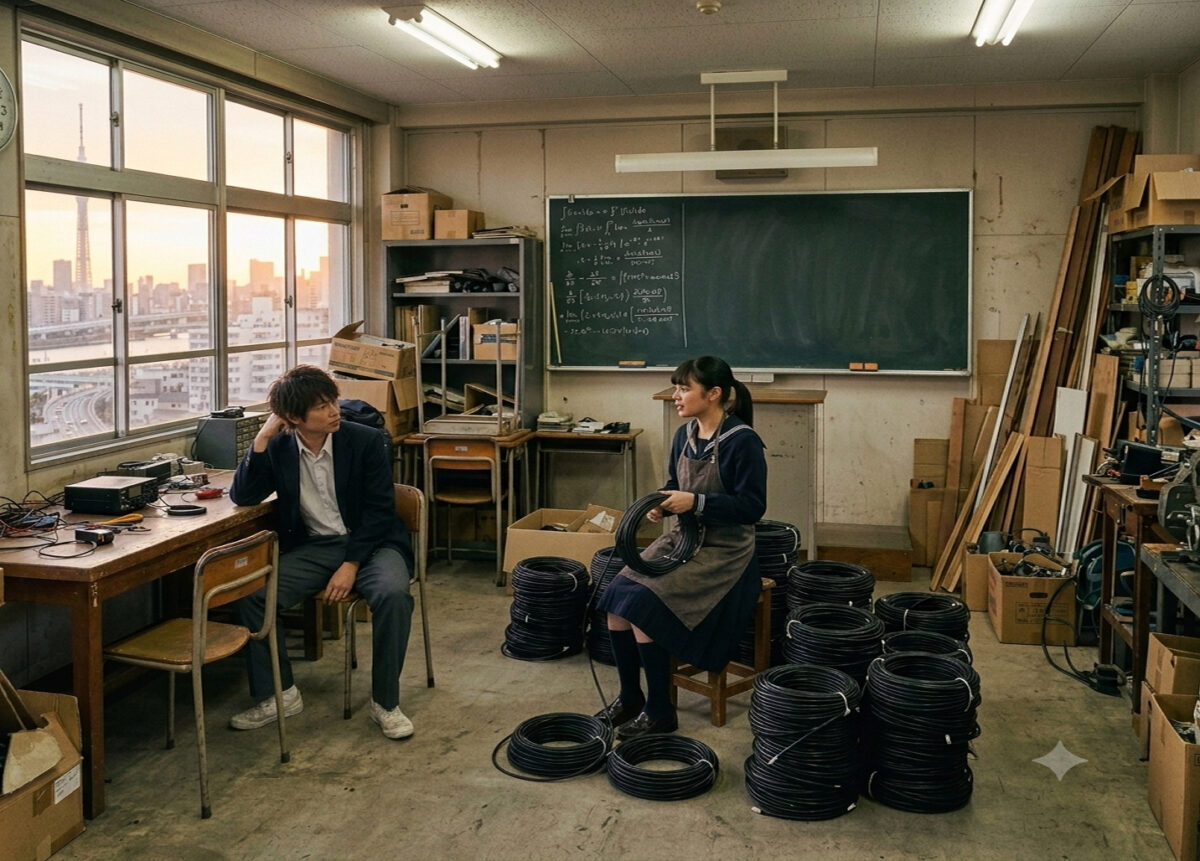
Kanako stood there, stunned, and the bundle of coaxial cable slipped from her arms, hitting the floor with a heavy thud.
“No way. That’s impossible.”
A strange silence filled the room.
I have this habit of buying too many buns at the school store. Anyone can relate to buying two when you can’t decide on just one, but I can’t even manage that. I end up buying three, intending to eat them later, but I always end up eating two and a half, leaving the last half behind.
The Yakisoba bread is a must. Then there’s the melon bread and the French bread. Unable to decide between them today, I’d bought all three.
I fished out the half-eaten Yakisoba bun I’d stuffed into my pocket and washed it down with a carton of soy milk.
“Anyway, what made you decide to confess your identity as Kaguya-hime to me now, of all times?”
“That’s…” Kanako hesitated. “The time has finally come. The time when I must reveal my true nature to the world.”
“The whole world?”
“Yes.”
“I see. Then I guess there’s no reason for you to keep secrets from me anymore.”
Our high school life is coming to an end. Soon, each of us will start a new chapter.
Let me tell you a story from the past. I feel like if I don’t, you won’t understand what I’m talking about.
Kanako and I met in our first year of junior high. We were in the same class, two strangers who hit it off instantly. Before we knew it, we were “boyfriend” and “girlfriend.”
Looking back, we were like two puppies who had happened to run into each other in a park during a walk. We just frolicked together without a second thought.
We weren’t thinking about anything. Really. Absolutely nothing.
It’s the kind of time that, looking back, you can only think, Man, that was fun. We were so stupid.
In our second year, we were placed in different classes, and we grew apart.
Around that time, I started to think a bit more—or so I thought.
How pathetic. To think that whether you’re in the same class or not can determine whether you love someone or break up.
The cause of our fallout was clearly on my end.
Simply because we were in different classes, I started putting distance between us. I became aloof. I was too embarrassed to go to another classroom just to see a girl. For that reason alone, Kanako got upset, and for a while, we didn’t speak a word to each other.
What an idiot I was.
We should have drifted apart, just like any other ordinary middle school couple.
But I couldn’t forget her. And so, I followed her all the way to the high school she chose to attend.
As I entered high school, I began to think more and more—to the point where I felt I couldn’t speak unless I thought first. When I was a child, I just spoke. Or rather, I spoke first and thought later. But then I started thinking while speaking, and eventually, I reached a stage where I had to decide exactly what to say before I even opened my mouth. As a result, I lost my fluency. I became taciturn, clumsy with my words, and my personality drifted toward the introverted.
Even now, I’m not good at speaking. I just use sheer effort to compensate for my lack of eloquence, barely managing to masquerade as a normal human being who can hold a decent conversation.
No one breathes because they’ve consciously decided to breathe. You don’t think, “Okay, now I’ll exhale, now I’ll inhale,” every single time you take a breath. If you did, you’d probably forget how to breathe entirely. You don’t walk by consciously thinking, “First, I’ll move my right foot, no, let’s lead with the left.” If you did that, your legs would get tangled and you’d trip and fall.
But for a while, that’s exactly the state I was in. Everything became clunky; I couldn’t operate my own self smoothly. I suppose that’s what they call being “hyper-self-conscious.” Or perhaps it was what the world calls Chuunibyou—the Eighth-Grader Syndrome.
Chuunibyou manifests in many different ways. I guess this was simply how the symptoms appeared in me.
Normal people don’t “think” while they speak. If you try to think through a conversation, it ceases to be a conversation.
If someone says, “Lovely weather, isn’t it?” the correct response is simply, “Yes, it really is.”
If you start recalling this morning’s weather forecast, calculating the probability of that forecast being accurate based on recent data, comparing the amount of clouds in the eastern and western skies, predicting whether the weather will hold or turn based on the wind direction, and then checking the rain radar on your smartphone… you’ve already killed the conversation.
In other words, a conversation is primarily a set of greetings. Whether the proposition “The weather is lovely” is factually correct is not particularly important. “Lovely weather” is nothing more than a ball being thrown to you in a game of catch. What matters is not the accuracy of the information transmitted, but the lack of latency and the quality of the tempo.
This is the “STEM Trap.” I’ve only recently become aware of it.
I found myself understanding women’s psychology—and Kanako in particular—less and less. In the process, I stopped understanding myself, too. But then again, since I never understood anything to begin with, maybe I just became aware of the fact that I’m clueless.
I became a slave to Kanako’s moods. And it wasn’t just me; Kanako must have changed, too. I suppose everyone goes through this to some extent. During puberty, the human spirit is perhaps like a caterpillar in a cocoon: the body melts into a sludge before a butterfly is born. Maybe our minds melt into a similar sludge, and a different version of ourselves emerges.
It happened in my first year of high school. The Halloween madness had passed, and everyone was starting to get excited, wondering how to make the most of the upcoming Christmas.
As we passed each other in the hallway, Kanako spoke to me. “Hey, Takuya.”
“Huh?”
“I need to talk to you.”
Kanako said this while gazing vacantly out the window. I followed her gaze. A crow was perched on a power line. Crows are jerks. Whenever you walk under them, they always try to drop a bomb right on your head.
Kanako wouldn’t meet my eyes.
And yet, it was obvious she was looking at me.
I don’t know how she was doing it, but she was observing me while pretending not to. It wasn’t that she was stealing glances from the corner of her eye.
The only way to describe it was as if she had a 360-degree field of vision.
I don’t know if all women are like that, or if it’s a special skill unique to Kanako, but perhaps it’s possible to sense a presence with the heart, even without using the eyes.
Maybe it’s a kind of superpower.
And since I could feel Kanako’s gaze even when she wasn’t looking at me, perhaps I’m a kind of esper too.
Well, there’s the possibility that I’m just imagining it, or overthinking it.
Or perhaps women are simply creatures that induce such illusions in men.
Or perhaps men are simply creatures prone to such illusions.
Maybe I’m just exceptionally hyper-self-conscious. Maybe I’m sick.
There were often times when I felt something like telepathy zipping back and forth between Kanako and me. A feeling that our hearts were communicating without words.
Which, again, was probably just my imagination.
I think I saw it in some movie once. The idea that humans only use ten percent of their brain’s capacity. And that if you could somehow tap into a hundred percent, your senses would become so acute that you could hear the footsteps of an ant, or even perceive the very rotation of the Earth.
Maybe Kanako has a special ability like that.
Maybe she doesn’t even need her sight to understand everything happening around her. Maybe my emotions and thoughts are just… leaking out, completely transparent to her.
I find myself indulging in these fantasies while staring at her face. But since staring too intently is usually frowned upon, I pretend not to look while I’m actually observing her.
And maybe Kanako is looking at me the same way, thinking, I can’t tell where this guy is actually looking.
That’s just how we are.
It’s hard to tell what ethnicity Kanako is. At first glance, she looks like a typical Japanese person, or perhaps like many people of East Asian descent, but then again, she doesn’t.
She has a well-shaped nose. Her eyes are large and sharp—one might even call them dignified—and they cast deep shadows across her face. Yet, looking closer, she doesn’t have the deep-set features of a Westerner; her profile is surprisingly flat, and while her frame is slender, her cheeks are rather plump.
Her eyebrows are a bit too thick for a girl, and she doesn’t seem to pluck or shape them—she just lets them grow.
Her hair is very fine and straight. Depending on how the light hits it, it looks chestnut or even golden, though I suspect it’s actually a youthful, deep black. Her eyes, too, shift between brown and a bluish tint depending on the light.
Her teeth are perfectly aligned. I wonder if she had braces as a child.
She looks like she might be mixed—half or quarter, or something like that.
I don’t remember the rules for the seating chart back then—it was a long time ago—but that was also during our first year of junior high. I don’t think it was a coincidence. By then, Kanako and I had become incredibly close, and we had deliberately arranged it so we were seated in a vertical line along the wall by the hallway, with me sitting directly behind her. It was extremely convenient; even during class, whenever the teacher looked away, we could share secrets.
There was this one time when the homeroom teacher had to leave suddenly for a meeting or some other errand. “Study on your own for thirty minutes. I’ll be right back,” he said, and stepped out of the room. We began doing whatever we pleased, though no one dared to leave their seat or make a scene, since we didn’t know exactly when the teacher would return.
I wondered what Kanako was doing, so I peeked over her shoulder. Sensing my presence, she turned around.
“Look at this,” she said, pinching the end of a strand of her hair and holding it up for me to see.
“Look at what?”
“See? Right here at the tip.”
It was just a hair.
“It’s a split end. So frustrating. Look, this one too.”
And so, plucking one strand after another, Kanako began to tell me all about how difficult it is to maintain hair and deal with split ends.
“When it splits like this, you have no choice but to cut it. It’s such a waste. I worked so hard to grow it this long.”
Kanako has long hair. Elephants have long trunks.
Up until that moment, I had never cared whether a girl’s hair was long or short. I had never even been conscious of hairstyles—certainly not my own, or whether I had bedhead.
But she was right. If you grow hair that thin all the way down to your waist, of course you’re going to get split ends.
I wonder why Kanako felt the need to tell me about split ends back then?
If any other girl had talked to me about someone else’s split ends, I wouldn’t have been interested, I wouldn’t have listened, and I certainly wouldn’t have remembered it. In fact, if a typical girl had brought it up, I probably would have found it repulsive—I might have been totally grossed out, had nightmares, or even been traumatized.
But I still remember how my heart pounded back then, because Kanako’s face was so close to mine. It was the first time I had ever spoken to someone with our faces that near. I remember thinking that I wanted to stay like that forever.
But the teacher returned shortly after, and class resumed.