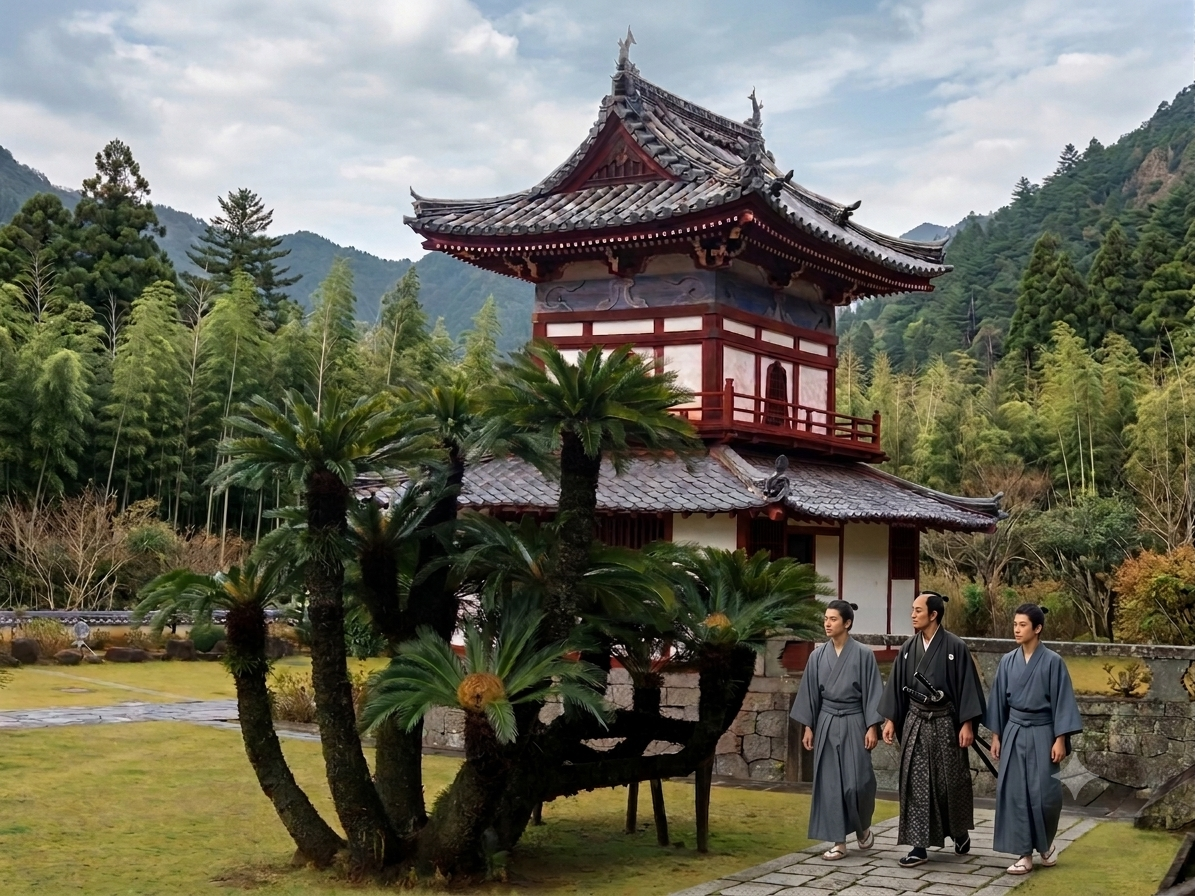
人斬り鉤月斎
Tachiki Shinzaburō was a hatamoto (direct retainer of the Tokugawa shogunate) who held various official posts in Kyushu, including the Nagasaki Magistrate and the Regional Magistrate for Western Japan (Saigoku-suji-gundai). His second son, Tetsunosuke, was adopted as a son-in-law by Tachibana Genshichiro, a renowned swordsman in Edo. Genshichiro passed down his family headship and his name Genshichiro to Tetsunosuke, retiring under the name Kogetsusai (“Moon-Fishing Hut”). “Kogetsusai” was originally the alias he had been called during his time as a covert agent for the Tokugawa shogunate.
Upon his return to Edo, Shinzaburō Tachiki (立木信三郎) was granted a new estate along the Kōgai River (笄川; perhaps it means: the river where the hair-washing tool Kōgai is used) on the Hiroo Plain (広尾ヶ原), south of the Edo Castle. Buried in a dense thicket of tall chigaya reeds (茅萱), complete with a watermill and a small vegetable patch, its appearance resembled a humble peasant’s house in Tama (多摩) or Chichibu (秩父) rather than a samurai residence. Yet Shinzaburō was thoroughly pleased with it.
To start, Shinzaburō decided to take his two sons, Kikunosuke (菊之助) and Tetsunosuke (哲之助), for a stroll around the neighborhood. No retainers, no servants—just the father and his sons.
The bottom of Mami-ana Slope (狸穴坂). As its name—”Badger Hole”—suggested, the path led into a thick grove of trees where foxes and badgers seemed likely to make their den.
“Taking the shortcut through these bushes should be fastest,” Shinzaburō remarked. He pulled a map of the Azabu area from inside his robe, studied it, and slipped it back into his bosom. Scanning his surroundings, he picked up a suitable branch from the ground. Not too long, not too short, nor a damp, rotten twig, but a well-seasoned, sturdy piece of wood. It was not meant to serve as a walking stick.
“This is for you. Walk in front and clear the cobwebs. Mind the vipers,” Shinzaburō said, handing the branch to Kikunosuke. Countless cobwebs, glistening with night dew, spanned across the drooping branches of the wild trees. Though he could have cleared them himself, Shinzaburō felt that on occasions like this, he ought to teach his sons how to navigate through the overgrown wild.
“Tetsunosuke, follow close behind Kikunosuke’s heels as you climb.” Placing Tetsunosuke ahead, Shinzaburō stepped onto the side path with Kikunosuke, sandwiching the youngest boy between them.
Before long, they came upon a flight of stone steps—neatly swept and aged, yet strikingly elegant for such a secluded spot. At the top of the stairs stood a grand, crimson-lacquered mountain gate, ornate as the Dragon King’s Palace.
“Ah, here it is, here it is.”
Stepping into the precinct, they found themselves in a grove so quiet it felt miles away from any settlement. Arrayed within were colorful temple structures painted in vibrant reds and blues.
Shinzaburō walked along the cloister with curious eyes, taking in the hall structures.
“Look. The principal image is Śākyamuni Buddha (釈迦牟尼仏). A gilded body, azure curls, and dark eyes, hands folded in the Zenjō-in (禅定印) meditation mudra. Yet strangely, flanked on either side are shrines to Mazu (媽姐) and Guan Yu (関帝). What an unusual combination. The bell tower (鐘楼) is magnificent too. It seems they even have a scripture library (書庫) and a lecture hall (講堂).”
It was unlike almost any typical Japanese temple. The giant sago palms and century plants growing in the inner courtyard lent it the distinct air of a Nanking-dera (南京寺)—a Chinese-style temple. “Look at this wooden clapper. It is shaped like a fish. This is a true wooden fish drum.”
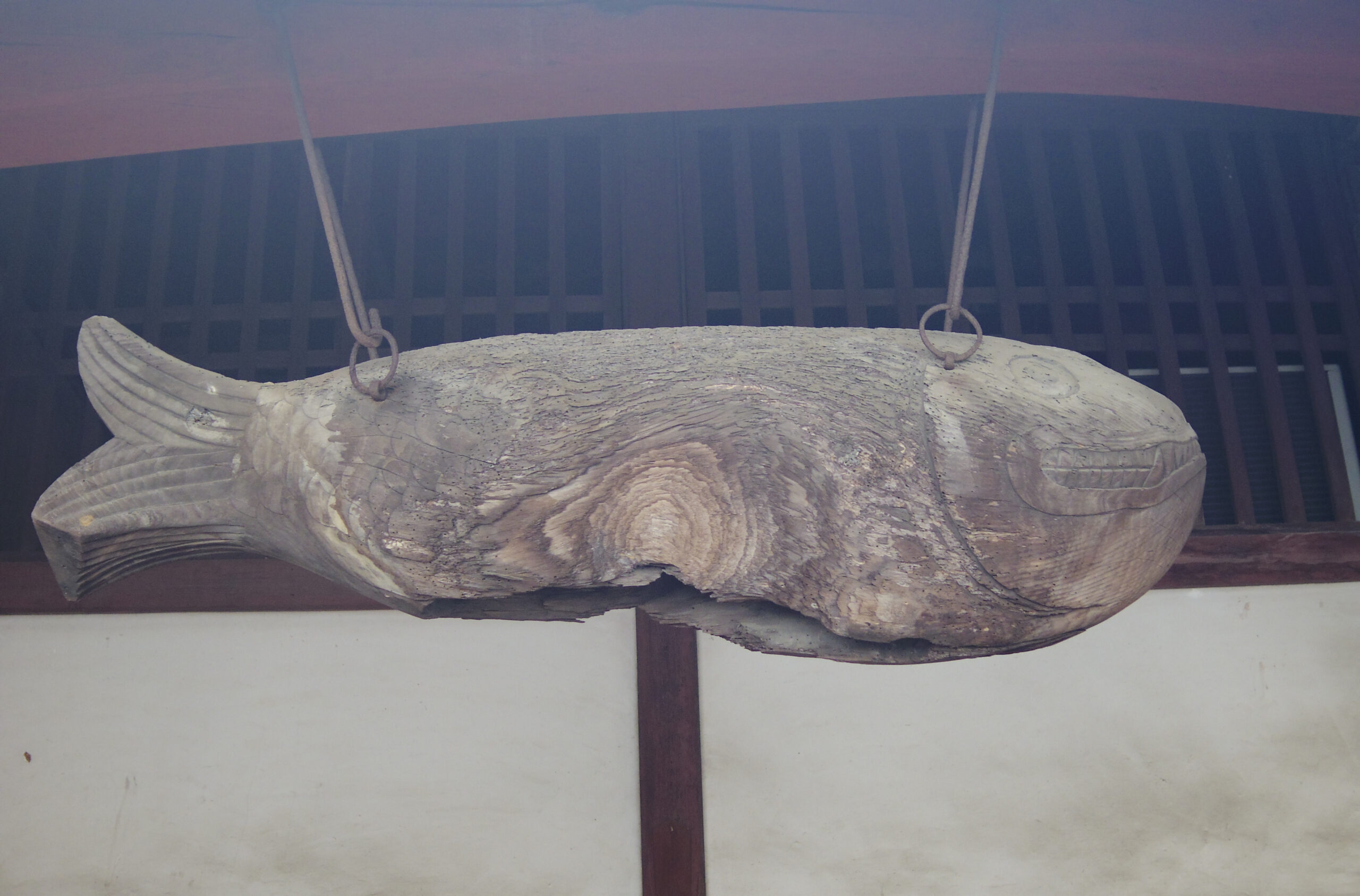
While Japanese wooden fish drums were curiously rounded like bells, this one was sculpted precisely in the shape of a wooden carp.
“You won’t find a temple like this in Kamakura, Kyoto, or Nara. In all of Japan, Nagasaki is likely the only other place.”
Indeed, Shinzaburō had seen many such temples during his time in Nagasaki.
The Tachiki family were hatamoto (旗本)—direct retainers of the shogun—said to have descended from the Taira clan through a branch of the Chiba clan (千葉氏) of Shimōsa (下総). Their domains were located in the Inba and Katori districts of Shimōsa Province. Kikunosuke had been born in the Edo residence, but when his father was appointed as the Shogunal Deputy for the Western Provinces (西国筋郡代) and posted to Hita (日田) in Bungo (豊後) Province, he lived there for eight years. Tetsunosuke was born in Hita. Later, Shinzaburō was transferred to serve as the Nagasaki Magistrate (長崎奉行), spending five years in Nagasaki. Now, at long last, the family was reunited in Edo: his wife and Tetsunosuke, who had remained in Hita, and Kikunosuke, whom Shinzaburō had brought to Nagasaki and raised with his own hands. Though Kikunosuke was born in Edo, he had virtually no memory of it. For Tetsunosuke, it was his very first time seeing the city.
This temple, Jōnanzan Zen’in-ji (城南山善因寺), was said to have been established during the Jōkyō era by Tokugawa Mitsukuni of Mito (水戸光圀)—famously known as Mito Kōmon—at the vow of the imported Chinese monk Tōkō Shin’etsu (東皐心越). Nearly a century had passed since its founding. In its early days, the temple must have been far more splendid than it was now. Today, its paint had discolored to a dark persimmon hue or peeled away entirely to reveal the wood grain beneath. Perhaps the rafters supporting the roof were rotting from rainwater leaks; the roof tiles warped in crooked waves, overgrown with ferns and shinobu grass. Even the few Chinese residents lingering in Edo rarely approached it. It seemed less a historic site than an abandoned temple.
“Zen Master Jinkaku (迅覚).”
“Ah, Lord Tachiki. As usual, you arrive without any prior notice.”
“I heard you had become the head priest here.”
“Had you informed me in advance, I would have ground some high-grade green tea for you.”
“Think nothing of it.”
“Have you been in Kyushu all this time?”
“Yes. Ever since.”
“They certainly do transfer you to Kyushu quite often.”
“Indeed. The posts of Nagasaki Magistrate and Deputy of the Western Provinces are together referred to as the ‘Kyushu Governors.’ After all, it is far from Edo, making communication inconvenient. In Kyushu, both Nagasaki and Hita are shogun-controlled territories wedged in among the lands of tozama lords. When business arises in one, the official in the other often temporarily takes on both duties. Usually, these two positions are passed around a handful of specific families among the distant-province magistrates. It isn’t quite hereditary, but it comes from the consideration that assigning someone unfamiliar with the region could lead to mistakes in distant lands—a hassle the shogunate prefers to avoid.”
“And when did you arrive back in Edo?”
“About ten days ago.”
“My goodness. You must still be exhausted from the long journey.”
“All the more reason I wanted to be alone and stretch my legs early on.”
“Is your new residence uncomfortable?”
“No. I am quite fond of the estate itself. At least, I am. But lately, perhaps because we’re both getting older, my wife and I just don’t see eye to eye.”
“With Lady Tachiki?”
“Upon arriving in Edo, I chose my current estate out of several options offered to me simply because I liked it. But my wife complains that even though we are in Edo, it is more countryside than Hita in Kyushu! She now makes unreasonable demands, asking if I can petition the authorities to swap it for a more bustling place, like Nihonbashi, Denma-cho, Bakuro-cho, Kanda or Asakusa, even if it’s smaller. Granted, it was my fault for deciding without asking her opinion, but I lost my patience and stormed out of the house with my sons.”
“And where is this new estate of yours? If I recall, you were near Surugadai before.”
“No, surprisingly, I was granted an estate quite near here.”
“Around where?”
“Hiroo Plain.”
“That is close. Though Hiroo Plain is quite vast.”
“Indeed it is. The gokenin retainers cut reeds there, and the Shogun himself hawk-hunts on those grounds. Tell me, do you know the Kōgai River?”
“Of course.”
“Near Tengenji Bridge, the Shibuya River and the Kōgai River merge, and downstream the river changes its name to the Furukawa.”
“Yes, yes.”
“Upstream on the Shibuya River, parallel to the Kōgai River, another stream called the Salamander River (イモリ川) flows into the Shibuya River.”
“The Salamander River?”
“Yes. No one knows its real name; everyone in the neighborhood just calls it that. It’s merely a small stream swarming with newts, fire-bellied small salamanders, but my estate sits on the hill sandwiched between that Salamander River and the Kōgai River.”
“So, just across the Kōgai River from Azabu, then.”
“Precisely. So I shall be dropping by to visit you often. You should also come over to my place when taking a stroll. After all, Hiroo Plain is practically our front yard. Black kites circle in the vast sky singing their pii-hyoro calls, and the thud of the watermill’s pestle echoes like the pounding of fulling blocks—a truly refined atmosphere. Yet my wife fumes that the sound is eerie and grating, and demands I make it stop.”
“Is that so? By the way, will you be returning to Nagasaki anytime soon?”
“No. I won’t be going back. Eventually, I will likely be appointed as a local governor somewhere else, perhaps Izu or Kai. Accompanying the Korean Embassy to Edo was my final duty in Nagasaki. I hear the Council in the Castle has not yet decided on my next assignment, so I am to stay in Edo unassigned for a while.”
“Oh, that is wonderful news. You ought to take this opportunity to rest and recover at Hiroo Plain.”
“Yes, that is my intention. In any case, I’ll likely be assigned to a regional post again soon and have to surrender the estate. There wouldn’t even be time to move house again.”
“And those who accompanied you here are…?”
“These are my sons, Kikunosuke and Tetsunosuke.”
“Ah, is that so? Having no shortage of heirs—what a blessing.”
“Thank you for your kind words. I am currently showing them around the streets of Edo.”
“How busy, having just returned. You are remarkably doting—or rather, deeply devoted to their upbringing.”
“Please, do not tease me so. Come now, boys, this is Master Jinkaku, the head priest of this temple. Greet him.”
“I am Kikunosuke. It is a pleasure to meet you.”
“I am Tetsunosuke.”
With that, both boys bowed, revealing the freshly shaved, bluish skin of their topknot foreheads.
“Wandering through the fields has made us quite thirsty,” Shinzaburō said.
“Ah, I imagine so.”
“May we borrow your well?”
“The well? Go around to the back of the temple; my wife and I live in the residence there. You’ll find the well in the yard.”
“Then we shall draw a bit of water, if you don’t mind.”
“Not at all. My wife should be near the altar room or the side entrance. Speak to her, and she’ll likely offer you some weak bancha tea and stale rice crackers. Will you wait a while until I finish my chores?”
“No, we won’t stay long. But we would gratefully accept a cup of tea.”
“Very well. Do as you please, then.”
“Without an extraordinary figure like Lord Tokugawa Mitsukuni, a temple like this would never have survived in Edo,” Shinzaburō remarked to his two sons as he guided them through the temple grounds.
In a later era, during the turmoil of the late Qing and early Republican periods, many Chinese literati and monks would flee or study in Japan. Among them were Sun Yat-sen (孫 逸仙), who would become the first president of the Republic of China, and Guo Moruo (郭 沫若), who studied medicine in Japan.
Similarly, many of the Chinese who crossed over to Nagasaki and Hirado during the late Ming and early Qing dynasties and settled there were political exiles rather than mere merchants. Many received protection from Sengoku warlords who prized imported artifacts and foreign philosophy. Figures like Tōkō Shin’etsu and Zhu Shunshui (朱 舜水), whom Mitsukuni invited to Edo, belonged to this tradition. Mitsukuni was remarkably open-minded and possessed a passion for learning. Had he been Shogun, Japan might never have enforced its policy of national isolation.
“Every detail of the temple showed meticulous care,” Shinzaburo said, “the furnishings and the principal image were likely imported goods as well. Was this Mitsukuni’s personal taste, or perhaps Tōkō Shin’etsu’s? In any case, bringing various rare treasures all the way from China via Nagasaki, inviting master carpenters, and spending lavishly on construction must have cost a fortune. The rumor that the Mito Domain’s finances deteriorated during Mitsukuni’s time seemed entirely plausible.”
“Is that so?” Kikunosuke mused. “To me, it also bears a resemblance to Tōshō-gū (東照宮).”
“How so?”
“Rather than Lord Mitsukuni, wouldn’t shrines to Mazu and Guan Yu align more with the tastes of Lord Iyeyasu, the Divine Lord of Tōshō?”
“Hmm. Could that be?”
It might well have been a whim of Lord Iyeyasu.
“Kikunosuke. Do you enjoy learning?”
“Yes. In Nagasaki, besides Chinese books, I read a fair number of Dutch books as well.”
“What? Can you read Dutch?”
“No, only after a fashion.”
“In Nagasaki, I was too occupied with official duties to find time for scholarship or to familiarize myself with curious foreign customs. But in my youth, I studied Chinese culture and the Confucian Classics under Master Jinkaku. The knowledge I gained then proved immensely useful when I was appointed Nagasaki Magistrate. Kikunosuke, why don’t you study Buddhism and Chinese culture under Master Jinkaku as well?”
“Yes, I would very much like to do so.”
Tetsunosuke, however, spoke up with a sullen expression. “Father, I do not believe I possess my brother’s talent for letters. Now that we have come to Edo, I wish to practice something fitting for Edo—a martial art or the like.”
“Ho? Martial arts? Which kind?”
“I wish to learn swordsmanship.”
Shinzaburō was well aware that back in Hita, Tetsunosuke had played at swordsmanship with children his own age, defeating them all and becoming quite puffed up with pride.
“Tetsunosuke, Edo is the seat of the Almighty Shogun. It is not a rural backwater like Hita. Here, men as strong as you are a dime a dozen.”
“Then all the more reason I wish to test my own strength.”
“I see. Do as you wish. No one is stopping you.”
Arriving at the entrance of the residence adjacent to the grounds where the priest and his wife lived, Shinzaburō called out, “Grandmother, it is Shinzaburō. Shinzaburō Tachiki. I shall rest here a moment,” and strode right inside. Crossing the altar room, he felt inclined to sit by the low table on the veranda. The garden with its Western-country flair reminded him of Maruyama-chō near Shian-bashi, where he had spent many pleasant nights.
From the back, a wrinkled old woman came bustling out with quick, light steps.
“My, my! It has been such a long time. Did you see my husband outside?”
“Yes. We greeted him just a moment ago.”
“What would the young gentlemen like? Would you prefer water-jelly sweet bean paste or dried persimmons?” she rattled off all at once.
“No, no, please do not trouble yourself. More importantly, we are thirsty. Where is the well?”
“Wait just a moment. I shall brew some tea right away. Oh, is this your eldest son?”
“Yes, it is,” Kikunosuke answered.
“I remember meeting you when you were about two years old. You were just a toddler learning to walk! Ah, I have grown so old,” she reminisced, almost in tears. Naturally, Kikunosuke had no memory of that time.
“And is this young man your second son?”
Tetsunosuke nodded in silence.
Suddenly listening closely, a dull sound of clashing bamboo swords and heavy footwork on wooden boards could be heard in the distance. Tetsunosuke spoke up.
“Father. It seems there is a practice hall nearby.”
“Ah, the sons of samurai families must be practicing in the lecture hall.”
“I shall go take a look.”
“Very well. Go along, then. Make sure not to be a nuisance.”
“I shall go look at the statues of Guan Yu and Mazu,” Kikunosuke said.
The lecture hall within the grounds of Zen’in-ji had originally been a scripture-offering hall donated by the surviving family of a certain samurai commander to pray for his soul. Some fifty years ago, scripture chests and an Amitabha Trinity statue had been enshrined there, but now all of those were gone, leaving it a vast, empty room. Finding it ideal as a practice hall for martial arts, gokenin and hatamoto retainers who were parishioners of Zen’in-ji naturally gathered there to train. In time, the most skilled master among their comrades came to serve as the instructor.
The instructor, Nagaharu Dewa (出羽長治), noticed Tetsunosuke peering into the hall, known as “Shigetsu-dō (指月堂).”
“Who are you? Why are you standing there?”
“Uh, no—I simply came to visit the temple.”
“Do you like swordsmanship?”
“Yes.”
“Whose retainer’s son are you? A hatamoto?”
“Yes. I am the son of Tachiki, the Nagasaki Magistrate.”
“Lord Tachiki? Ah, I know him. Has he returned from Nagasaki? Well, well. Don’t be shy. Come up inside. You can’t see properly from out there.”
Dewa watched with narrowed eyes as Tetsunosuke borrowed a bamboo sword and protective armor to spar with boys his own age.
“You have remarkable raw talent,” Dewa praised him. “With another five years—no, three years of training here, you could receive full mastery of the style. Give it ten years, and you might well become an assistant instructor.”
Dewa may have intended it merely as a compliment, but it served only to fuel Tetsunosuke’s ambition.
(Did I not come to Edo to become a master swordsman? Is this not my true destiny? Should I really let my talents lie dormant?)
“Then please, formally accept me as one of your disciples!”
“You are far too impatient. I wonder about that. Though Shigetsu-dō has an instructor and disciples in name, it is fundamentally nothing more than a casual gathering place for hatamoto and gokenin who happen to love martial arts. Even to enroll the son of a fellow hatamoto, there are all sorts of tedious formalities. Would you consider coming here as a guest for a while, rather than a formal disciple?”
Tetsunosuke was unsatisfied. Studying a craft under a dedicated master—he was hearing of such a concept for the first time today, yet suddenly he felt that without a true master, he could not truly feel like he was training.
“Lord Tachiki,” Master Jinkaku said, returning to their earlier topic. “I wonder if the Shogunate intends for you to retire and pass the family headship to Kikunosuke?”
“Master Jinkaku, I wouldn’t mind that in the least,” Shinzaburō replied. “However, I would like to serve a little longer. For the time being, I intend to leave Kikunosuke as an apprentice among the Yori-ai-shū retainers (寄合衆見習い) , and only pass the torch once he gets used to the workings of Edo.”
“I see. And what of your second son, Tetsunosuke?”
“Ah, that is the dilemma. My only option is to send him out as an adopted son to another hatamoto family. Abbot, do you happen to know of any suitable matches? A hatamoto family with no sons, and a daughter between thirteen and seventeen?”
“Hmm, I am afraid that is beyond my knowledge. But if you were to ask Master Dewa of Shigetsu-dō, he would surely find a good match and might even offer to act as a matchmaker.”
Through such connections, Tetsunosuke also came to frequent Zen’in-ji’s Shigetsu-dō, holding the status of an apprentice in the Yori-ai-shū, dressed in a crested robe and hakama with two swords tucked into his sash.
It had been early autumn when they arrived in Edo, but now it was already late autumn. The grounds of Zen’in-ji were covered with fallen ginkgo nuts. Did no one gather and eat them, or did the nuts fall faster than anyone could pick them up? The pungent, sour scent of trampled fruit pierced his nose.
Tetsunosuke had not come to Shigetsu-dō today to practice. He had come to receive a letter of introduction that his instructor was supposed to write for him. Master Dewa was absent, but the assistant instructor was holding it for him. Having received the letter, Tetsunosuke crossed Asakusa Bridge.
Ryōgoku Hirokoji was as bustling as a festival, as always. The aroma of broiled eel wafted from the shops, while vendors selling grilled clams and night-market buckwheat noodles fought for prime territory. It was also in this plaza that theater tents and sideshow booths were erected. Suddenly, his eye caught a haircomb kanzashi displayed on an antique stall.
For some reason, Tetsunosuke felt a sudden urge to buy a hairpin.
“Is this real silver?”
“Yes, sir! Genuine solid silver, through and through.”
“It’s not a wooden fake, is it?”
“My good samurai! It’s a hairpin, not a sword—you jest!”
“Is this sort of thing in fashion in Edo right now?”
“A souvenir for your lady back home?”
“Don’t talk nonsense. I’m not old enough to have a wife yet.”
“Well, surely it won’t be long now.”
“Who knows?”
“Surely you have a childhood friend or a betrothed, at least?”
The vendor was clever at flattering customers, even a young boy. Such was the way of Edo merchants. Tetsunosuke found his hand idly scratching his own head.
“A piece like this—though Japan is vast, only the silver smiths of Edo can craft such a thing. You won’t find it in Kyoto or Osaka, let alone the countryside.”
“Is that so? How much is it?”
“Well… how about two bu?”
“Too expensive. Give me a discount. How about two shu?”
“No can do, sir! I’d be ruined! How about this: I’ll throw in this brush-and-ink case (矢立; yatate), and we’ll call it one bu for the lot?”
One bu equaled four shu. It was still expensive, but it was half the asking price, and an extra item was included. But wait—Tetsunosuke recalled his father’s warning not to let people take advantage of him just because he was a country bumpkin. As the son of a hatamoto, he was not short on money. Tetsunosuke peered suspiciously at the hairpin vendor. The antique ink-and-brush case handed to him, though well-used, actually possessed a charming, aged character that made it look like a fine piece. It seemed perfect for everyday carry.
“Very well, I’ll buy them. Wrap the hairpin nicely, will you? It’s a gift. You can leave the ink case as it is, since I’ll be using it myself.”
“Thank you kindly, sir!”
Truth be told, Tetsunosuke had a woman named Otaki (お滝) back in Hita whom he was fond of. He thought that if he bought a souvenir from Edo and sent it with a letter, she would be delighted.
From Asakusa Bridge to Bakuro-chō and Ō-denma-chō. For a country youth, it was a district filled with temptation. Wholesale and retail shops selling fabrics, rice, charcoal, tea, and other daily necessities lined the streets, constantly pulling at his gaze. Tetsunosuke paused in front of a shop in Ko-denma-chō and stepped inside.
“Pardon me. I wish to make an inquiry.”
Tetsunosuke bowed deeply with the earnest politeness of a provincial boy.
“Yes, sir?”
“My name is Tetsunosuke, second son of Tachiki Higonosuke Tadatomo. This shop is the Ozu-ya (小津屋) cotton wholesaler, is it not?”
“Yes, sir. Ozu-ya is the only shop by that name in these parts.”
“Then could you tell me where the tenement house owned by Dembei (伝兵衛) of Ozu-ya is located?”
“Ah! You must mean the tenement behind this shop. Pass through the ditch-board alley beside us, and you’ll find it in the back.”
“Thank you for your kind assistance. And would the residence of Lord Genshichirō Tachibana be in that tenement?”
Hearing that, the head clerk of Ozu-ya cocked his head with a suspicious look.
“Hmm? Who would this ‘Genshichirō’ gentleman be?”
A chief shop hand nearby answered in his stead.
“Ah, he must mean Gensan the Buddha! The hatamoto.”
“Gensan the Buddha?”
“Ah, right! He claims to be a hatamoto, but looks for all the world like a masterless rōnin—or at best, an unassigned gokenin. Gensan’s place is the second from the back. If you can’t find it, just ask the housewives having their well-side gossip inside. They’ll tell you right away.”
“Thank you very much. Excuse me, then.” Bowing deeply once more, Tetsunosuke left Ozu-ya.
Sure enough, between the adjacent shops was a gap barely wide enough for people to pass each other, with wooden boards laid over the drainage ditch on the ground. Such foul-smelling, rotting gutters did not exist in rural places like Hita. To Tetsunosuke, it felt like an alien world.
At the end of the narrow alley appeared a long row-house tenement, narrow as an eel’s nest. There was a sort of central courtyard, but it was a damp, sunless place. A small red shrine dedicated to Inari stood there. The garden trees grew wildly, their branches sprouted with bracket fungi and hanging ferns.
(A back-alley tenement in Edo is a gloomy place indeed,) Tetsunosuke thought.
Past the courtyard stood a row of earthen storehouses. Passing through that alley, the view suddenly opened up to the banks of the Dōsanbori Canal (道三堀). Aha, Tetsunosuke realized, they unload the cotton here, store it in the earthen warehouses, and then display and sell it in the street-facing shop. And the leftover land between the front and back is rented out as tenements. Cleverly designed, indeed.
As he stood absentmindedly watching barges hauling fish to the market and the black kites and seagulls gathering to target the catch, the sun was already beginning to sink. Damn it, I’ve wasted too much time, he thought, turning back. He called out to a ragpicker he happened to spot.
“Excuse me. Which house belongs to Lord Genshichirō Tachibana?”
“Huh?”
“He is said to be called ‘Gensan the Buddha.’”
“Ah, Gensan! Gensan’s place is right over there.”
Clack-clacking his scrap-collecting tongs, the ragpicker pointed toward a corner of the tenement.
It was far removed from anything resembling a hatamoto residence. Tetsunosuke was dumbfounded.
“Are you certain that is the house?”
“Yeah. No mistake.”
Hearing that, Tetsunosuke bowed deeply once more, stood before the doorway, and called out: “Pardon me! Is this the residence of Lord Genshichirō Tachibana?”
“Yes.”
The person who came out was a girl who looked barely fifteen years old.
“Genshichirō is my father. Are you an acquaintance of his?”
“No, I have never met him before. I apologize for the intrusion. Forgive my rudeness, but I have come hoping to be accepted as Lord Genshichirō’s disciple.”
“A disciple? I do not believe my father takes disciples.”
“Oh? But surely he has had at least one before now?”
“No, none. He has never had a single one.”
“How unexpected… Why is that?”
“I do not know.”
“I see. Even so, I ask that you indulge my request.”
“Pardon me, but do you happen to carry a letter of introduction?”
“I do.”
The sealed letter he held out bore the endorsement on the back: Martial Arts Instructor, Dewa Nagaharu. Tetsunosuke had asked Dewa to introduce him to the finest swordsman in Edo. Dewa had cautioned him, saying that while the greatest swordsman in Edo today was indeed a man named Genshichirō Tachibana, Tetsunosuke should avoid him, offering instead to introduce Tetsunosuke to another respectable, well-known dojo in the city. Yet Tetsunosuke simply could not get this Genshichirō out of his mind. Wanting to at least meet him, Tetsunosuke had pressed Dewa relentlessly until Dewa reluctantly wrote the letter.
The girl’s eyes widened. She turned the sealed envelope over and over, studying both sides, before speaking.
“I believe he will return shortly. Please wait inside.”
Tetsunosuke followed the girl into Genshichirō’s home. She set the letter of introduction on the household altar for the time being.
The girl served the guest coarse bancha tea along with a small plate of sliced pickled nozawana mustard greens. Alone in such a cramped room with a young girl—what an awkward situation, Tetsunosuke thought. Idle chit-chat felt out of place.
Before long, a man who appeared to be the girl’s father rattled open the sliding door and entered. The girl informed him of the situation.
“Ho! How unusual. A guest from Nagaharu’s place? Thank you for coming all the way to such a wretched, ditch-board tenement.”
Indeed, this was “Gensan the Buddha.” He was an extremely gentle, small-statured old man with a humble demeanor. Yet the casual way he referred to Dewa without any title was strikingly peculiar.
Is this man truly the greatest swordsman in Edo?
Both his dwelling and his mannerisms were worlds apart from the image of a master swordsman.
“What business might you have with a street-dwelling hermit like myself?”
He was likely fully aware of Tetsunosuke’s skepticism; a faint, knowing smile touched his lips.
“I shall be direct so as not to waste your time,” Tetsunosuke said. “I have come to Edo for the first time with my father, Tachiki Higonosuke Tadatomo (立木肥後介忠智 the official name of Tachiki Shinzaburō with his post: the Deputy Governor of Higo Province). Desiring to learn swordsmanship in Edo, I entered Master Dewa’s dojo.”
“Higonosuke Tadatomo… I see. You are the child of Lord Shinzaburō Tachiki, the hatamoto?”
“You know my father?”
“At the Castle, I served as a Wakadoshiyori (若年寄) junior councilor. Having sat at the foot of the Shogunate cabinet, I know most of the daimyō, hatamoto, and senior counselors.”
A Wakadoshiyori among the Shogunate’s hatamoto would command no less than five thousand koku. If he were a hereditary lord, it would not be surprising if he commanded twenty thousand—or even a hundred thousand koku. Was this true? Or was he merely a senile old man given to wild tall tales?
“I was unaware that you served among the Junior Councilors; forgive my ignorance. If I may ask, where was your domain?”
“Domain? You mean my fief? As you can see, it is just my daughter and me living together. Fiefs and official lands are unnecessary for us, so I surrendered them all back to the Shogun.”
“Well… indeed, for just two family members, a fief of thousands of koku may not be necessary. But if your daughter were to take an adopted husband to carry on the family name, wouldn’t a hatamoto status and official land be essential for your descendants and for fulfilling official duties?”
“I was originally a gokenin with three hundred koku. When I became a Junior Councilor, over five thousand koku were added, but now I have returned to an unassigned status, receiving a three-hundred-koku stipend to live on. If my daughter takes a husband and he proves useful to the Shogunate, he will receive a fief. If he is of no use, then he simply won’t—and that cannot be helped. It is best left entirely to the Shogun’s discretion.”
“But…”
If he spoke the truth, what a selfless man he was! There might be those who were selfless regarding themselves, but few could be so detached about the future of their own children and grandchildren. In today’s world, fiefs were not granted based on whether one was useful or not. Official posts were almost entirely hereditary; vested interests were what mattered most. Once surrendered to the Shogunate, who knew when—if ever—they could be reclaimed?
“I see… Be that as it may, to return to my point: during the thirteenth-anniversary memorial service for Master Dewa’s late instructor, a discussion arose among everyone as to who was the greatest swordsman in Edo. I assumed it would be Master Dewa himself, or one of his senior disciples.
Yet Master Dewa stated that while the greatest swordsman had been his late master, Seiichirō Sakurai, he was now deceased.
But his close friend, Lord Genshichirō Tachibana, was still alive—and therefore, the greatest living swordsman was Lord Genshichirō.”
“That fool Nagaharu. What ridiculous things to say—even bringing up Sakurai’s name. He overestimates me beyond reason.”
“So I consulted my father. I told him that since Master Dewa declared Lord Genshichirō Tachibana to be the finest swordsman in Edo, I wished to become your disciple.
My father replied, ‘If you feel so strongly, I will not stop you. Obtain a letter of introduction from Master Dewa and go to Lord Tachibana.’
But Master Dewa warned me, ‘Becoming Lord Tachibana’s disciple is a completely different matter from learning bamboo-sword fencing here. You had better give it up.’
I insolently countered: ‘All the more reason! I wish to learn the swordsmanship of real combat and true duel—something that cannot be acquired through bamboo swords.’ Because I was so persistent, Master Dewa reluctantly wrote this letter of introduction for me.”
“When I explicitly told him I take no disciples at all… What an unnecessary thing to do.”
“Master, your swordsmanship must be formidable.”
“No. There is no one worse at the sword than I.”
“You are being humble.”
“I am neither humble nor boasting. It is a simple fact.”
“Master Dewa would not tell a lie. I cannot accept that.”
“Since Nagaharu went out of his way to write a letter of introduction, you must be quite capable yourself.”
“Setting aside the vast world out there, within Dewa Dojo I am now an assistant instructor.”
“How reassuring,” Genshichirō said with a beaming smile. “If I were to go to Nagaharu’s dojo, put on armor, and strike at you with a bamboo sword, I would lose. That much is obvious.
But such strength or weakness in fencing has nothing to do with me.”
“I am all the more perplexed! Then please, accept me as your disciple. Allow me to determine for myself whether you are a master of the sword!”
“Ho? You mean to gauge my skill?” Genshichirō’s eyes sharpened as he glared back. “You are relentless. In any case, I do not take disciples.”
“Why will you not take disciples?”
“Because I would feel pity for anyone who became my disciple.”
“Such consideration is unnecessary!”
“I have never taken a single disciple until now. I have never even shown my swordsmanship to anyone.”
“Is that so? Even so, I have come here with my mind fully resolved. My father told me: ‘If you are to learn the sword under a master, obey everything he says. If he tells you to die, then die.’ He said that without the resolve to die, one can never master martial arts—and that I must not bring shame upon the Tachiki name with half-hearted efforts. I have no intention of backing down now. Please, accept me as your disciple!”
“Even if your father, Lord Shinzaburō Tachiki, spoke such words, it was merely a figure of speech. No parent does not love their child.”
“Not my father. He meant every word.”
“It is impossible for you.”
“How can you know it is impossible without letting me try? I will work hard. Please, let me stay here!”
Genshichirō felt a genuine earnestness in this young man named Tetsunosuke. Yet he was far too wound up and obsessed, in no state to listen to reason calmly.
Genshichirō reasoned with Tetsunosuke patiently: Go consult your father and Nagaharu once more. Tell them what Genshichirō Tachibana had to say. If, after that, you still wish to come, then come again.
With all the detours he had taken, night had begun to fall. Tetsunosuke had no choice but to withdraw for the day.