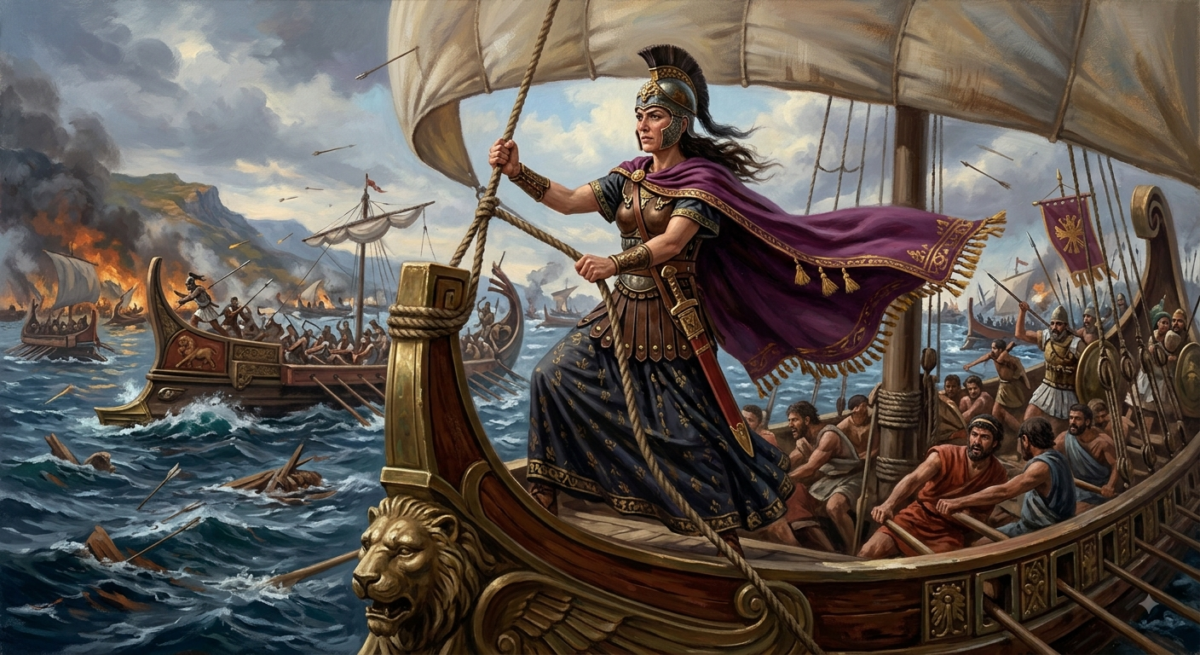
Once, the Persian King Xerxes I invaded Greece via Macedonia and crushed the Spartan King Leonidas at the Battle of Thermopylae, but was ultimately defeated by Themistocles at the Battle of Salamis and retreated.
Since childhood, Nearchus had admired the Athenian admiral Themistocles, yet he held an equal measure of reverence for Artemisia, the enemy’s female admiral. This was because, while Artemisia’s father was a Halicarnassian, her mother was a Cretan—from the very same homeland as Nearchus.
The Battle of Salamis was the very clash where Themistocles led the Allied Greek fleet, and Artemisia led the Persian armada, meeting head-on. Nearchus used to tell me stories about the Battle of Salamis all the time. Of course, it was merely secondhand knowledge borrowed from Herodotus.
The Persian force was a massive fleet numbering twelve hundred ships in total. Onboard were Phoenicians from Egypt, Palestine, and Syria, as well as Greeks from Cyprus and the coastal cities of Anatolia. Among them, the one with the most ferocious fighting spirit was Queen Artemisia of Halicarnassus.
After her husband’s death, Artemisia had served as regent for her son, who by then had already grown into adulthood. Nevertheless, she took to the battlefield herself as admiral, contributing five ships of her own, and led the Persian fleet in Xerxes’ stead.
The Persian fleet swept southward along the intricate bays and islands of the eastern Greek coast from Thrace, taunting the Greeks as they made their way into the Isthmus of Corinth—the narrow neck connecting Attica and the Peloponnese. Artemisia spear-headed the charge into the strait between Salamis Island and Attica. However, Themistocles ordered the Greek fleet to retreat even deeper, drawing the Persian fleet—still maintaining its battle line—deep into the heart of Greece, where the straits and isthmus formed a complex maze. It appeared as though the joint Athenian-Spartan fleet was finally trapped like a rat in a corner.
At the critical moment when the tide was about to turn, Themistocles launched his counteroffensive. The enemy’s center was pierced by Themistocles, throwing their formation into chaos and allowing them to be destroyed piecemeal. When Artemisia’s flagship fled, the rest of the Persian ships began to break away from the battle zone as well.
Themistocles’ tactic was to lure the enemy fleet into the waters between the port of Piraeus and Salamis Island, lining up the Persian fleet right before the inner sea of Athens. By doing so, he forced his men into a desperate resolve, awakening in them, so to speak, superhuman strength born of crisis. It was a high-stakes gamble between life and death, but the seamanship was equally brilliant. Fully mastering the local tides and shifting winds, they repelled the enemy in an impeccably disciplined formation.
Themistocles became a hero who saved his nation. Yet, the citizens of Athens ostracized him. The fear of the Athenian citizens was understandable. Backed by his naval power, Themistocles could have seized power by force and crowned himself King of Athens. Even without taking the crown, he could have effectively reigned and ruled over them. Even if that had meant complete independence from Persia, it would have been a total denial of Athenian democracy.
Indeed, even before Alexander, the unification of the Hellenistic world under the leadership of Themistocles was entirely possible. Alexander was merely a latecoming Themistocles.
In ancient times, democracy did not exist in Greece. The kings who founded the nations reigned over the people as representatives of the gods. These kings and lords were the descendants of gods who had descended to the earth from Mount Olympus, their heavenly realm, and the commoners, born from the mundane soil of the earth, possessed no inherent right to defy them. Yes, that was how it remained until the reforms of Solon began in Athens. Solon was hailed as the mediator between the offspring of the gods and the ordinary citizens.
Peisistratos occupied the Acropolis leading fifty private soldiers and became tyrant of Athens, yet his rule was rational and earned the people’s support. Carrying on Solon’s reforms while concentrating power in his own hands as leader, Peisistratos accelerated the process of reform. He suppressed the landlord class that monopolized agricultural lands and favored the newly emerging merchants and tenant farmers. He developed silver and gold mines and minted currency. From this period onward, Sparta and Athens began to tread entirely different paths.
Peisistratos passed his position on to his two sons, Hipparchus and Hippias. While a king might be a descendant of the gods, a tyrant is merely a child of man. Deciding that the hereditary transmission of power was unacceptable, the Athenians assassinated Hipparchus; Hippias sought help from Persia and went into exile with the aid of Sparta. It is said that when the Persian Wars broke out, Hippias attempted to return to his homeland, but died along the way.
Themistocles, too, suffered the same fate as Peisistratos. In his Anatolian exile, Themistocles became a local ruler and even minted silver coins bearing his own likeness. He abandoned Athens, turned his back on Greece, and chose the path of establishing his own rule under the Persian umbrella. He associated with figures like Queen Artemisia of Halicarnassus and died a natural death at the age of sixty-five. Nevertheless, the Athenians fabricated a story claiming that when the Persian king commanded him to strike Greece as admiral, he preferred to drink from a poisoned chalice rather than betray his fatherland.
It was the great reformer Cleisthenes who drove out Hippias, yet he himself harbored no political ambition. He was a pure mediator, a coordinator, and precisely because he was a selfless and impartial man, he responded to the trust of a broad range of classes to amend Athenian governance. Though it is said that Cleisthenes teamed up with Sparta to banish Hippias, what he actually did was merely assist Hippias and his family in safely escaping Athens with the help of Sparta.
To prevent a strategos from turning into a tyrannos, Cleisthenes prepared a safety mechanism called ostracism. The factor guaranteeing its effectiveness was a healthy public opinion, yet nothing is as fickle as public opinion. While he adopted the opinions of many people—appearing on the surface to cherry-pick the best of all worlds—his reforms ultimately gave birth to Pericles, the poisonous flower of populism.
Pericles was an aristocrat by birth and a cunning politician. The wife of his father, Xanthippus, was the niece of Cleisthenes. Like other nobles, Xanthippus had risen to prominence in the political arena through war and populism, and was likewise ostracized through political strife and populism; yet, he returned to his homeland under a general amnesty during a national crisis. Achieving great feats, he was appointed strategos.
Having grown up watching such a father, Pericles did not believe in the masses or in democracy from the start. As an aristocrat, he merely played the role of a defender of democracy. Few could have known the Athenian polity as intimately as he did.
Taming the system left behind by Cleisthenes, he was re-elected to the position of general for fourteen consecutive years, bribed the lower-class citizens—who constituted the majority of Athenians—to escape ostracism, and while maintaining the pretense of a democracy in Athens, he became a tyrant worse than Peisistratos or Themistocles, transforming into the absolute dictator of Athens—indeed, of all Greece.
In doing so, he paralyzed the sole virtue that ought to belong natively and exclusively to a democratic polity: its capacity for autonomous self-correction—or, one might call it, its self-purifying mechanism—and ultimately brought about the ruin of Greece.
The end result of that descent is the Athens of today: a pitiful state that has surrendered its hegemony to Macedon and is tossed about by demagogues like Demosthenes.
That is why our Master says that it would have been far better if Athens, back in the era of Peisistratos or through Cleisthenes’ reforms, had promptly restricted civil rights and transitioned into a polity akin to a tyranny—for that would have made the people of Athens far happier.