A boat setting sail from Piraeus, the outer port of Athens, navigates through the Saronic Gulf, where warships and fishing vessels of all sizes lie at anchor. Weaving past intricate capes and scattered islands, it heads east across the Aegean Sea. On its way to Asia, the vessel makes a port of call at Lesbos, an island lush with thick, verdant groves.
I must bring back the plant called Angelos, which grows wild on this island—root, stem, and leaf, all in one piece. That is the mission entrusted to me by my master. They say the deeper one ventures into the mountains, the more bountiful and finer the herbs to be found. The essential oil extracted from its roots is particularly precious, yet its flowers and leaves can also be eaten entirely as herbs. And yet, no matter how hard I search, I cannot find the Angelos.
As I follow the mountain path, figures emerge one by one from the thickets and from the shadows of the trees, becoming my companions on the road. The one holding my right hand bears a striking resemblance to Barsine. Could the one holding my left hand be Artonis? No, that cannot be. There is no way those ladies would ever appear in such scandalous, revealing attire. Ah, of course—this must be a dream. If it is a dream, then there is no need for reservations; I ought to enjoy it to my heart’s content.
Passing by a spring that gushes from a rocky ledge, and parting a thicket of wild strawberries that emit a sweet fragrance warmed by the afternoon sun, the nymphs lead the way. It seems as though they are trying to show me the whereabouts of the Angelos. Yet, it also feels as if they are merely idling about, playing with me. A sudden thought strikes me: could I be under their spell, lured into some valley that connects to an otherworldly realm, never to return to the mortal world again? In truth, maybe that wouldn’t be so bad. What do I care if I never return to Athens? Listening to the melodic laughter of the nymphs, I press onward in a state of blissful intoxication.
However, beneath their chime-like voices, a sorrowful, discordant melody begins to mingle, note by note. Pushing past the nymphs, a figure steps forward while plucking the strings of an instrument, and pinches my nose.
“Eumenes.” The voice calling my name sounds exactly like that of my tutor.
I opened my eyes. Against the backdrop of a dark blue sky flecked with sunlit clouds, the face of Circe, my music teacher, was right before me. Her hair was tied back in the same tight bun as in my dream. Beside Circe stood Artonis, leaning forward to peer down at me, her prized long hair cascading down. She wore her usual favorite linen tunic. Was that nymph in my dream truly this girl? Looking at her face now made me feel terribly self-conscious. As I closed my eyes again, trying to grasp the sweet visage of those maidens, the fading image of the dream vanished into thin air.
I was still half-asleep. Sitting up, I looked around to recall where I was. The setting sun warmed the unusually flat, leveled ground. Suddenly, a small whirlwind kicked up at my feet, kicking up dust as it swept across the completely deserted training ground, only to die out halfway. Ah, right. I am still at the Lyceum. Before I knew it, my hair was covered in sand.
“You looked like you were having a lovely sleep,” Circe said.
“Ah…”
“Skipping class again, I see.”
“My apologies, Professor Circe.”
“If you don’t have enough credits, you’ll be expelled—a maximum-term expulsion.”
“How much more before I fail?”
“My dear, you cannot afford to miss music even one more time.” Circe ran her eyes quickly over the ledger in her hand. “This is a sacred subject dedicated to the gods.”
We do not pursue learning merely to serve the gods, I thought to myself.
“I am going to be a physician, so I have no need for music. All I need is medicine and botany. Even the Master says that is perfectly fine.”
“The Master? Your master only arrived here two years ago. He clearly doesn’t know the regulations of the Lyceum. Among the three academies established on the outskirts of Athens—the Academy, the Cynosarges, and the Lyceum—here at the Lyceum, which is built upon the sacred precinct of Apollo, music and theology are strictly compulsory.”
How rigid. Such stiffness is utterly useless to true learning. And then there was physical education. Yes, for some reason, students were required to train their bodies through athletics as well. Physical education was another subject I was miserable at. Just this morning, I had been forced to run around here during gym class. It’s not as if I want to become a soldier in the future. Exhausted and drowsy, I had laid down on the embankment, and before I knew it, dusk had fallen.
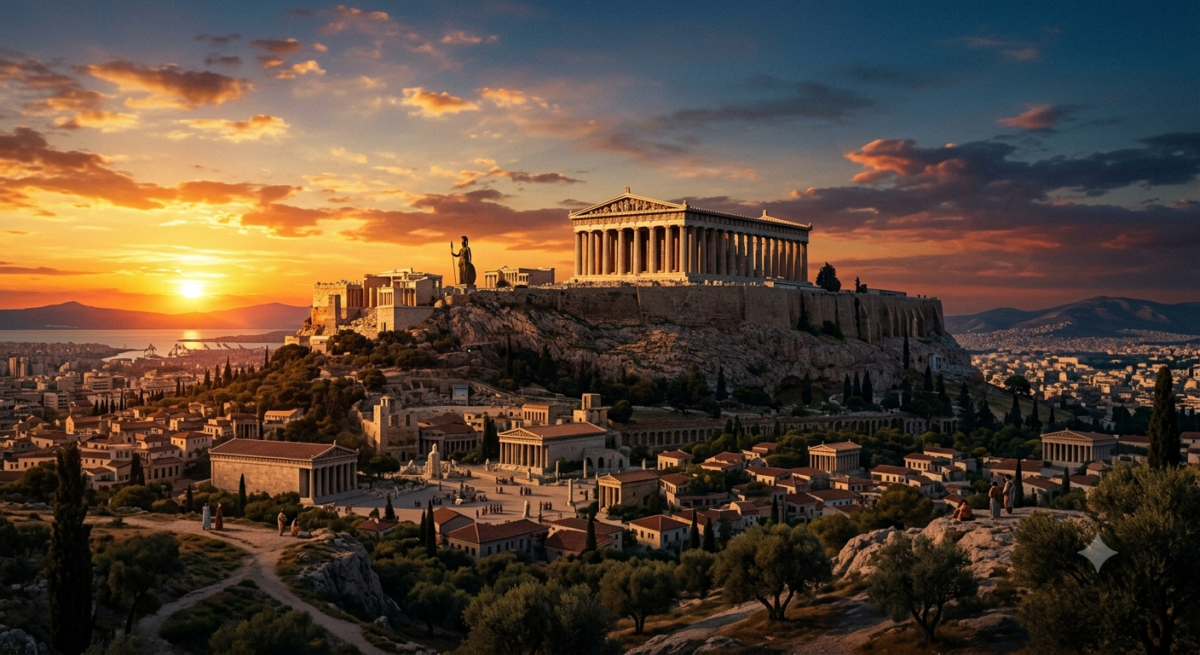
Whenever I gaze upon the silhouette of the Parthenon, bathed in the dying embers of the setting sun as it sinks into the western sky, I cannot help but feel a strange tightening in my chest. The glory of Greece is slowly, imperceptibly bleeding away. Athens is no longer the Athens of a century ago.
“Eumenes, listen to me seriously. Do you understand? Apollo is also the god of music. He is the deity who plucks the lyre, narrates poetry, and composes songs. Only those loved by Apollo are worthy of remaining here at the Lyceum.”
I had never once desired to be loved by Apollo, so her words only made me bristle.
“I am not looking to receive a diploma from the Lyceum. As long as I can learn medicine from the Master, that is enough for me. It doesn’t matter whether the academy is the Lyceum or the Academy, or anywhere else for that matter. Besides, who knows how long the Master will remain here? If he moves elsewhere, I will move with him. If I am expelled from the Lyceum before then, so be it.”
“Suit yourself.” Circe turned and walked away, tracing the path where the small whirlwind had just passed.
“You didn’t have to put it like that. There is absolutely no point in talking back to the professor.” I didn’t need Artonis to tell me that. As I began to walk, Artonis followed close behind. What does she want from me? The last thing I need is a lecture from her, too. “Are you heading to the Master’s place?”
Yes. Since yesterday, I had been writing a thesis through the night by the light of an oil lamp. It was a Syrian lamp that Barsine had left behind long ago when she returned to her homeland. I had finally finished writing it just before dawn. It was a morphological analysis and species identification of a certain plant I had spent about six months collecting. I had been completely consumed by this research for ages.
“It must be a new species, Artonis. If it’s a new species, the person who discovered it gets to name it whatever they like. I could even name it after myself. Like, Angelos eumenesi.
But depending on the circumstances, I might name it after you. If I did, it would be something like Angelos artonoy.”
“Oh, how flattering. A radish named after me.”
“The Angelos isn’t a radish. It’s a member of the Apiaceae family—like a carrot or parsley.”
“Hmm.”
I’m certain Artonis thinks a carrot is just an orange radish.
“By the way, do you know where the Master is?”
“No idea.”
“Shall we go look for him together, then?”
I needed the Master to read what I had written. We went from the gardens to the library. After searching thoroughly between the bookshelves, we passed through the colonnade of marble pillars, walked past the livestock pens, and headed toward the botanical garden. Still, there was no one around. What was going on? Everyone had been there this morning during gym class.
“I was dreaming about the island of Lesbos earlier,” I said.
“Oh? What kind of dream?”
“I was being seduced by a host of nymphs, who were leading me deep into the mountains.”
“Nymphs seducing you? You?”
“Deep in the mountains, it became a rugged, dense forest…”
“Rugged mountains? Deep forests? In Lesbos?”
“Actually, I’ve never been to Lesbos. I just hear stories from the Master from time to time. He says there are deep, unexplored forests there. So, I only saw it in my dream.”
“What a silly dream.”
“Sorry about that. All dreams are like that. Silly and meaningless. Come to think of it, that island is your hometown, isn’t it? What is it like, Artonis?”
“What is it like? Well, it has two massive bays—calm, inland seas like lakes. And it has two large mountains.”
“Artonis, where were you born and raised?”
“Mytilene, a port town on the eastern coast of Lesbos. My mother runs a shipping inn there all by herself as the landlady. My father was a commander in neighboring Phrygia—I’ve never even seen his face. I’ve forgotten his name, too.”
“So, a seafaring man from Anatolia came to Mytilene, met your mother, and had you there.”
“Exactly. And my father was always away, whether for trade or military expeditions, never staying home. Eventually, he probably hooked up with some woman outside the island. Not that I care. So, I grew up with just my mother, two women alone. In Mytilene, there is a traditional school founded by Sappho—whom Plato called the ‘Tenth Muse.’ I enrolled there. The Master actually tried to enter Sappho’s school long ago, but he was rejected.”
“Why?”
“Because Sappho’s school is strictly for women. Men are barred.”
“Huh.”
“Do you even know who the poet Sappho is?”
“Never heard of her.”
“She is the most famous poetess in all of Greece.
If she runs away, you will likely want to chase after her.
If she refuses gifts, you will likely want to offer more.
Even if you don’t love her now, you will soon come to.
Even if you don’t care about her.“
“Is that Sappho’s poetry? What a bizarre poem.”
“Is it?”
Artonis smiled suggestively. Could she possibly be implying that she wants me to pursue her, or give her a gift?