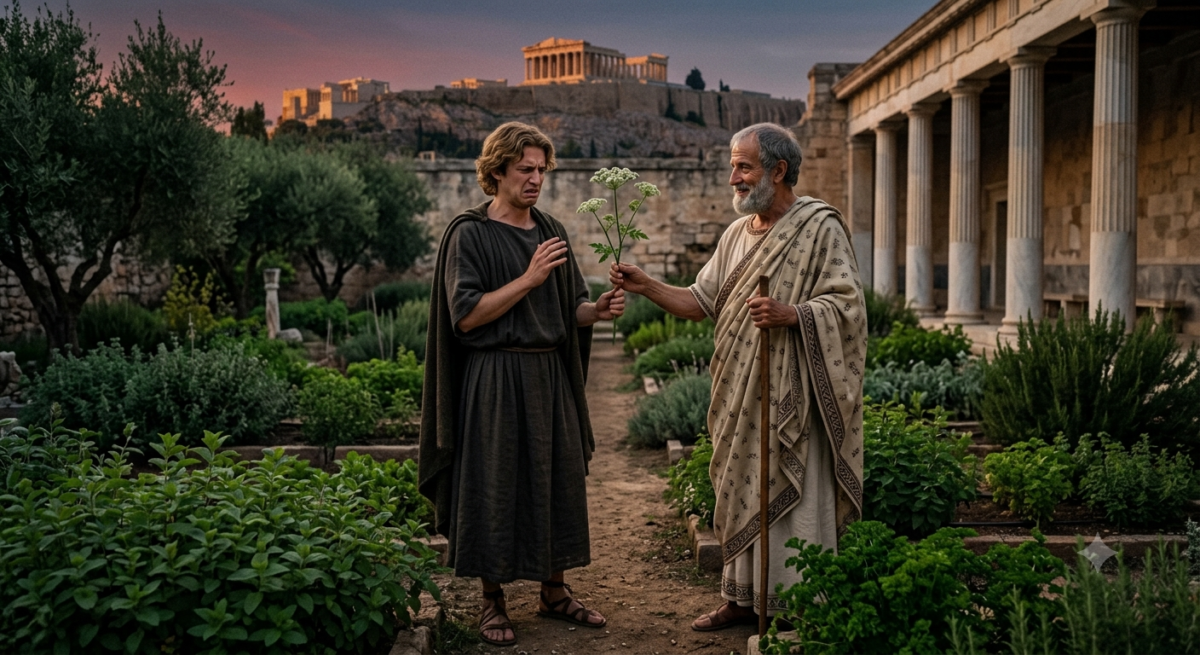
The Master was in the botanical garden. With a hoe in one hand, he was walking between the ridges, gently touching leaves and petals with the fingertips of his other hand.
“Master, you are here all by yourself?”
“I am harvesting vegetables for tonight’s supper.”
“You could have simply ordered Artonis to do that.”
“I cannot have this garden treated carelessly, like just any ordinary field.”
Artonis seemed to pout a little, puffing out her cheeks.
“At any rate, the sun is setting. It is the season to prepare for winter; it would be disastrous if you caught a cold.” I refrained from adding that old people easily worsen from a mere cold and that pneumonia would be fatal, knowing he would surely lose his temper if treated like an old man.
“What did you come here for?”
“I thought you might read what I have written.” The Master remained silent. I couldn’t help but offer an excuse. “I have spent months revising it over and over. There shouldn’t be any more major rewrites needed.”
“I see. I shall read it when I am at leisure.”
“Then I will bring it to your room later. Would you like me to give you a brief overview now?”
“No. I will understand it when I read it.”
The Master dug up a root vegetable with his hoe and handed it to me without a word. Then, carelessly plucking some lentils, he handed them to Artonis. I went to the storehouse to fetch two baskets, giving one to Artonis. The Master gathered a few more vegetables—turnips, cabbage, onions—and some herbs. He harvested only the herbs himself, while I placed the rest into my basket. Artonis carried the vegetable baskets in both hands back to the kitchen; she was to prepare tonight’s meal. Still holding the herbs, occasionally inhaling their scent, the Master walked slowly along the colonnade.
“How is it? A fine aroma, isn’t it? Taste it.”
I knitted my brows. The Master was trying to make me eat a bitter weed yet again.
“What is this?” At first glance, it resembled rosmarinus. Its finely serrated leaves were covered in tiny hairs, giving them a grayish appearance. Given its potent fragrance, it was likely related to mint or wormwood.
“When I was on the island of Lesbos, the locals used to decoct this herb in olive oil to make aromatic oil.”
“I see. And what is the name of this herb?”
“In Lesbos, it is merely a weed with no particular name. However, around the Euphrates, it is a herb that blankets the plains like a sea, called apsinthos. The Lesbians use this aromatic oil to flavor their wine—Lesbian wine. Have you ever drunk it?”
“No. What is it effective for?”
“It invigorates the stomach.”
Reluctantly, I accepted a single leaf and put it in my mouth. It possessed a distinctive aroma, and as I chewed, it was, as expected, bitter.
“It is somewhat toxic. The islanders do not let their children or livestock eat it. However, unless consumed in vast quantities, it will not kill you.”
The Master had taught me about many medicinal plants. Every single one of them was bitter. Even when decocted or steeped to remove the harshness, an acrid taste remained, leaving my mouth and throat tingling. I rinsed my mouth with water and spat. Looking at me, the Master merely said, “It is only natural for medicine to be bitter.”
It seemed the Master found more joy in collecting and classifying flora and fauna than in healing people with medicine. If only I could become such a detached scholar, my mind would be at ease, I thought. To tell the truth, my desire to become a physician had waned compared to the old days. What could a physician, or knowledge about humans, animals, and plants, or even a medicine like this, truly accomplish?
“Do you know this plant?” The Master proffered another herb to me. It was not in bloom, but its leaves bore a striking resemblance to the Angelos. It was likely of the Apiaceae family. “You do not know it? This is hemlock.” I had heard that name. It was the poisonous herb that Socrates was condemned to drink at his execution. “I shall give some to you as well. Taste it.”
“Absolutely not. I have no wish to die just yet.”
“A mere fraction of an amount is of no consequence. If you remain in Athens, the time may come when you too must drink this. Therefore, would it not be wise to test what effect it has on your body while you can?”
“No, thank you. If anyone ever accuses me, I would flee Athens long before the trial even begins. Would you not do the same?”
The Master smiled. “Athens is delightful and full of stimulation, but it is no place to linger. You must think so too. Unlike Socrates, you are not a native citizen born and bred in this city, and besides—”
“Besides what?”
“The current Athens is hardly worth rendering such loyalty to.”
“True. It is exactly as you say. So, where would you flee?”
“Let me see… perhaps to Phrygia, relying on my mother’s connections, or to Macedonia, through acquaintances from our days in Mieza.”
“Not to Thebes or Sparta?”
“No, I would hate that. Just as much as Athens. Perhaps I simply dislike Greeks.”
The Master handed me a stalk of hemlock, and I accepted it, once again out of necessity. For now, I’ll take it back to my room, put it in a vase to observe it, and then throw it away. As I stared at the koneion with these thoughts in mind, the Master abruptly shifted the topic, as if suddenly remembering something.
“Yet, have they not said that the King of Macedonia has already died in Illyria?” The master said abruptly.
Illyria was a region northwest of Macedonia along the Adriatic coast, inhabited by Thracians. For nearly a year, the King had been away on an expedition, and moreover, he had been entirely out of contact.
“The King?”
“It is the prevailing rumor among the Athenians.” The rumors of the Athenians were hardly reliable.
“Could the King really die so easily?”
“At the very least, there has been no word sent to me.” The Master naturally disliked political topics.
“Why does the King’s matter concern you?”
“He promised me a lifelong pension for my research and education. Yet, it has entered the second year and the money has still not been sent. Without funds, I am in difficulty.”
The King of Macedonia had granted various forms of assistance in accordance with the Master’s wishes. He had restored the Master’s hometown of Stagira, and had made immense donations to the academies of the Greeks—to the Academy, and furthermore, here to the Lyceum. Regardless of what the Athenians thought, we scholars residing in Athens all benefited in no small measure from the King.
By now, the sun had completely set over the Acropolis, and the sky was turning from crimson to a deep ultramarine. The beautifully adorned temple standing upon the hill was dissolving its form into the darkness.
“Did you ever offer your gratitude to the King, Master?”
“Gratitude? For what?”
“For the pension you receive from him, of course. For instance, by writing a letter of thanks, or dispatching an envoy.”
“I do no such thing.”
“You should at least do that much.”
“What do I care? If it is money that cannot be obtained without sycophancy, I am better off without it.”
I found it amusing that the Master had said something that sounded like it came from the mouth of a Cynic philosopher.