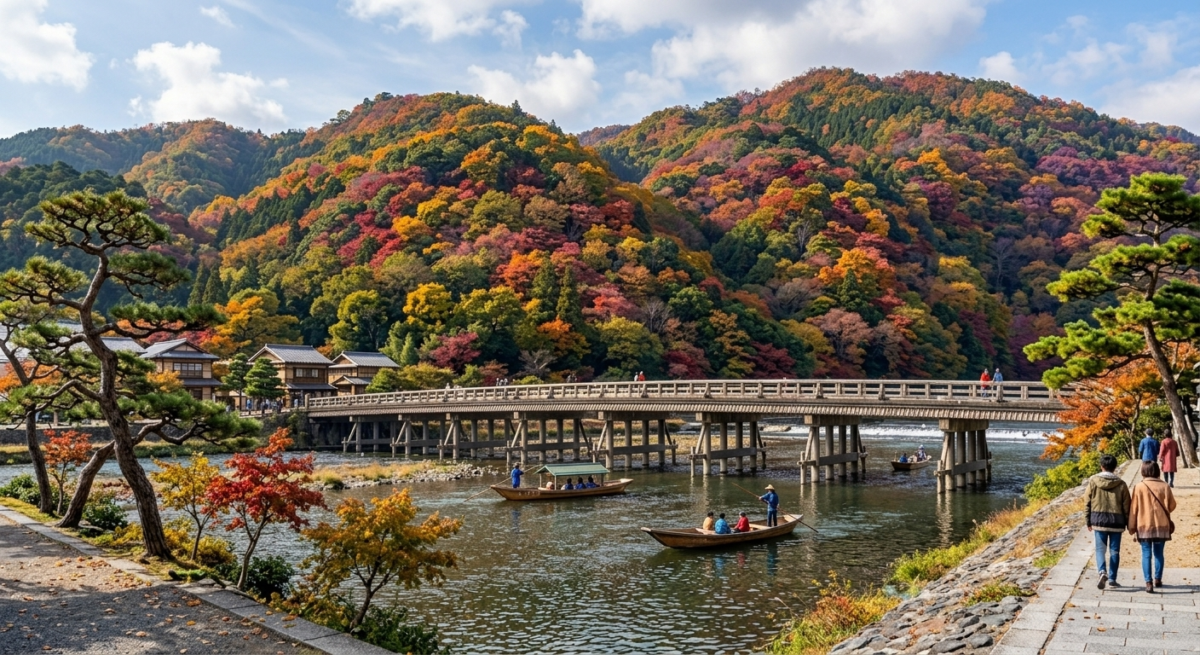
When you think of Sagano or Arashiyama, Tenryu-ji comes to mind.
Ever since Fujiwara no Teika established his hermitage here at the foot of Mount Ogura, the area has been beloved by Kamakura-period royalty, the Saionji family, Emperor Go-Daigo, and Ashikaga Takauji. I recalled a guy named Okita—a colleague from my days in Professor Makinouchi’s lab—who was currently living and training at Tenryu-ji. For now, I’d try meeting up with him to ask his advice. I got in touch with Okita right away. So it was a double-back, going straight from K University in eastern Kyoto to Arashiyama in the west. Even if I met Okita now, I could still make the last Shinkansen tonight.
While waiting for Okita at a soba restaurant just across Togetsukyo Bridge, I ordered ten-nuki—tempura in hot broth—and casually started drinking on my own. Okita arrived soon after.
“What’s this? Starting without me? Guess I’ll get a sake cup too.”
To my surprise, Okita had a woman in tow.
“Let me introduce you. You remember that guy Asakura from back in our school days, the monk-in-training?”
“Ah, yeah, come to think of it.”
“This is his wife.”
“I’m Yuriko.”
I recalled hearing a rumor after graduation that Asakura had married a junior from the university. As I recall, they hadn’t held a wedding. Not that it mattered—a guy like me who hates ceremonial occasions wouldn’t have attended even if invited.
“Huh. Mrs. Yuriko Asakura? I don’t believe we’ve met before, have we?”
A playful look crossed her face. “We have, actually. We spoke back when you were a student. Though I doubt you remember.”
“Is that so? What was your maiden name?”
“Yamaga. Yuriko Yamaga.”
Yuriko Yamaga. Nope. No memory of it whatsoever.
“My apologies. Where and when did we meet?”
“Oh, don’t worry about it,” Yuriko giggled softly.
“Where’s Asakura these days?”
“Well, apparently he’s in Sri Lanka right now.”
“Huh? Wasn’t he in Tibet?”
“He’s been traveling around, training in various places.”
A shadow fell over Yuriko’s face, making me feel a bit sympathetic. I was all too familiar with Asakura’s personality—haughty, to put it politely, with a habit of looking down on people.
“What a troublesome husband, leaving his wife behind like that.”
“It can’t be helped. I registered our marriage knowing full well what I was getting into.”
Knowing what, exactly? I wondered.
“She’s Princess Yaśodharā,” Okita interjected with a touch of malice. “You know, Buddha’s wife.”
A monk-in-training abandons his wife and childen to leave home, leaving the woman behind to wait for him. I suppose that kind of relationship exists in the world.
Okita helped himself to a pour from the bottle of sake I had ordered into his small cup. It went empty in an instant, so he ordered another bottle. Along with an assortment of pickles. Yuriko simply sat there, dazed, merely sipping the tea that had been set before her. Why on earth did this woman tag along?
“A burial site for Minamoto no Katako in Sagano? And a hidden Buddha to boot? There’s no way such a thing exists,” Okita said bluntly. “Besides, ‘Sagano’ covers a lot of ground. If you say the ‘mountains of Sagano,’ it could mean Mount Ogura, or maybe Mount Atago, or even deeper into the mountains beyond.”
Mount Atago in Kyoto stands over 900 meters high, with the head shrine of Atago Shrine situated at its peak. Back in my student days, I had trekked up there specifically to get a fire-prevention talisman that read “Beware of Fire,” but it’s a mountain that requires some serious willpower to climb.
“Just saying ‘Sagano’ doesn’t tell us where on earth it’s supposed to be, and even if it did exist once, there might not be anything left today,” Okita said. “Even Tenryu-ji here was originally an imperial villa for Emperor Go-Saga before Ashikaga Takauji built it to appease the soul of Emperor Go-Daigo. It has burned down multiple times since Emperor Go-Saga’s era. It’s true that Emperor Shirakawa once made a royal progress to Arashiyama, following the precedent set by Emperor Kanmu.”
“‘Seeking out the ancient flow of the Oi River (or Katsura River), I come to gaze upon the autumn leaves of Mount Arashi (Ofowi-gafa Furuki nagare wo Tadune kite Arasi no yama no Momidi wo zo miru),’” I quoted.
“Right, exactly that. There’s no way a temple from that era would still be standing intact. Besides, who is this Nishikyogoku guy anyway? Is he a descendant of court nobility?”
“Yeah. I heard the family branched off from the Reizei family back in the Muromachi period. That’s supposedly why ancient documents related to Teika are turning up.”
“Were they nobility before the war?”
“Yeah. A viscount, apparently.”
“Didn’t all the noble families move from Kyoto to Tokyo? Why would they still have land around here?”
In truth, while the Kami-Reizei branch—which had split from the Reizei family—remained in Kyoto, most of the court nobility followed Emperor Meiji and relocated to Tokyo.
“The client I met earlier is the head of the Nishikyogoku family, a guy named Kiyomasa,” I explained. “According to Professor Makinouchi, the Nishikyogoku family had a main branch that moved to Tokyo and a side branch that stayed in Kyoto. But since the Kyoto branch finally died out, the Tokyo main family came to settle the estate. Kiyomasa-san was clearing out the storehouse of that Kyoto branch, and…”
“And that’s when the ancient documents came to light.”
“Exactly. So he called me in. But that Kiyomasa guy haggled down my appraisal fee.”
“Hmm.”
“He’s a total cheapskate. Telling me to do the appraisal just for the round-trip travel expenses between Tokyo and Kyoto.”
“That’s on you for taking a job like that.”
While Okita stepped out to the restroom, Yuriko took the opportunity to speak to me.
“Um… Mr. Enomoto, are you a researcher of Buddhist art?”
“Well… I suppose you could say that, more or less.”
I had majored in literature and aesthetics, but my passion for antiques spiraled to the point where finding a regular job became a struggle. Not that I ever intended to become a corporate worker in the first place, which is why I started an unprofitable second-hand bookstore. Having many acquaintances in Buddhist circles during my university days gave me a fair bit of knowledge about that world, too.
“So, are you investigating the assets of the Nishikyogoku family?”
“Well, initially I was just here to appraise some books.”
“I apologize. I know this is extremely sudden and rude of me, but if you have time tonight, is there something I could consult with you about?”
I was about to say that I had planned to take the Shinkansen back to Tokyo tonight, but when my eyes met her pleading gaze, I held it back. Since there was a chance the business trip might drag on, I hadn’t bought my train ticket yet, and my schedule for tomorrow was completely open.
“Does that mean you want to hire me for a job?”
“You may consider it as such, yes.”
“I’ll be demanding a fee, of course. For starters, my accommodation expenses for tonight—which count as a necessary business expense, naturally.”
“Of course, I don’t mind at all.”
“Could it be that you’re related to the Nishikyogoku family?”
“Yes. My late father was Nishikyogoku.”
“Meaning… the Kyoto branch? I heard that because the Kyoto branch died out, someone came from Tokyo to settle the assets.”
“The Tokyo Nishikyogoku is the branch family,” she corrected.
I couldn’t care less which side is the main family and which is the branch.
“You seem awfully young for that, though. The late head of the house and his wife must have been quite advanced in years.”
“I am the child of Nishikyogoku’s mistress. My mother was never registered in the family record.”
“Aha. I see.”
What a strange coincidence. The Tokyo Nishikyogoku and the Kyoto Nishikyogoku. It appeared I was about to accept requests from both clients. The plot was certainly thickening. Reading between the lines, this woman, Asakura Yuriko, must have heard from Okita that I had taken a request from Nishikyogoku. That was why she had tagged along with Okita specifically to meet me. It had to be.
“Yuriko-san, why were you with Okita today?”
“Well… it was related to my husband’s work. I happened to have an errand at Tenryu-ji today, so I just snuck out for a short bit during my lunch break.”
“Huh.” Her story sounds mighty suspicious.
Okita returned from the restroom. With a fountain pen pulled from her breast pocket, Yuriko scribbled a phone number onto a chopstick wrapper and slipped it to me. Her eyes made it abundantly clear that I was to keep this a secret from Okita. I casually stashed the paper wrapper into my back pocket.
It seems this woman knows something about the hidden Buddha.
I decided it was worth hearing what she had to say.
Past peak lunchtime, the soba restaurant began to fill up with tourists. Before I knew it, a line had formed outside. As customers who were already seated, there was no need for us to rush, but I was getting fidgety, eager to get out of there.
“Hey, drinking in the middle of the day like this—what are you planning to do about your work this afternoon?” I asked.
“What? A little drink is nothing,” Okita replied.
“Aren’t temples strict about ‘No alcohol beyond these gates’?”
“Nah, this is just ‘Hannya water’—sacred wisdom water.”
Pleasantly tipsy, Okita crossed Togetsukyo Bridge with Yuriko to head back.
After waiting a short while, I called Yuriko.
“Enomoto-san, do you happen to know the ‘En-kiri’ shrine—the relationship-severing shrine—in Gion?”
“Uh… I think I remember seeing something about it online. It’s that famous power spot these days, right?”
Yuriko giggled softly.
“Yasui Kompira-gu Shrine. The enshrined deities are Emperor Sutoku and Minamoto no Yorimasa. My mother runs a small establishment near there.”
How delightful. Kyoto really is a fascinating place. In Tokyo, figures like Minamoto no Yorimasa or Emperor Sutoku would never be enshrined as deities at a shrine.
“Is it a drinking spot?”
“Yes. A small Japanese eatery called ‘Kumiko’.”
“Just give me the address, and I can reach it using Google Maps.”
Yuriko read out the address to me.
“Well then, I’ll be waiting for you.”
“Is Kumiko your mother’s name?”
“It is.”
Gion this time, huh? Good grief. Zipping from the west to the east of Kyoto city. What a busy day.
Without rushing or panicking, I first booked a business hotel in the Higashiyama area and checked in.
I figured I should report in to Kiyomasa Nishikyogoku just in case. It’s always best to handle these things early.
“Mr. Nishikyogoku?”
“Yes.”
“This is Enomoto. I stopped by Professor Makinouchi’s place at K University earlier. While looking through the text, a rather intriguing description came up. Have you ever heard of a Heian-period hidden Buddha passed down in the Nishikyogoku family?”
“Yes, I have. My grandfather and father used to mention it. In fact, I was hoping that very thing might turn up from the storehouse.”
“So it wasn’t there.” So his true objective was the hidden Buddha after all. “Did anything else turn up that might serve as a clue?”
“Since you seem to be aware of it already, I’ll tell you: there was a copy of a Buddhist painting. It had been mounted into a hanging scroll, complete with an attached origin story. The figure in the drawing was in an informal posture, sitting with one knee raised on what looked like an elevated threshold or wooden frame. It was holding a single flower in its hand. To me, it looked like a representation of Kannon.
Then there was an old map, which seems to be related to the hidden Buddha, but it’s quite incomprehensible. It was likely drawn ambiguously on purpose. The cardinal directions aren’t clear, and the terrain seems distorted. Would you like me to show it to you as well, Professor Enomoto?”
“If necessary, please show it to me later. There are a few things I’d like to look into on my end first.”
“I see. Well then, if you find out anything, please keep me informed as things develop.”
“Were there any other potential clues? For instance, an asset inventory? Or land registry documents?”
“Well now… a whole mountain of ledgers from the Edo period turned up, as well as inventories, rosters, and receipts related to Buddhist memorial services and tea ceremonies from the Meiji era all the way through to the Heisei era.”
Yikes. This is why dealing with old families is such a pain. It’s a daunting prospect, but I couldn’t rule out the possibility that something might turn up if I dug through them.
“Hmm. I see. I may need to visit you again at some point, but please keep this strictly confidential.”
“That’s my line, isn’t it?”
“Would it be alright if I billed you for additional investigation fees?”
There was a brief silence on the line.
“As for that matter, I’ve already retained a lawyer on our end. But very well. You may send an invoice, and I shall decide after reviewing it.”
What a stingy guy. Usually, the moment you send an invoice to someone like this, they go dead quiet. Oh well. I’m already in deep now. At this point, I just have to know the truth.
“Right then. I’ll report to you as frequently as possible and send invoices as I go.”