The next day, I had two adjunct lecturing classes waiting for me back in Tokyo. Work was waiting for me. God, I hated it—but canceling the classes and being forced to hold make-up lectures later was even worse. Late that evening, I finally returned to Tokyo on the Shinkansen.
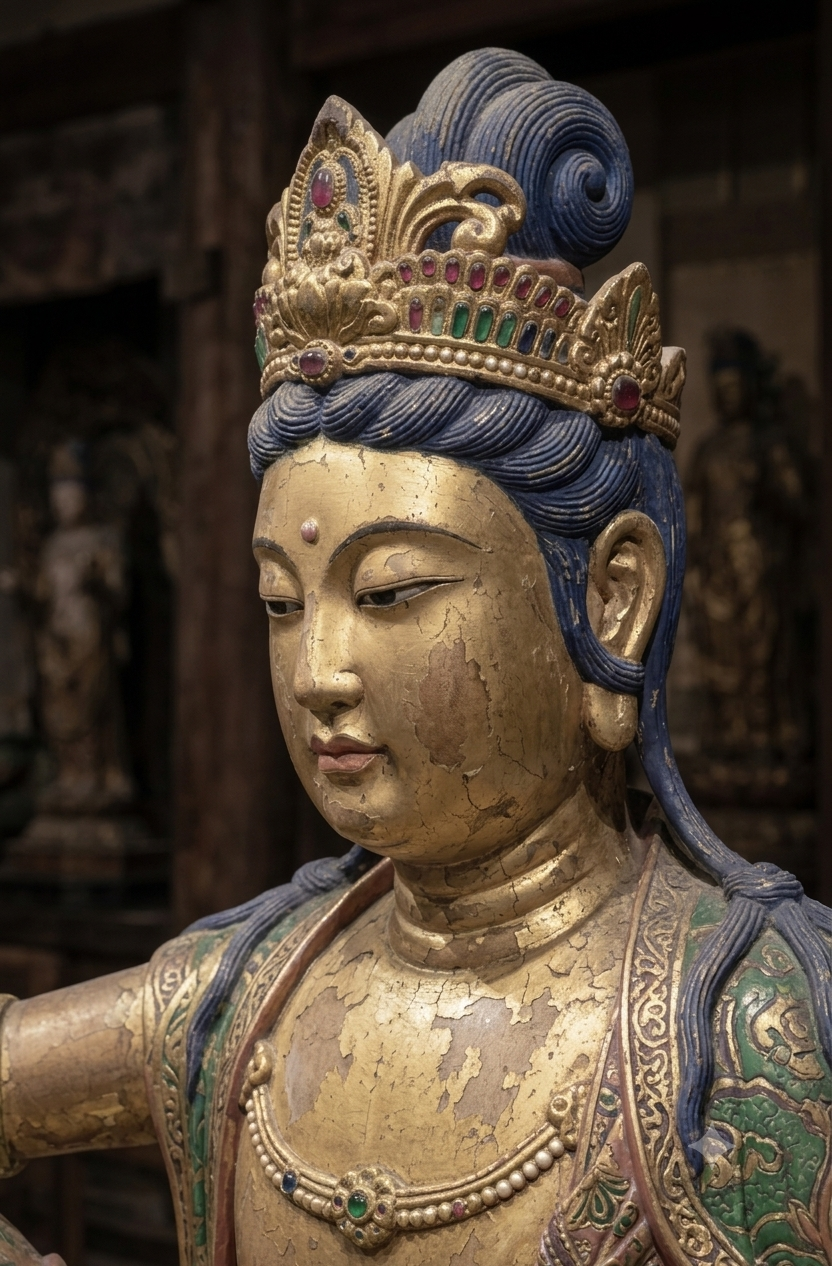
The more I researched, the more I began to think that the statue wasn’t a mere modern forgery. It might not be from the Heian period, but perhaps the Kamakura or Muromachi period. It could even be an imported Buddhist statue from abroad. Realistically detailed Kannon statues like that often originated from the Northern or Southern Song Dynasties—or perhaps Kamakura.
It might not be a National Treasure, but it could very well be an Important Cultural Property. Moreover, it wasn’t just the statue; there was the stone chamber, the sarcophagus, and the miniature shrine. Creating a complete set like that would require an astronomical amount of money and labor. There was no way to bring heavy machinery into a place like that with barely any forest roads. If you placed a legitimate custom order for all that, it would easily cost over a hundred million yen.
Could a group of sculptors and shrine carpenters have banded together, working off their own dime to pull off such a prank? Perhaps such connoisseurs forged a Heian-period hidden Buddha just to shock the world?
That was surprisingly plausible. After all, even without money, if architects and electrical engineers gather, they can build a villa in the mountains as a hobby. Japanese mountains are littered with such “ruins” and “abandoned sites.”
In any case, there was no way such an elaborate prank could be carried out on a mere whim. Even assuming a sculptor from the Showa or Heisei era carved that Kannon statue, anyone capable of carving something of this caliber was no ordinary craftsman.
I wanted to identify the author properly. There had to be a clue somewhere.
Presenting my findings at an academic conference would surely yield new leads. That was why I felt this Kannon statue ought to be formally investigated and published after all.
I called Yuriko time and again, trying to persuade her to change her mind, but it always ended up a fool’s errand. I had just about finished writing the draft of my paper and was intending to let Yuriko read it and talk to her in person—when it happened.
As usual, while keeping shop, I was registering books on Amazon—discarded volumes from regional university libraries, or books bought cheap right before being shredded at warehouses. Just as I was about to close up for the day, I received a phone call from Nishikyogoku Kiyomasa.
“I just saw on TV that the Asakura couple held a press conference announcing their discovery of a Heian-period hidden Buddha on Mount Atago. I also glanced at this morning’s paper, and it’s right there in the culture section. What on earth is going on here?”
“What?”
“Didn’t you know about it? The existence of that statue.”
“Well…”
“Lying won’t do you any good.”
Giving up, I spilled everything to him.
“I see,” he said, “so what was written in that ancient document was true after all.”
“No, well, as I said, we were right in the middle of appraising whether it was authentic or not, and I intended to contact you, Mr. Nishikyogoku, once those results came out,” I made a lame excuse for myself. Then, trying to shift the conversation, I asked a question of my own. “You mentioned the Asakura couple. Does that mean the husband, Asakura, has returned to Japan from India?”
“So it seems,” Kiyomasa said sullenly. “Thanks to you keeping me in the dark, I fell a step or two behind. If only you had reported to me immediately, I could have taken action before that Asakura guy returned. I bought that Yamaga mother and daughter a house in lieu of severance pay, you know. Therefore, all of the Nishikyogoku assets—from the land down to the artifacts—are supposed to be mine.”
Then go consult your lawyer; it’s none of my business. I felt like saying it, but knowing he was already well aware of that, I kept my mouth shut. After all, I had only been hired to appraise the manuscript; I had no contract regarding any hidden Buddha investigation, nor had I been paid a single cent, so I owed him no duty to report. I had heard about the map and the drawing turning up, but I had shared everything I knew on my end, too. We were even.
Nothing good would come from getting involved any further. I hastily ended the call with Kiyomasa and Googled it on my computer. Sure enough, it was all over the news. There was even a photo of the couple posing together with the statue. Now their faces and names were thoroughly out there in the public eye.
Next, I called Professor Makinouchi.
“Regardless of how the appraisal turns out, now that it’s been made public like this, you’ve permanently lost the chance to be the first to announce it,” the professor said. “Even if you publish a paper, its impact will be severely diluted. Everyone and their uncle will swarm in to research it all at once, so there’s no room left for you here, I’m afraid.”
“I know… I’m really in a bind here.”
“Right about now, the foot of Mount Atago is probably in utter chaos with news media, researchers, and crowds of onlookers,” he noted.
“Professor Makinouchi, here’s what I reckon,” I said. “Yuriko-san must have gotten in touch with Asakura right after our trip. Then she told him the advice I had given her. Asakura cut his training in India short and flew back to Japan. He must have realized that if he built a temple in the mountains of Atago and became its chief priest, they could live comfortably off the admission fees.”
To Yuriko, I was a man who was no longer needed. My ideas had been plucked for free, and I was played like a total fool. I had been dragged through the mud, plain and simple.
“That might very well have been the case, Enomoto-kun,” Professor Makinouchi said. “You were far too soft-hearted, weren’t you? Haven’t I always told you to sign a contract with your client right at the start?”
He was right. Swayed by emotion, I hadn’t signed a single contract with either Kumiko or Yuriko.
“Still, don’t hold a grudge against Asakura-kun and Yuriko-san over this. Rather, offer the Asakura couple your blessings with an open heart. Once a person reaches their fifties—or even their forties—they can’t go on living like a vagabond forever. Even Asakura, who rushed off saying he was prepared to leave his bones in Tibet, might have had a change of heart and wanted to settle down.
From now on, I’ll toss a few more lucrative gigs your way, and I’ll buy second-hand books from your shop, too. So don’t let this get you down, and just keep plugging away at your appraisal work. In this line of business, if you stick with it until you’re fifty, anyone can become an ‘authority.’ Just hang in there a little longer.”
“Right… Thank you very much.”
His attempt at comforting me only made me sink deeper into depression. Just ten more years until I turned fifty. Man, I’ve gotten old.
Professor Makinouchi showed an awful lot of favor toward Asakura, but both Asakura and I were equally his “beloved students.” His words make sense. I should just put this whole affair completely behind me. Persuading myself of this, I hung up the phone and began browsing the web on my computer, where I stumbled upon a video of the Asakura couple’s press conference. As I stared at their bright, cheerful smiles, a sudden, chilling realization hit me.
Yuriko had never smiled like that in front of me, free of care. She had always carried a somewhat shadow-cast expression. I had assumed that was simply her personality. It wasn’t.
Asakura and his wife, Yuriko, had been in cahoots from the very start.
In truth, Yuriko and Asakura had been in touch all along. Yuriko happened to hear about the situation from Okita and learned that I had started searching for the hidden Buddha at Nishikyogoku’s request. Panicking, Yuriko contacted Asakura and came to see me. Yuriko got her story straight with Kumiko, put on a performance, and tried to seduce me with her feminine wiles to buy time until Asakura returned from India—all to prevent me from pressing forward with my investigation and letting the hidden Buddha fall into Nishikyogoku’s hands.
Then Asakura secretly returned to Japan behind our backs, got all the preparations perfectly in order, and made a surprise, lightning-fast announcement to the press.
Yes. That had to be it. Thinking of it that way explained why Yuriko had suddenly popped up before me back then.
I had been played like a fiddle. I had let a once-in-a-lifetime, monumental opportunity slip right through my fingers.
Night comes early to the bookstore district. I packed up the display racks at the storefront, pulled down the shutter, and began walking down the deserted asphalt pavement, thinking I’d go blow off some steam and drown my sorrows under the elevated railway tracks of Kanda or Ueno.