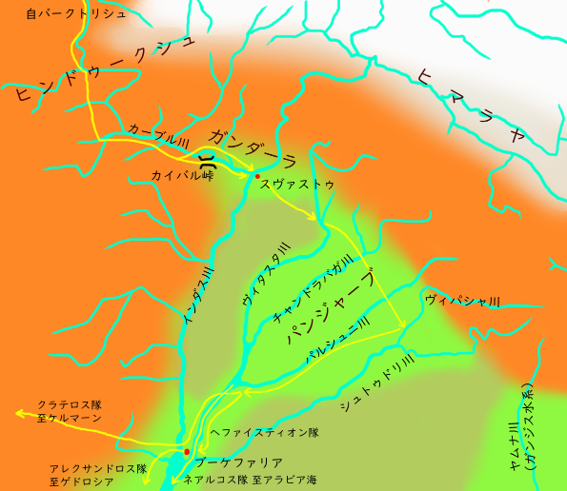
The snowmelt of the Hindu Kush became myriad streams, flowing down the foothills to irrigate the lands of Gandhara before joining the Kabul River. The Kabul itself was but one of the tributaries gathered by the great Indus. The main stream of the Indus sourced its ice from the glaciers of the Himalayas and poured into the Arabian Sea.
Following the Kabul River, we descended the Hindu Kush and reached the gateway to the Punjab plains. This is truly a land abundant with water. It was unlike the turbid, muddy waters of the Nile or Mesopotamia. This water was, to the very last, clear and pure.
The hush of the sal groves; the babbling brooks flowing deeply and purely, brimming with water that gently swayed the waterweeds; the mystical, profound lakes where divine spirits seemed to dwell; and countless white waterfalls cascading from rock ledges. Beyond them, the softly undulating, green-yellow hills stretched boundlessly. It was a place of such breathtaking beauty that one involuntarily clasped one’s breath.
As we pressed further, we arrived at the point where numerous great rivers from the east merged into the Kabul, and the volume and width of the river increased dramatically. The water was turbid, stained a yellow-ochre. Only then did we finally realize: this was not a tributary joining the Kabul; this, indeed, was the main stream of the Indus.
“Unless we cross the Indus and take India, we shall not have recovered all the former territories of Persia.”
Knowing that the King still intended to advance east, the soldiers let out deep sighs.
The entire army joined in the labor of constructing a floating bridge. Boats were aligned and fastened together, and planks were laid across them to form the bridge. On the bank, a vast multitude of laborers busyed themselves—some sawing logs, some assembling boats, others stacking and carrying materials.
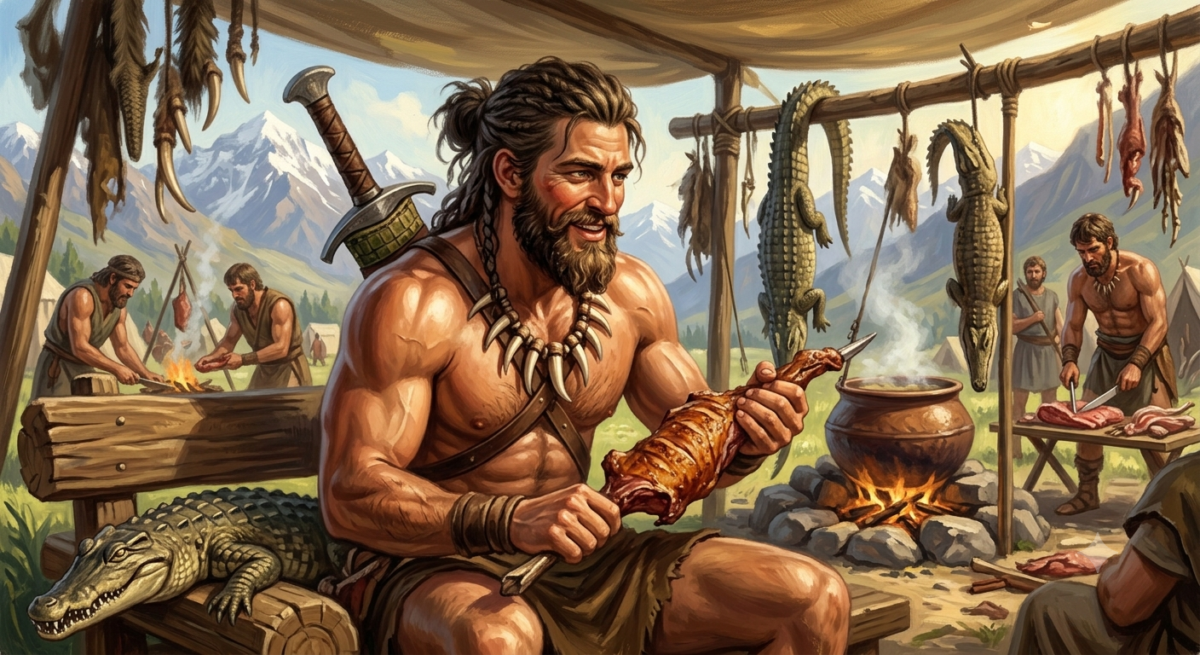
While listlessly observing this spectacle, someone called out, “Hey, Eumenes.” Turning around, I saw a man with bulging muscles, his deeply tanned upper body exposed to the sunlight, a barbarian sword slung diagonally across his back, and a necklace of strung beast fangs. He stood with his arms crossed, glaring this way. This man affected such barbarian attire by choice, but in Macedonia, he was a distinguished nobleman.
“Instead of just watching, why don’t you occupy yourself with some labor for a change?”
“You make it sound as if I’m a lazy sort who dislikes work, Hephaestion.”
“No, I’m just saying you should move your body for once, not just your brain.”
“Even without being told, I was just about to offer my help.”
“Dinner on a day of physical labor tastes good—shockingly so. You sleep well at night, too.”
“I believe you were the site foreman here, were you not?”
“Foreman? Of what?”
“Of the bridge-building.”
“No.”
“No? Then what should I help with?”
“Asking me doesn’t help. I was only commanded by the King to lead the advance party and come this far.”
“You are the commander?”
“No. The commander is the Crown Prince.”
“The Crown Prince? You mean Perdiccas?”
Perdiccas. He, too, was of Macedonian royalty. Should the King fall in battle, Perdiccas would immediately ascend to the Macedonian throne. In other words, Perdiccas was first in the line of succession. Although he had not gone through a formal investiture ceremony, it was not improper to refer to him as the Crown Prince of Macedonia.
Among the dynasties still enduring in Greece, the oldest royal house was, without question, that of Sparta. Sparta had seen over seventy kings. In Sparta, two kings always ruled simultaneously. Apparently, the first king of Sparta was a twin, so they had ruled in pairs ever since. Therefore, as a dynasty, it had continued for about half that number—thirty generations or so. Even allowing ten years per generation, that meant it had lasted three hundred years.
Athens, too, was a kingdom at its inception. Its first king, Cecrops, was said to have had the lower body of a snake, but this, of course, was merely legend. Athens came to detest monarchy, expelled the king, and became a deliberative body of aristocrats claiming descent from the gods. Now, it boasts of having established a peerless civic polity where even the aristocrats have been expelled, and the masses themselves govern the masses. In contrast, Sparta’s monarchy has not changed at all since antiquity. It makes a striking contrast.
The Macedonian royal house, the Argead dynasty, like the Spartan, is one of those lineages that has maintained its bloodline uninterrupted from the remote past when gods and men coexisted on earth. Macedonia is not merely a recently emerged, upstart nation from some remote backwater that has only just appeared on the stage of history.
And if one traces the Argead lineage carefully, one might even say Perdiccas belongs to the main branch more so than the current King. He possesses all that is fit for a monarch: majesty, presence, vigor, and that certain kind of madness often seen in kings. However, he is frequently judged as a man of shallow thought, too impetuous to be king.
On the other hand, although also royalty, Hephaestion is merely a descendant of an old neighboring royal house that was gradually harvested and bound by Macedonia. He is apparently not entirely unrelated to the Argead dynasty, but almost completely unrelated to the Macedonian succession. He is wealthy but has no responsibilities; he is carefree and free, with an untroubled personality. Many of those who have been the King’s friends since childhood are in such positions.
“You lot came through the Khyber Pass, didn’t you? We led a separate force, sweeping through the mountains to clear out the barbarians who had fled there, before coming here. Even though ours was the more arduous detour, we arrived over a month ago. Yet, with no time to take a leisurely rest, we were immediately commanded to undertake this river-crossing work—to have the bridge built before the main body arrived. How hard do they intend to make us work?”
“It cannot be helped. We cannot simply be idle. The King is still eager for what is to come.”
“For what?”
“For the conquest of India, of course.”
“Ah. He is a man who knows neither rest nor surrender.”
“Is India vast?”
“I don’t know. No one has ever investigated how vast it is. Or rather, there must have been plenty who tried to investigate. Indians, Persian merchants—I don’t know who, but a great many, surely. And yet, no one has managed to investigate it fully. I suppose it must be that vast.”
“Does it look like the bridge can be thrown across?”
“No, no. Not yet. Along the way, the barbarians scattered and fled into the mountains, so we didn’t pursue them deeply and came this far smoothly enough, but the Indus is a great river, isn’t it? It requires careful preparation to cross. It is indeed the river that forms the border between Asia and India. Oh, heavens, just when you think you’ve finally finished crossing, that’s not the other bank yet. It’s just a sandbank, and beyond that lies another great flow. And beyond that, and beyond that, there are more sandbanks, and you never seem to reach India. There’s no end to it.”
“Fed up, aren’t you?”
“Before the King’s main body arrived, we had to establish the camp, build the boats, and cross to the other bank to scout for enemies. You need boats first to build the bridge. We’ve been occupied with such things for a month.”
“Then you have my gratitude for your hard work.”
“In the meantime, we’ve been exterminating crocodiles and eating them.”
“Crocodiles?”
“Yeah, there are so many that even with this many people eating them, we can’t eat them all. I guess I’m the crocodile-hunting commander around here. They’re good roasted. Good stewed in a pot, too. Aren’t you hungry? Stay and eat.”
Looking where Hephaestion pointed, I saw several crocodiles hanging from poles, and smoke from a stewing pot was rising from a hearth.
“No. Not right now. Is it good?”
“Yeah. It’s decent. The soldiers are all happily eating it, saying it’s delicious. It’s like chicken. And look at this,” Hephaestion said, jingling his necklace to show it off. “Teeth this big—fifty on the upper jaw, fifty on the lower. About a hundred per crocodile. No matter how many we catch, there’s no end to them. If you want some, I can give you a few.”
“No. I’ll pass.”
“The hide is good, too. You get tough, high-quality leather. This sheath is crocodile skin, too. It’s cool, isn’t it?”
With that, Hephaestion smoothly drew a curved, single-edged barbarian sword from the sheath on his back, gave it a single flourish, and sheathed it again. The sound of the blade rubbing against the leather was terrific, sending a chill down my spine.
“It suits you well.”
“Anyway, the place is crawling with crocodiles; it’s no simple matter to throw a bridge across.”
“I thought crocodiles were only found in Egypt.”
“Yeah, that’s right. There are crocodiles in the Nile, but none in the Ister (Danube), the Euphrates, or the Tigris. And yet, there are crocodiles here in the Indus, too.”
“Are the crocodiles here related to the Nile crocodiles?”
“Who knows. Probably not. Their faces are quite different.”
“How so?”
“The mouth is slender and long. Like the beak of a heron or a snipe.”
“Huh. And how do you catch them?”
“How? When we told the laborers hired locally to do something because the crocodiles attack people and are dangerous, they absolutely won’t catch and eat them because they think the crocodiles are messengers of the gods.”
“And so?”
“Well, but a crocodile is a crocodile. No matter how wide the world is, there is a way to catch a crocodile. In any case, their scales are so hard that neither arrows nor spears work. Blades won’t even dent them. So, one by one, we sneak up on them and, with bare hands, cover their heads with a sack. Then they become docile, and in that moment, we bind their mouths round and round. Once we’ve done that, they aren’t dangerous at all, so we flip them over, split their bellies, and butcher them.”
“If there are crocodiles, does that mean there are hippopotamuses, too?”
“No, there don’t seem to be any hippopotamuses.”
“Are crocodiles dangerous?”
“Well, whether it’s a hippopotamus, a crocodile, or a water buffalo, if you’re daydreaming on the bank like you were, it’s dangerous. Those things are watching us intently from inside the water. They suddenly come bursting out of the water and attack people. You’d best be careful.”
I, too, have been conscripted into the Macedonian army for over seven years, traveling around various parts of the world and experiencing my share of hardships. Yet Hephaestion still mocks me as an ignorant scholar. I have decided not to let it bother me each time.
A number of small boats are floating upstream. It seems they will let them drift down and connect them here to make the bridge.
Those boats to be connected to the bridge are large enough for a single horse to stand and float. A rope is tied to the bow, and another boat tows them one by one. In this way, with the bow being pulled, the boat naturally aligns itself along the current, facing upstream. They align the boats at appropriate intervals, lower conical anchors filled with stones in baskets from the bow, and secure them to the riverbed. Then they lay planks between the adjacent boats and connect them with ropes. This is repeated all the way to the far distant other bank—a repetition of simple work. It seems it would take an infinite amount of time to bridge this great river, but if a great number of people work efficiently, it is completed surprisingly quickly. Armies are good at such human-wave tactics.