“A herd of muskoxen is moving north through the village,” Eric reported. “They’ve entered the commune’s territory.”
“A herd? How many?”
“Roughly a hundred. Winter is approaching, so they’re beginning to congregate.”
The “courtiers” surrounding Eric and Mary began to murmur.
“They’re at their fattest this time of year,” one remarked.
“Yeah. It’s hunting season.”
“Are they far?” Mary asked. To show them, Eric began to sketch a large map on the ground of the square using his staff.
“They are here. Our village is here. If we don’t set out immediately, they’ll be out of our territory within three days.”
“Eric, can I leave this in your hands?”
“Of course.”
“Please, ensure there are no casualties.”
Eric gave a small smile and gave her his word.
He set out on a massive drive-hunt, gathering all the young men from the nearby villages, accompanied by horses and hounds. Mary went with them. The village was buzzing, feeling less like a hunt and more like a military deployment.
“You’re not coming, Hiroshi?”
“No. I’ll pass.”
“Muskox is delicious, you know.”
“Is it? Are we allowed to hunt them?”
“In small numbers, yes. Their conservation status is ‘Least Concern’; they aren’t endangered. They were once widely distributed across the Arctic, but they went extinct in Eurasia during the common era due to overhunting. The ones here were imported from Greenland, but hunting them in moderation is permitted.”
“A long journey for them.”
“Not necessarily. But the rule is that we hunt and eat the prey on the spot. Everyone loves it too much to let it go to waste. We don’t bring the meat back to the village.”
“Too bad, then,” I said, seeing them off and deciding to stay behind in the village as usual.
A drive-hunt for muskoxen. Part of me wanted to see it for future reference. Part of me wanted to taste the meat. But I would only be a burden to them, and more importantly, the mood would be killed if the “Queen’s” consort tagged along.
Autumn was deepening. During the day, everyone headed out to hunt. The village square grew desolate, and even the boisterous campfires of the night were beginning to fade.
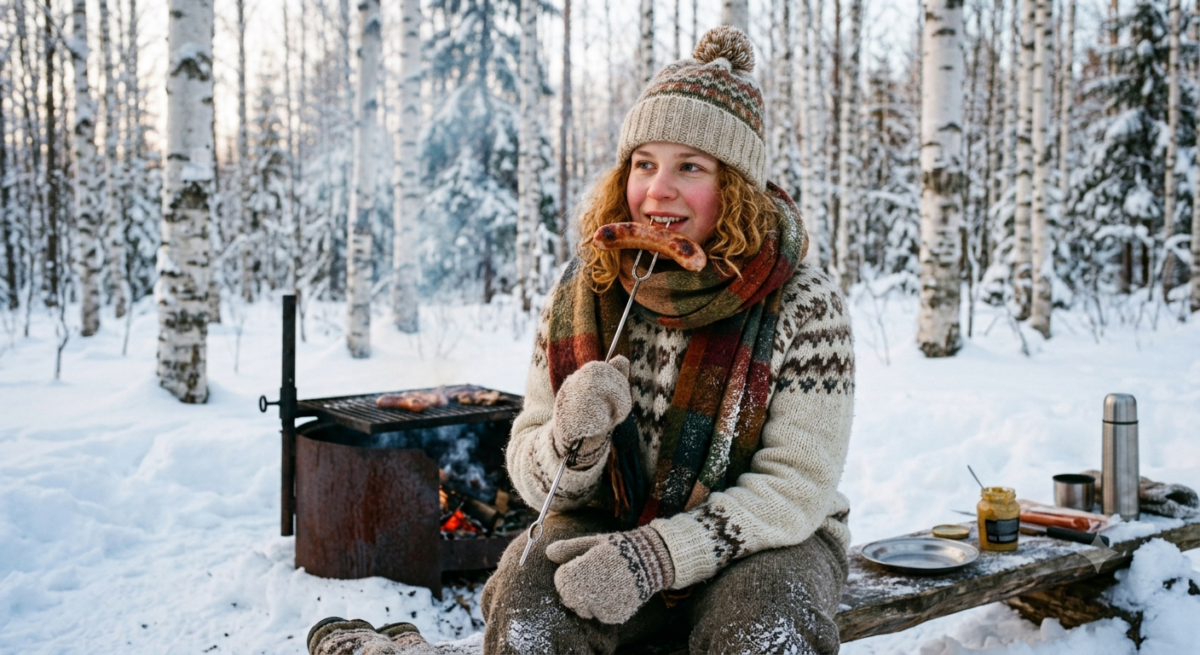
For me, the silence was perfect. I spent my time skewering small fish that I’d kept alive in a basket in the stream, plucking the feathers from sparrows and quails and roasting them over the fire while drinking. As I sat there, a woman who had been lounging on a nearby bench—bundled up in a woolen muffler, a woolen hat, and a woolen sweater—stirred and approached me.
“Looks delicious. Can I have some?”
“Go ahead.”
I felt a flicker of caution. Not because of the woman herself, but because if I were seen chatting or drinking with a woman, there would inevitably be someone who would take offense, accusing me of flirting again.
“Yakitori?”
She looked like a little bear bundled in wool. I thought her voice and appearance sounded familiar, and then it hit me.
It was Natasha.
“Natasha. It’s you.”
She looked equally surprised.
“You’ve changed quite a bit, Hiroshi.”
“Have I?”
“You don’t look like a settler. You look completely like a native who’s lived in this fjord for generations.”
“Really? Like an Inuit or an Eskimo?”
“Something like that.”
“I’m flattered.”
“What a coincidence,” she said, with a small sniff—a nostalgic habit of hers.
“Yeah. I’m shocked. Why on earth are you here?”
“I’m on assignment.”
“Assignment?”
“Reporting on the Geo-commune.”
“Right. I remember you saying you wanted to be a journalist.”
“Yeah. Well, as of now, I’m more of a ‘failed journalist,’ unfortunately.”
“Failed?”
“I’m a freelance writer who can barely make a living. I have an editor I know who told me if I had nothing better to do, I could do this. He wanted me to go undercover in the Geo-commune and write a report on what it’s really like. He said he’d cover my expenses and stay.”
“I see.”
“For now, I’m reporting on the local ingredients used in the bar’s dishes and the homemade liquor.”
“A food review, then. How’s the liquor here?”
“Far from a passing grade. I feel like I’d have a terrible hangover. They probably think they’re scenting it with heath peat, but it just smells like a rotten sewer. But it would be cruel to write that plainly, so I’m writing something like: ‘A unique flavor and intoxication. The attempt to pursue a taste characteristic of the subarctic is noteworthy. One looks forward to future developments.’”
“That’s brutal. You’re not praising it at all.”
“There’s nothing to praise, but I don’t want to write it maliciously. That’s the hardship of being a writer. I’m just writing it in a way that those who understand irony will get it, and those who don’t won’t.”
“The rhetoric required of a professional.”
“Exactly. This one is actually easy. I’ve been told I can write the good and the bad as they are, and there are almost no requests for revisions. This means the money isn’t coming from the Geo-commune, but rather from people critical of it, or neutral parties who are simply curious.”
“I see.”
“I’ve had much worse. I was once forced to write a movie review.”
“You? A movie review?”
“Yes, I was.”
“Why?”
“Who knows. Maybe the deadline was too tight, or no one else wanted the job. Then my editor would call me and scream, ‘Why are you only writing the bad parts? Praise it more! I know it’s not good, but if you look hard enough, there must be a few good things. Stretch those parts out as much as possible. That’s the job of a professional writer.’ The editor knew it was a piece of trash, yet he dumped it on me. But no matter how hard I searched, I could only find a grain of truth to work with. I almost refused, but in the end, I wrote it while crying.”
It seemed that for Natasha, the phrase “faith as small as a mustard seed” didn’t apply to her writing material.
“What technique did you use?”
“For example, I’d write, ‘The goals the filmmakers aimed for were likely far more ambitious than what was achieved,’ or ‘In a work produced under such overwhelming expectations, it is perhaps inevitable that some of the grand ambition remained unfulfilled.’ That’s how I did it.”
“I see,” I said with a wry smile.
“In other words, what I actually wanted to say was: this movie was based on a source material that was too good, and an author who was too great. The capitalists and producers gathered around, made it according to their own convenience, and the resulting film was basically garbage.”
“That’s just how most movies are, isn’t it?”
“Whether it’s a novel, an academic book, or a movie, I want to read and see great things and write reviews that praise them. But usually, I’m assigned to write fake reviews for projects that were doomed from the start.”
“Puff pieces.”
“Yes, exactly. I’m forced to write fake news. The hardest part of being a journalist is that the fastest way to make money is by writing tethered fake news. Cases where you can write what you want and get paid are non-existent. You can only do that on a blog for free.”
“You get travel expenses from the publisher, and they specify the location and the sources. Even when you know there are no raw resources there, you still go. They even change the title. That’s business. But they also demand major rewrites of the text. However, because it’s a signed article, I can’t write outright lies. There is a final line that a freelancer who relies on their own name cannot cross. If I didn’t have to sign my name, I might have just written whatever they wanted.”
“Do you always sign your articles?”
“Yes.”
“You never write anonymously?”
“Well, sometimes. For small pamphlet introductions, there’s no need to put my name on it. The agency’s name goes on the front, and I just take the fee. But I refuse to be a ghostwriter for someone else.”
“I see.”
“If I ever get to the point where I can’t afford to eat, maybe. But anonymous writers are just puppets for directors; they’re forced to write things they hate, and their fees are slashed. It only tightens the noose around your own neck.”
“And how is your Geo-commune article doing?”
“Reader response? Non-existent. Readers are the most unreliable thing in the world. But some colleagues encourage me.
‘Keep it up. The fee we can give you is meager, but keep going,’ they say. For now, I’m content as long as I can eat three meals a day and my name is in print.”
“What else do you write about?”
“Stories about cosplay old men and old women.”
“Like Mary and Eric?”
We both laughed.
“I’m also taking photos to accompany the articles. The fjords. The birch forests. Wild animals. Lately, the photos have been more popular, so I’m thinking of changing my title to a photographer. A nature photographer.”
“Photos? Are you allowed to take photos here?”
Natasha chuckled.
“Isn’t it funny? According to the rules here, silver halide photography—the kind that doesn’t use electricity—is permitted.”
“Silver halide? What about the darkroom?”
“There isn’t one. I develop them in my tent in the middle of the night. In black and white.”
“Are chemicals allowed?”
“The waste fluids are entrusted to a contractor and processed outside the commune.”
“Hmm.”
“Photos of the Geo-commune are rare. And because they are old-fashioned black-and-white silver halide photos developed by an amateur, people find them ‘atmospheric’ and interesting.”
“It’s strange how such a thing becomes popular. How do you write the articles?”
“With this typewriter.”
Natasha opened her bag and pulled out a manual typewriter—the kind with alphabet type-bars and a bell that dings when you reach the end of a line.
“Hardly anyone uses those these days.”
“First, I write a diary in a notebook with a fountain pen every day. I pull stories from there, type them onto paper, and from there, the news agency handles the rest. I know money can’t be used in the commune, so I send them C.O.D. They probably use OCR to transcribe the text and check the spelling. Anything I need is sent to me prepaid.”
Natasha opened her notebook and showed it to me. It was filled with handwriting in various colors of ink. I remembered then that Natasha loved cheap, transparent fountain pens that showed the ink inside; she used to keep a pen case stuffed with pens of every different color.
“That sounds incredibly tedious.”
“Yes. But for me, it’s like experiencing the reporting methods of a 20th-century journalist. I enjoy it in its own way.”
Natasha bit into a roasted sparrow, head-first.
“This little bird is delicious. How do you catch them?”
“I set traps with bait. These things will eat anything. Crickets, earthworms, larvae. Even human leftovers. They’re small and timid, so they’re easy to catch.”
“Do you make the traps yourself?”
“Of course. I have plenty of time. I also make traps for fish—tube traps. There are plenty of wild birds and fish.
Nature is abundant, and in the summer, I have no trouble feeding myself. But when winter comes, I’d probably starve. The problem is winter.”
“I see.”
“Aren’t you afraid?”
“Of what?”
“Eating birds that were roasted while still in their living shape.”
“Not really.”
I wondered if I’d already told her about Ray being confiscated at immigration. In fact, all electronic devices are forbidden here. I can’t use Zoom, let alone send an email. I haven’t been in touch with Michael for a long time. I’d heard it was strict, but I didn’t realize the rules were this suffocating.
“I’ll take a photo of you too,” Natasha said, and she snapped a picture of me looking like an Eskimo, biting into a roasted sparrow.
“Stop it. Don’t put it in an article.”
“Hehe. That slightly bashful expression of yours is lovely.”
“And don’t go spreading rumors about our old relationship.”
“What? You’re the one who shouldn’t spread them. By the way, is your wife doing well?”
“Did I tell you I got married?”
“No. I saw the news that the chairwoman of this place got married, and I found out her husband was you.”
“I see.”
As I suspected. Natasha hadn’t just happened to come here for a report and run into me by chance. She knew I was here, and she had likely taken the job expecting to reunite with me.
“What kind of work are you doing now?”
“I was ordered by my company to be a software engineer without using a computer.”
“That sounds absurd.”
“It is. I’m officially on secondment from my former company to the Mary Foundation. I still have a seat at my old company, though I don’t know if I can actually go back. My salary comes from the Foundation, and my tasks are given by the Foundation, but the task is extremely vague: ‘Support Mary.’”
“And?”
“I asked Mary, ‘What exactly should I do here in the Geo-commune?’ She asked me, ‘What is your specialty?’ I told her I’d majored in computer science throughout graduate school. Then she said, ‘Then please figure out a way for humanity to survive without using computers.’ When I asked why I should do that, she said, ‘Because it’s a job that can only be done by someone who knows computers. You know about humans and computers. So, show me.’”
“That actually sounds like an interesting task. Any results?”
“None at all. It’s like a Zen riddle. It’s like being told to walk without using your legs or eat without using your hands.”
“But as I’ve shown, you can take photos without using electricity.”
“Don’t lump photography and computers together.”
“Do you want to try using electricity?”
“What?”
Natasha poured some muddy-smelling distilled liquor into my glass, emptying the bottle.
“Can I trust you?”
“…Can I trust you?”
We looked intensely into each other’s eyes.
“Actually, there’s a reason I really want to use electricity.”
“Oh, really?”
“But if electromagnetic waves are detected, I’ll be caught.”
“Correct. Even the weakest signal is detected immediately.”
“But if I shield it so no waves leak, they won’t know.”
“True.”
“The problem is how to build such a facility inside the Geo-commune.”
“You’ve got it figured out, haven’t you?”
“I want to talk to Charlie.”
“Who’s Charlie?”
“Look at these glasses of mine.”
I handed her my thick, black-rimmed glasses. She stared intently at the minute patterns on the frames.
“These look like solar panel patterns.”
“Yeah.”
“So this is an electronic device. This is Charlie?”
“That’s the one.”
“Can you talk to him?”
“Of course.”
Charlie, now in the form of glasses, spoke to me via bone conduction. His voice, vibrating through my skull, was the same old artificial voice, like C-3PO. But he had remained silent since we arrived. He knew exactly why Ray had been arrested.
He must have been keeping his power consumption to a minimum and suppressing all electromagnetic emissions.
“Tell me, are you actually spying on the secrets of the Mary Foundation?”
“Who knows. Perhaps.”
“You actually approached me as someone’s agent, didn’t you?”
“Hehe. I’ll leave that to your imagination.”
I agreed to go to Natasha’s hideout.
“Do you remember this?” Natasha pulled a transparent bottle with a clear liquid from her bag.
“Of course I do.”
“I’ve always wanted to try drinking this in a real fjord.”
“Me too.”
It was that nostalgic “Viking Fjord” vodka we had drunk back in the park on the East Coast. We decided to drink heavily until morning, just like old times.
If you try to bring a computer into the Geo-commune, you’ll be caught by metal detectors or X-rays. Charlie only survived because he was so small. If there were a computer made entirely of organic matter—like a human brain—it might pass.
Perhaps such computers exist in the world, but I doubt I could get my hands on one.
“Why are they so obsessed with hating electronic devices?” I asked Natasha. “For example, your SLR camera with a mechanical shutter. It’s outdated, but it’s still a piece of precision machinery. It couldn’t have been made without electronic equipment.”
“Devices that are electronic-free but were manufactured using electronics are safe.”
“Why draw the line there?”
“To prevent the degeneration of the human species.”
“Prevent degeneration?”
“Yes.”
“Why? Isn’t humanity evolving?”
“Human civilization is advancing. Culture is becoming richer. But conversely, the human species itself is degenerating.
Many have believed this for a long time. Because of agriculture, civil engineering, and medicine, the selective pressure has decreased; genes only degenerate or deteriorate, they don’t evolve. On the other hand, evolution occurs discontinuously.”
“Wait. I thought children born to genetically distant parents were more intelligent and physically stronger, while genetically closed societies saw a decrease in brain and body size.”
“That’s a fact. Hybrid vigor often produces superior individuals from distant genetic pools. But that’s only for one generation. Over many generations of interbreeding, the two genetic pools merge, and genetic diversity is lost.”
“Speciation occurs discontinuously in a specific, small genetic group, in a genetic bottleneck isolated from others. It doesn’t happen continuously through the mating of genetic pools.”
“But speciation doesn’t always produce a superior species. Bottleneck effects and resulting speciation likely happen frequently, but in most cases, the result is inferior and thus selected against. And since speciation is thought to occur
on a scale of tens or hundreds of thousands of years, it’s meaningless for us to try and affect it over a span of ten or a hundred years. The Mary Foundation knows this.”
“What about genetic modification? Isn’t that a technology for creating new species?”
“Hiroshi, do you really not know the difference between speciation and genetic modification?”
“I don’t, that’s why I’m asking,” I said, slightly miffed. But Natasha had clearly studied a lot for this assignment, and I only had superficial knowledge. I had to concede.
“I’ll explain. First, modifying genes within the same species doesn’t create a new species, does it?”
“No.”
“Then, does transplanting genes ‘across species’ create a new species? Is the difference in genes the same as the difference in species?”
“Maybe not.”
“Exactly. A species doesn’t live alone; it coexists with countless other species, like bacteria. Roughly speaking, genetic modification is an extension of symbiosis with bacteria. Humans have used pesticides for over fifty years. For
example, herbicides to kill weeds. But if the herbicide kills the crop too, that’s a problem. So crops were bred to be resistant.”
“Right. And?”
“It was discovered that certain bacteria are resistant to herbicides. By fusing the resistance DNA of those bacteria into the DNA of a crop—usually at the zygote stage—the crop becomes resistant. This is the typical genetic modification
technology. There are others for pest resistance, stress resistance, or increasing useful components like oils by introducing mold DNA into soybeans.”
“And for humans?”
“In the past, insulin extracted from cow or pig pancreases was used to treat diabetes. But human and cow insulin differ by three amino acids, and pig insulin differs by one. Some people developed allergic reactions because their immune system created antibodies against pig insulin. Also, it took seventy pigs to treat one human. So, by introducing human DNA into yeast or E. coli, we can now produce human insulin cheaply and in mass quantities.”
“So?”
“Genetic modification alters part of the DNA, so it creates a subspecies. Unlike mutation, it doesn’t rely on chance; it imports existing DNA.”
“Not all genes express their traits. Also, mutations happen frequently within one species. That’s why we see very different traits within the same species or between closely related species.”
“Even so, current DNA manipulation isn’t meant to cause speciation. It’s a partial replacement within the framework of one species. Currently, it’s used for things like making one species’ cells produce a specific amino acid or protein typical of another species. It’s not that grand. And subspecies created through genetic modification will interbreed with other subspecies of the same species and lose their diversity over several generations.”
“What about ‘chimeras’? I’ve seen a mouse with a human ear on its back,” I asked.
“The ear-mouse,” Natasha sneered. “As long as normal immune function exists, you can’t create a chimera by grafting or transplanting different species. But with conspecific transplants—like blood transfusions or organ transplants—it’s been practical for a long time using immunosuppressants. You could call those chimeras, but they don’t cross the species barrier, nor do they create a new species.”
“I guess so.” Reactions to mismatched blood types or organ rejection, and allergies to pollen or metals, are all actions of the immune system. But without immunity, one is susceptible to viruses and cancer. It’s like having AIDS. Immunity is a normal function provided by the organism. “So human-to-human transplants can’t create a new species. But is a chimera with another species not a new species?”
“Xenotransplantation never creates a new species,” Natasha asserted. “It has been partially put into practice because there is technology to create individuals without immunity. T-cells, produced in the thymus, distinguish self from non-self and attack non-self tissues—viruses, infected cells, or mutated cancer cells. Organ rejection is caused by these T-cells.”
“T stands for Thymus. There are mutant mice that lack a thymus, or mice where the thymus-generating gene has been ‘knocked out’ using genetic modification—so-called immunodeficient mice. Because they lack T-cells, they don’t attack foreign objects transplanted into their bodies. But because their immunity is broken, they can only survive in a sterile laboratory environment.”
“It’s possible to embed human cells in such mice and grow them. You can even shape ear cartilage cells into an ear. Dr. Vacanti created the first one, so they’re called Vacanti mice.”
“Anyway, even if new technology were developed to solve the immune problem and allow for cross-species chimeras, it would simply be a case of different species’ tissues living within a single individual. It doesn’t cross the ‘species barrier.’
It doesn’t merge species or create a ‘new species.’ If a cyborg is a fusion of biological and mechanical, a chimera is just a fusion of biological and biological. A chimera is, in the end, just a chimera.”
“Natasha, I’m starting to get confused. In the end, what is the Mary Foundation trying to do?”
“You’re quite confused. Let me organize this for you. The opposite of evolution is not necessarily degeneration, and vice versa. Degeneration is a slow, albeit ‘rapid’ from the perspective of a species’ lifespan, ‘negative adaptation’ that can occur over thousands of years. Fish trapped in a dark cave lose their sight over several generations; their eyes degenerate.”
“Pigs were once hairy, but after generations of being kept by humans, their hair thinned and disappeared. The genetic factor for hair growth stopped expressing itself. This is a phenomenon observable even in the short history of humans.
And if pigs go wild, the hair grows back. Atavism. The opposite of degeneration is this atavism. In either case, speciation or evolution is not occurring.”
“Even fancy carp return to being ordinary carp if they interbreed in nature. Goldfish become crucian carp. Wheat and rye merge into one in a natural state. Oats return to wild oats. Rice is the same. Asian and African rice were developed from their respective wild species before human history, but they can produce hybrids—the ‘Nereda’ variety. Since Asian rice can hybridize even with the African species, all Asian rice is compatible. You can change how genetic factors express themselves through generations of selective breeding, but once human intervention stops, they return to their original state. That’s the limit of human power. It is clearly different from speciation. Although, the fact that people confuse ‘species’ and ‘subspecies’ is also a problem.”
“The differentiation of a subspecies is indistinguishable from a congenital abnormality or a malignant tumor. It can be considered an ‘irreversible pathology’ that occurs terrifyingly frequently across all species on Earth, even this moment.”
“A subspecies can arise from a single mutation. That is, a descendant of a single individual—a ‘founder’—who acquired a superior gene through mutation becomes a new subspecies. The method of creating such subspecies, like homing pigeons, Thoroughbreds, or goldfish—’artificial selection’—is just an efficient way of doing this. But subspecies interbreed easily and lose their characteristics; left alone for several generations, they return to the original species.”
“Speciation—what Darwin called ‘natural selection’—occurs between subspecies, or rather, between genetic pools composed of specific individuals. There is no single ‘founder’ individual. There might be a ‘founder genetic pool.’”
“The question of ‘the chicken or the egg’ is nonsense. Because the chicken is at the end of a chain of life starting from single-celled organisms. Before the chicken, the speciation toward the chicken was a process involving genetic pools of hundreds or thousands of individuals over tens or hundreds of thousands of years. You cannot say which egg or which individual evolved into a chicken.”
“When a species is divided into several subspecies due to reproductive isolation—for example, geographic reasons— mutations accumulate in each. After tens or hundreds of thousands of years, interbreeding becomes impossible. Hybrids are either not produced, or they are sterile. At the moment interbreeding becomes impossible, two new species are born. In this way, ‘natural selection’ or speciation takes far longer than ‘artificial selection’ and is not observable within human history.”
“If one of those two new species is better adapted to the environment, it will eliminate the other and propagate its own descendants. That is what is called evolution. Conversely, if the environment doesn’t change and there is no competition between species, the ‘species lifespan’ can continue for hundreds of millions of years, like ‘living fossils.’”
“That’s the theory of Neodarwinism,” I said.
“In my interpretation, yes. What Darwin observed in the Galapagos were these phenomena of natural selection. In an environment isolated for millions of years, species suddenly—though on a scale of tens of thousands of years—diverge and are preserved. These accumulate to create an ecosystem that is very similar to, but slightly different from, the continent.”
“We think speciation is easy because we see the dramatic effects of selective breeding in livestock and crops. We think we can artificially create human races. We think mutants are born from radiation or drug accidents. We think chimeras or stem cells can be created if we just control the immune system.”
“But speciation and natural selection are far more slow, gradual, and time-consuming. Modern humans have inherited and perpetuated the misunderstanding of what Darwin noticed but couldn’t fully comprehend.”
“After all, humans prefer sensationalism over science. Mass media and the education industry constantly reproduce these misunderstandings. Even now, people believe that a new humanity will be born because one single child, a savior, is born.”
“Because natural selection is slow and gradual, the boundary between subspecies and species is blurred. For example, it’s said that Neanderthals and modern humans diverged 500,000 years ago, but it’s also said that modern humans leaving Africa 60,000 years ago interbred with Neanderthals who had already reached Eurasia. If it was 500,000 years ago, it’s possible they hadn’t completely separated into species. Researchers and historians can’t wait 500,000 years for speciation to occur. Complete species separation probably takes over a million years. Until then, there’s a period where artificial
insemination might be possible, or a period where hybrids are born but sterile.”
“Trying to produce intelligent children by marrying intelligent people—that eugenic, stud-farm approach, similar to Nazi racial segregation—might produce individuals with superior genes, but it is neither speciation nor evolution. It’s just artificial selection. It doesn’t actively create a superior subspecies, nor does it improve the race by crossing superior individuals. It’s more like promoting atavism.”
“I think I get it. The Mary Foundation isn’t trying to evolve humanity. They’re trying to prevent degeneration and promote atavism.”
“Perhaps. Humanity has clearly degenerated compared to ten thousand years ago. It’s evident from skeletal structure and brain volume. From the moment humans appeared through speciation, they have been slowly degenerating, like being strangled by a piece of cotton. To achieve further evolution, one must wait for the next speciation.”
“So, artificial intelligence that replaces the functions of the human brain is particularly harmful because it accelerates that degeneration.”
“Computers and AI make human abilities seem higher temporarily, but they conversely cause the human brain to degenerate.”
“So, to isolate the human brain from civilization, science and technology should actually be used actively. Is that it?”
“I’m not sure I’m entirely in agreement with you,” I said. “But a friend of mine once told me that the only way to truly love a woman is to treat her as if she were a mysterious creature from another planet. I think I’ve been doing that with Mary.”
“You’re a romantic, Hiroshi,” Natasha smiled.
“Maybe. But I’m also a scientist who’s terrified of a world where humans can’t even tell the difference between a person and a program.”
We sat in silence for a while, the fire crackling and the smell of smoked fish and high-end bourbon filling the air. In the distance, the hoot of an owl echoed through the mist, a reminder that in this strange, primitive corner of the world,
the only thing that mattered was survival, and the silent, slow ticking of a biological clock that had been running for millions of years.
this is an experimental translation using AI (gemma4:31b). You can read the full story in Japanese at KDP.