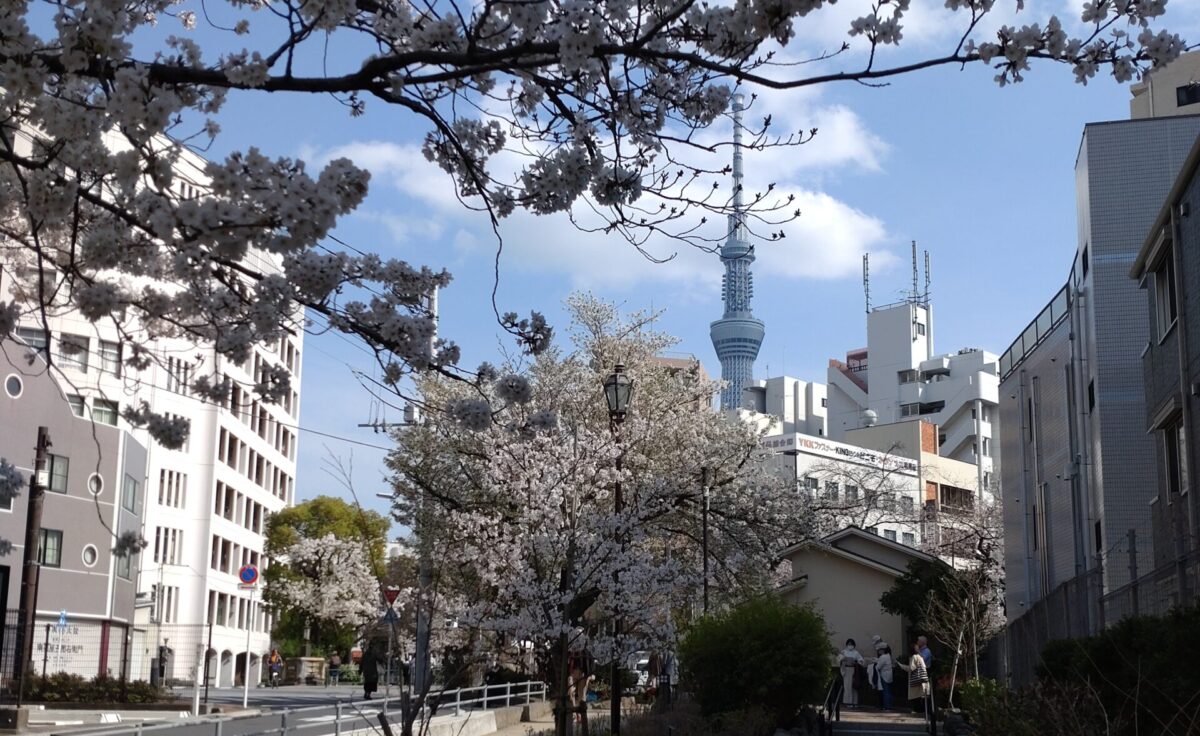
While Bokuto Kitan (A Strange Tale from East of the River) is often thought to be exclusively about Tamanoi in Mukojima, the story actually opens in Asakusa. The “movie theaters” mentioned at the beginning likely refer to Asakusa Rokku (the Sixth District). After thoroughly examining the signs of every single building, the narrator walks from the edge of the Asakusa Park out into Senzoku-machi. He then notes that the right leads to Kototoi Bridge and the left to Iriya-machi. This description clearly points to the intersection of Kototoi-dori, right where the exit of Hisago-dori connects to Senzoku-dori today.
At this spot, a tout approaches him. When the narrator says he is heading to Yoshiwara and sets off, he must have taken Senzoku-dori. The “secondhand bookstore at the foot of the embankment” probably refers to the area around the Jikata-bashi intersection, where Senzoku-dori hits Dote-dori (Nihon-tsutsumi). In fact, even today, the Sanyabori canal becomes a covered culvert starting from this exact vicinity.
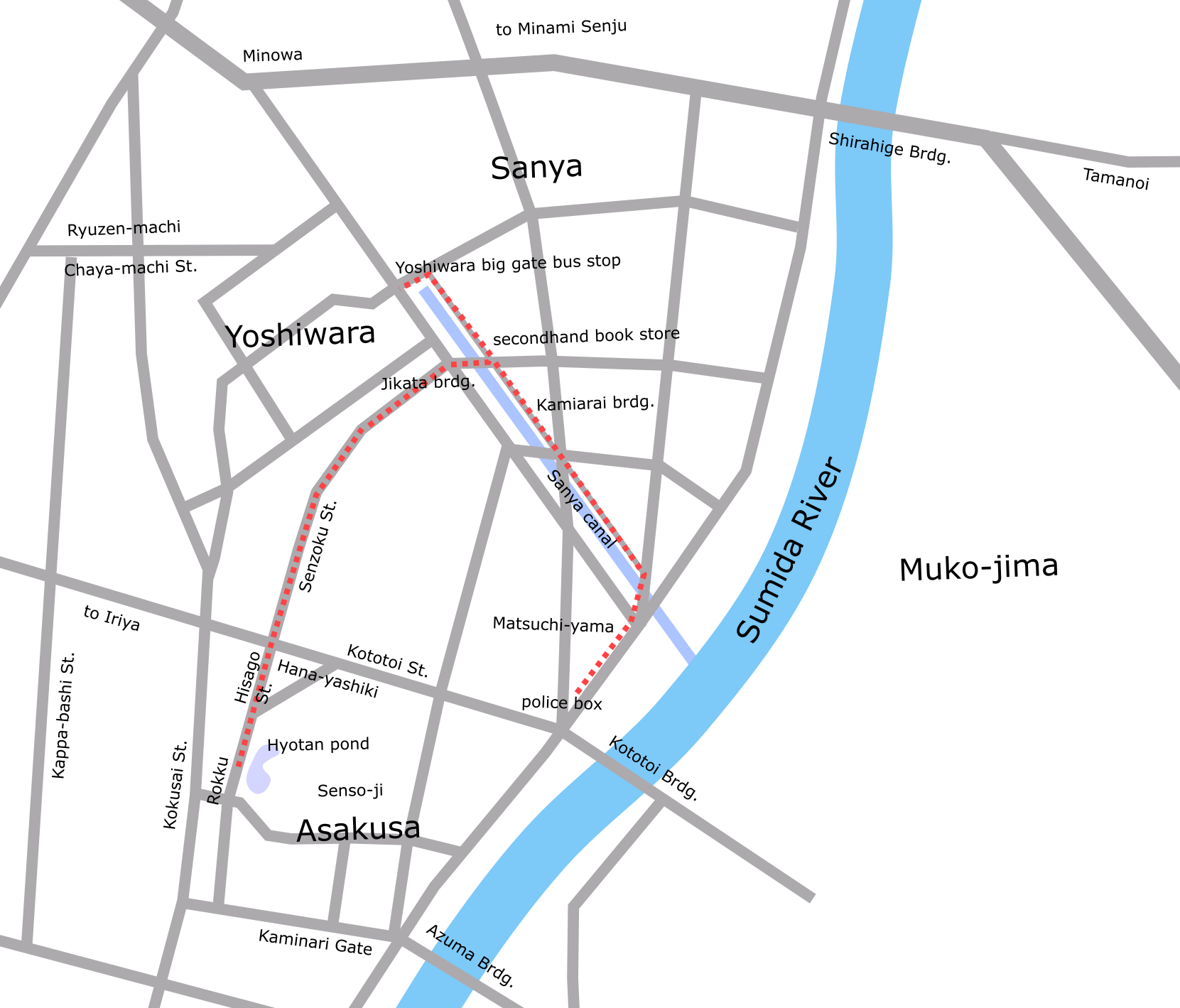
Kafu lists the bridges as Shohoji-bashi, Sanya-bashi, Jikata-bashi, and Kamiarai-bashi. However, the geographical order of Kamiarai-bashi and Jikata-bashi is actually reversed. Furthermore, “Kamiarai” (髪洗, hair-washing) was originally “Kamiarai” (紙洗, paper-washing), meaning a bridge named after the practice of rinsing plant fibers in the river water to craft sheets of Japanese paper. There should also have been another bridge, Jikata-shinbashi (Jikata new bridge), between Kamiarai-bashi and Jikata-bashi. The term “Jikata”(地方; rural/outlying areas) was likely used in contrast to “Machikata” (町方; urban/town areas), so Jikata probably means that the location was outside the bustling center of Asakusa.
In any case, Kafu buys some secondhand books and a woman’s long undergarment (nagajuban) at the bookstore. He then heads further upstream and stands at the bus stop in front of the Yoshiwara Omon (Big Gate). Annoyed by the persistent taxi drivers offering flat-rate rides (entaku), he slips back into the alley he came from—the narrow path running parallel to Dote-dori—and begins walking toward the Sumida River.
As he approaches the river, the lights of Kototoi Bridge come into view. Finding the riverside park sketchy and unsafe, he decides not to go all the way to the riverbank, sitting down instead near an area where chains are strung across. This was most likely near Matsuchi-yama.
While he is opening his wrapping cloth (furoshiki) to organize his belongings, a police officer approaches and takes him to the local police box. Regarding this police box, the text describes: “In front of the police box, the road forks diagonally into two lanes, one running toward Minami-Senju and the other toward Shirahige Bridge, intersecting with the main avenue behind Asakusa Park that crosses Kototoi Bridge.” This is unmistakably the Shoden-cho Police Box, which still stands today. The officer finds the woman’s undergarment suspicious, but releases Kafu after finding his family register transcript and official seal certificate in his wallet, which proves his identity.
With this, Chapter 1 ends. From Chapter 2, the story shifts entirely to his visits to Tamanoi to gather material for his novel. It is not entirely clear why Chapter 1 exists at all, but diving straight into Mukojima or Tamanoi might have left the average reader bewildered. Therefore, Kafu likely used the tales of “Bokusei”—the area west of the river, covering Asakusa, Yoshiwara, and Sanya—as an introductory prologue before describing “Bokuto” (east of the river) tales.