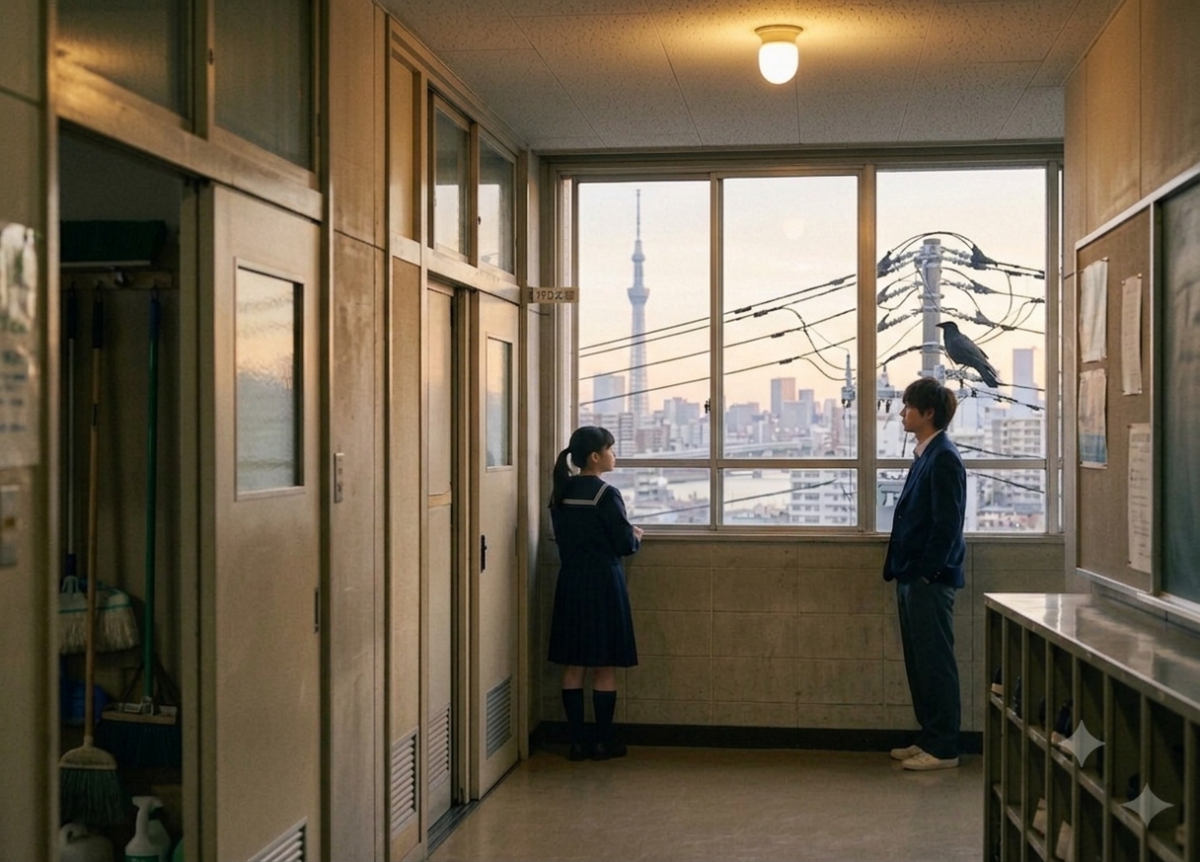
I had suspected for some time that the high school Kanako intended to attend was Kuramae General Science High School. I didn’t hear it from her directly. But by eavesdropping on her conversations with guidance counselors and friends, it became clear that she was indeed planning to go to Kuramae.
Actually, it was easy to imagine her choosing that school. Kuramae General Science is a hardcore STEM school, second to none in its field. Because of its location and curriculum, it’s remarkably popular with a certain subset of girls—especially those in the cosplay scene who love Akihabara.
For boys, it goes without saying: Kuramaes is a mecca for otaku. It’s a ten-minute walk to Akihabara, and if you’re on a bike, you can get there in five. It’s an extreme proximity. Although the number of electronics and parts shops has dwindled over the years, Akiba still stands proud as Japan’s world-renowned electric town. Whether you need a specific tool or a niche component for a class project or club activity, you can buy it in an instant. What a dream environment.
“Why the hell are you here, Takuya? Gross.”
On the day of the entrance ceremony, she looked at me with an expression that said she had figured everything out.
“I didn’t exactly take the entrance exam just to follow you, Kanako. I applied because I liked the school. That’s all.”
I played dumb with exaggerated innocence.
“So gross. En-gacho! I’m cutting ties with you!”
She said this while avoiding me and pretending to be disgusted, but that was only at first. After that, she didn’t particularly hate me. She didn’t go out of her way to ignore me, either. When she was in a good mood, she’d even initiate conversations.
Just as I thought.
I was a bit nervous, but I had predicted this outcome. Deep down, Kanako was happy that I had come to the same school. If she had truly loathed me—if she had made a scene and complained to our parents, teachers, or friends—I would have been in serious trouble. I might have been expelled or forced to transfer. At the very least, she would never have spoken to me again.
But she didn’t. She didn’t hate me.
Kanako has her own social circle. If I try to force my way into it, she pushes back, and her entourage—her “praetorian guard,” if you will—steps in, leading to inevitable conflict.
At first, I thought it was because she hated me that much and had incited them. I was devastated. I couldn’t believe she loathed me to that extent. I wondered why I hadn’t noticed it sooner, and what a fool I had been.
But that wasn’t the case. Kanako was simply concerned about her public image. If she and I were to clash, the self-proclaimed boyfriends in her orbit would go berserk and attack me. That would be a major nuisance.
But eventually, those troubles would vanish as if they had never happened. The self-proclaimed boyfriends would disappear, and in the end, only Kanako and I would be left.
I gradually learned how to handle this, and Kanako probably got used to dealing with me too. On the surface, we are total strangers. As long as we maintain that facade, Kanako treats me naturally. I have no choice; for now, I have to settle for this kind of relationship. Maybe she doesn’t love me, but she doesn’t hate me either. Or maybe she’s just shy and actually loves me deeply. Maybe even Kanako herself doesn’t know, or has never thought about it. At the very least, she doesn’t seem to have any other “kept men” besides me. Perhaps something will progress in the future. Perhaps the time will come when I uncover Kanako’s secret. Until then, I must exercise restraint and continue to be Kanako’s kept man.
Kanako is incredibly capricious. There are days when she absolutely loves a present I bought her, becoming so overjoyed that I think she’s fallen for me all over again. But then, more often than not, she’s completely cold the next time I see her. I wonder if she’s unable to regulate her emotions. Or perhaps she is always suppressing some feeling, and it occasionally boils over.
Maybe she really is harboring a terrible secret. Maybe she doesn’t want to drag me into it, doesn’t want to burden me, but loves me anyway and is agonized by her situation.
Then again, maybe I’m just imagining things.
“Did you already decide which club to join, Kanako?”
“Don’t follow me into a club.”
“So, which one?”
“The Computer and Electronics Club.”
“Huh.”
The Computer and Electronics Club. A den of computer geeks. I guess Kanako and I really are on the same wavelength after all. And just like that, it was decided: I was joining the club.
Anyone who chooses to enroll in a school like Kuramae General Science High School has, to some extent, the motivation and the qualifications to join the Computer and Electronics Club. The real issue is the chemistry between the student and the lab.
“Lab.” Exactly. Plenty of other clubs call themselves “labs” or “research centers,” but in reality, they’re just social circles. The Computer and Electronics Club is different. You could say it’s a traditional, old-school research lab with a real backbone.
Of course, there are plenty of more casual clubs. Many members join and quit almost immediately, or they become “ghost members” who never show up. I was one of them. I wanted to play around with Blender and Unity—the trendy stuff. I thought that by coming to Kuramae and joining the club, I’d find plenty of kindred spirits who loved Blender and Unity. But I found absolutely none. Not a single soul.
There are clubs specifically for that, of course. The CG Lab, to be precise. The CG Lab is fantastic. Gaming PCs with LED lights that flash in a rainbow of colors, gaming keyboards, gaming speakers—all blinking and glowing. Gaming mice, headsets… they are packed into the clubroom in a blissful, shimmering array. It is a sanctuary. A paradise. I wanted to be in there. But since I’m following Kanako, joining the Computer and Electronics Club is a must. I tried to ask if I could be a member of both, but my request was rejected. The Computer and Electronics Club is an official school club, whereas the CG Lab is an unofficial hobbyist group. Every student is required to belong to one official club. While there isn’t a specific rule forbidding membership in an unofficial group, the CG Lab and the Computer and Electronics Club somehow despise each other, and dual membership is strictly forbidden.
The history of our club is ancient. So ancient it’s almost maddening. It’s like a living fossil. Originally, it started shortly after the war as a circle called the Radio Club, growing alongside the history of the school and Akihabara itself. Yes, amateur radio. I had heard of it, but I was shocked to find that there are still people doing that.
I don’t know the details, but around the time the NHK was established, a company called Hirose Electric was founded in Akihabara. This shop became the core, and due to various circumstances, open-air stalls selling electronic parts gathered in the black markets of the scorched earth that was post-war Akihabara. Later, when the GHQ issued an order to remove the stalls, shopping arcades like the Radio Center, Radio Garden, and Radio Department Store were built under the railway tracks—a sort of marketplace for parts shops. Our Radio Club was born around that time.
Akihabara grew into the world’s premier electronics district, and Kuramae and the Radio Club developed right along with it.
The alumni are simply legendary.
You know Back to the Future, right?
The video camera in that movie? JVC.
The RC car? Futaba.
The cassette recorder? AIWA.
The digital clock with a radio? Panasonic.
The watch? CASIO.
The pickup truck? TOYOTA.
The stopwatch? SEIKO and CITIZEN.
Back then, the electronics industry was dominated by Japan. The high schoolers, college students, and engineers who entered the workforce during that era are the alumni of our school. They are the men who carried the weight of “Electronic Nation Japan” on their shoulders. That is why a relic of the previous century, like the Computer and Electronics Club, could survive in this school.
Nowadays, Japan has fallen miserably. It’s truly lamentable.
Half of the club members have been into amateur radio since they were children, meaning they already hold radio operator licenses. Some of them even applied to this high school specifically so they could enjoy amateur radio to the fullest. There is no age limit for the license. It ranges from Class 1 to Class 4; Class 4 is the easiest and uses the weakest signals. Some monsters in this club got their Class 4 license when they were seven or eight (incredible early education! Their parents must be manias) and go on to obtain Class 1 by the time they’re in high school. Well, they used to be common; now they aren’t. In fact, the hobby is rapidly dying. But a handful of core “natural monuments” are fighting against the inevitable flow of time to keep the radio tradition alive. Of course, the club is like a patient on life support; if you unplug the machine, it dies instantly. The alumni, apparently, cannot stand the thought of that happening.
On the roof, there’s a massive Yagi antenna, and every day, cables are coiled in figure-eights. Figure-eights! Don’t confuse that with a headband or some kind of sushi roll. Figure-eights.
A huge portion of the clubroom is taken up by radio equipment. Everything from the ancient to the modern is piled high on desks and in steel cabinets. It has an overwhelming “analog” feel. The collection is so impressive that junk shops from Akiba occasionally come by to buy antiques. To top it off, back issues of Transistor Gijutsu and CQ Ham Radio are lined up, occupying the top of the cabinets.
I suspect that in the past, the entire room was filled with radio gear. But now, one section has been occupied by Macs.
Macs!
Oh, my arch-nemesis: the Mac.
You know the one. Apple’s Macintosh. The kind used by Steve Jobs devotees—those white, thin, yet inexplicably heavy machines that radiate a vague sense of “style” but can never compete with Windows in terms of cost-performance.
There is nothing more polarized than a Mac and a gaming PC.
Why on earth did they make the keyboard so thin and unsatisfying? Why did they make the mouse look like a single grain of rice perched on a piece of mochi? It drives me crazy.
A mechanical keyboard, illuminated by a rainbow-wave LED backlight.
You have to be able to slam the Enter key or the Space bar with a satisfying clack to feel like you’re actually typing, right?
And then, of course, the gaming speakers that change color in sync with the sound. A transparent PC case with a GPU that glows with LEDs inside.
Isn’t it wonderful?
Mac users don’t hate LEDs. In fact, they love them even more than we do. When backlighting was introduced to the MacBook Air keyboard, they welcomed it with open arms, as if receiving a blessing from Lord Jobs himself. And when the backlight was later removed, they withered away like cut hydrangeas. Lord Jobs, seeing the plight of his devotees, pitied them and brought the backlight back. The Mac users praised it as a masterpiece of functional beauty.
They must be jealous of us and our gaming keyboards. But since they’re Apple devotees, they pretend to have no interest in our gaming PCs. They even mock the gear we love, calling them “Christmas PCs,” “Christmas keyboards,” or “Christmas mice.”
They love shiny, glowing things even more than we do. But they aren’t allowed to comment on the sacred relics of their cult leader. That’s why they love things like Arduino and Raspberry Pi. Those microcontrollers. They connect their Arduinos and Raspberry Pis to their Macs and make LEDs blink every single day. They trek to Akihabara over and over again for parts. I have no idea what they’re trying to achieve. I don’t understand the appeal.
There are Windows machines in the club, but only one. And it’s a clunky, business-spec domestic model—a decrepit, old-timer of a machine that has been upgraded from Windows 7 to Windows 10, then clean-installed several times, and is miraculously still breathing in this era of Windows 11. When you turn it on, you have to wait ten minutes before the mouse even moves smoothly. Of course, it’s not equipped with a GPU.
If you trace the history of the club, they used to only do amateur radio. But when the microcontroller boom arrived, they started doing that too.
It started with single-board computers and micromouse.
That gave the Mac users an opening. Using things like Robocon as an excuse, the Mac users gradually infiltrated the Radio Club. They claimed that amateur radio was obsolete and that the era of microcontrollers had arrived, eventually forcing the club to change its name to the Computer and Electronics Club.
Then the internet became popular, and it was decided that amateur radio was old and the internet was the future.
Of course. That’s exactly how it should have been.
But it didn’t happen that way. Instead, the club evolved in a la strange direction: they started using amateur radio for packet communication. I don’t think you’ll understand what that is, but that’s fine. I don’t care about it, and I have no desire to explain it, so if you’re interested, just Google it.
Then, just as the world entered the golden age of the internet, the club established a terrifyingly ultra-conservative rule, defying the flow of time.
Anyone wishing to join the Computer and Electronics Club must already hold a radio operator’s license, or obtain one during their first year of high school.
What kind of nonsense is that?
What a ridiculously anachronistic club.
I believe that was around the time the CG Lab split off from the club and became its own entity.
Well, in the end, I accepted the condition and joined. Suddenly, I found myself buying textbooks and studying for the radio operator’s license exam.
What about Kanako? She had already obtained her Class 4 license before even entering the school. Why? Does she actually have a genuine interest in radio?