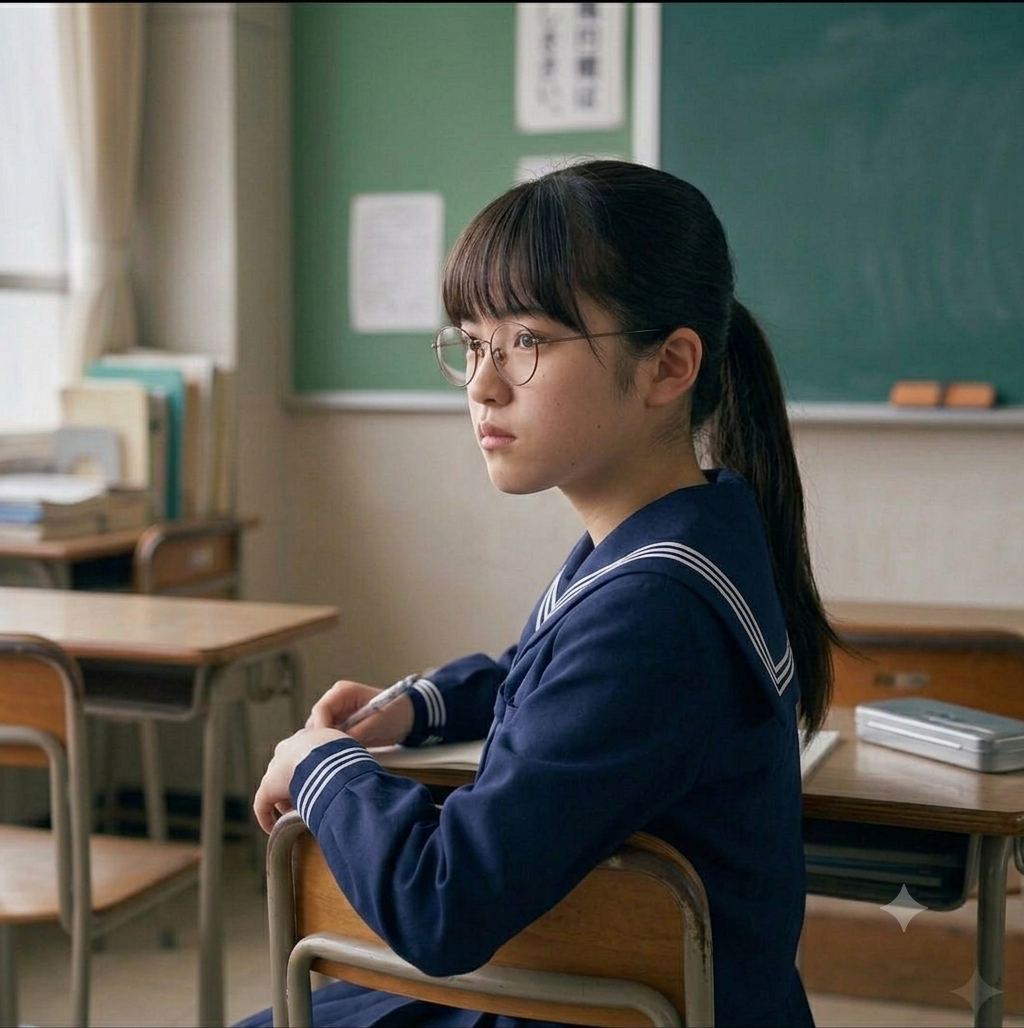
Kanako is, of course, beautiful.
And not just beautiful—she is incredibly rare. A treasure of humanity. She is as precious as Tutankhamun. If there were a gauge for beauty, she wouldn’t just be in the red zone at the far right; she would be off the scale entirely, breaking the frame. I’m not flattering her; she is a genuine, authentic beauty. If I could make her my girlfriend, I could brag to anyone. If I walked beside her, everyone would be envious. Or rather, from the moment she became mine, I would be consumed by an endless, agonizing anxiety that someone might steal her away, or that she might fall for someone else.
I long to show everyone the evidence of just how beautiful she is, but she absolutely refuses to let me take her picture. The strange thing is, she’s relatively relaxed about letting other guys take her photo or posing for couple shots with them, but for some reason, she never lets me. As for couple shots—completely out of the question.
You might ask, Why not just take a candid photo?
Absolutely not. If I did that, I’d be nothing more than a stalker.
Or you might say, She wouldn’t know if you just snapped a picture without asking.
No, no, no. That’s not how things are between Kanako and me.
If she refuses to be photographed, then I, with a clear conscience and a sense of honor, will not take a single shot. If I were to sneakily pry into her privacy—and I could, if I wanted to—our relationship would gradually warp, spiraling into something uncontrollable. That is why I would never do such a thing.
Besides, a photograph is nothing more than a dead painting. No matter how many you own, they are useless. There is nothing more tragic than staring at a photo of Kanako because you cannot be with the real thing.
I do occasionally see photos of her on other people’s smartphones. Usually, they are group shots taken by her female friends. In those, Kanako isn’t an extraordinary beauty. She descends to the level of a “pretty girl.” She blends in with the other, perfectly ordinary women. Among them, her features are a bit more striking, and she is certainly beautiful, but she is vastly different from the Kanako imprinted in my memory.
I’ve wondered if the Kanako in the photos is the real one, and the Kanako in my brain is just a phantom—a projection of my own fantasies that doesn’t exist anywhere. I’ve questioned myself like that. But no way. The photos are lying. What can a photograph possibly achieve? Even if I am the one who is wrong, so be it. I love my Kanako, not the Kanako captured in a photograph.
Furthermore, whenever Kanako is pointed at by a camera, she always assumes a “perfect” expression. This face is always the same, and it’s boring; I hate it. To her, that might be the face she’s most proud of, but to me, it isn’t. It looks slightly frightening. A face made for the public—a tense, constructed face that fakes her identity, a face that hides her true self.
I prefer videos, as they tend to capture her more natural expressions. Videos have less artifice than photos. You can’t maintain a constructed face for a camera indefinitely. For a split second, her true expression slips through. I hate how that small glimpse eases my loneliness. I find myself admiring the fact that she can make such a face. And then, inevitably, I long to see the real Kanako.
A photograph is like an oil portrait; it can be manipulated however the photographer wishes. That is where a photographer shows their skill. But I hate those constructed images. If Kanako were to become a gravure idol and a brilliant photographer took her picture, I’m sure it would be stunning. But that wouldn’t be the living Kanako. It would be a fusion of the “material” that is Kanako and the personality and technique of the photographer. I cannot tolerate such impurities intervening. I know Kanako too well. Therefore, the moment something that is not Kanako is mixed in, I have an immediate allergic reaction—even to things others wouldn’t notice.
Kanako must be Kanako. She must not be an idol; she must be the flesh-and-blood human being standing before my eyes. That is why I cannot become her stalker. Because if I became a stalker, she would become an idol. And an idol is, in the end, nothing more than a commodity you pay to admire.
Do you understand what I’m saying?
The bond between Kanako and me is simply something that can only be described as the relationship between the two of us. The relationship of our relationship is precisely the relationship between me and Kanako. It is something that can only be defined through tautology—a self-contained entity that transcends classification or analysis, and rejects all comparison to others. In a sense, Kanako is Philosophy; she is Zen. Heidegger and Wittgenstein said something similar.
I’m not talking about the cliché idea that an idol you see through a screen or on TV is different from an idol you see live at an event, or one whose autograph you get or whose hand you shake after buying a CD. This isn’t that kind of banal conversation.
Photographs. Videos. Idols. All the staging and processing that comes with them. All of these are obstacles that enter the space between Kanako and me.
Anything that stands between us—even the colorless, transparent air—feels like an intrusion. No, perhaps I’m exaggerating. I suppose air is acceptable. I can tolerate a few specks of dust dancing in the air. Even those particles, sparkling in the evening sun, only serve to make Kanako more beautiful. As the saying goes: Use the stones of others to polish your own jade.
Every guy falls for Kanako.
I was no different. Or at least, I thought I wasn’t. But lately, I’ve stopped understanding myself. At first, I’m sure I liked her simply because she was beautiful and charming. But what about now? Am I really that superficial? I don’t think so.
I might have fallen for her lightly, almost by accident, in the beginning. But now it’s different. Completely different. The only way to put it is that I’ve sunk so deep into her that I no longer even know why I love her. I suppose that’s how it goes with everything. When you love someone too much, you can no longer explain the reason in words. It was just that, at some point, I became drawn to Kanako’s abnormal, eccentric side. She is clearly not an ordinary woman. She possesses a charm unlike anyone else’s. Perhaps the act of believing that—of convincing oneself of this—is what it means to “truly love.”
Regardless, I cannot pull away from her. I cannot imagine a world without Kanako. Time and time again, I tried to be rational. But I couldn’t. Even when I thought I had succeeded, I’d slide right back to where I started. My mind is constantly occupied by her. And that, in essence, is what it means for me to love her.
“Talk?”
It was the break between the third and fourth periods. Students were zooming past us as they moved between classrooms. I had to get to my next class; this was no time to be standing around chatting. “Here? Now?”
“You’re free during the fifth period, right?”
“Uh, yeah.”
“Then come to the prefab classroom during the fifth.”
“What? The one on the roof?”
“That’s the one.”
“In a place like that?” I was surprised she even knew about that classroom. “Do you… have something you need to tell me in private?”
“Well. Something like that.”
“Hmm.”
I pretended to be calm, but inside, I was anything but.
I’ll admit, I have my own ulterior motives, so the fact that she wanted a private rendezvous certainly left me with a fair share of expectations. Yet, it’s painful to expect too much, only to be crushed by disappointment. For all I knew, this could be a breakup talk.
Having said only what she needed to say, Kanako quickly vanished, blending into the noisy crowd of students.
The great thing about my high school isn’t just that it’s practically on top of Akihabara’s Electric Town.
Equally wonderful is the fact that the campus sits right on the banks of the Sumida River. Just outside the sports field is a riverside promenade, where locals and foreign tourists from Asakusa wander at their own pace.
When you climb to the roof of the main building, the view is spectacular.
Water buses constantly ply the Sumida River right before your eyes. The sight is so moving that I find myself humming a poem by Taki Rentaro:
The gentle spring air on the Sumida River,
Where boats glide up and down the stream,
The droplets from the oars scatter like falling blossoms—
To what could I possibly compare this vista?
To my left, the neon glow of the Skytree pierces the clouds. To the south, the skyscrapers of the Tokyo metropolis are lined up like a diorama crafted by Hideaki Anno, and within that cluster, I can spot the diminutive red silhouette of Tokyo Tower. And if I turn my gaze to the western sky, I can see the faint silhouette of Mount Fuji beyond the mountain ranges stretching from Tanzawa to Okutama and Chichibu. On a crisp, clear winter morning, if I’m lucky, I can even spot Mount Tsukuba beyond the grey haze of the northern horizon.
Yes. This is the Kanto Plain. The Kanto Plain.
After enrolling in this school, I spent some time exploring the campus, and I immediately fell in love with this roof. Since then, I’ve come here from time to time, just to gaze at the view.
There is one strange thing about this roof. A single, unremarkable prefab shack stands there all alone. Inside, there’s a chalkboard, a teacher’s podium, and rows of desks. A sign hangs over it reading “Room H601,” so despite the cramped quarters, it is undoubtedly a classroom. In our school’s system, the “H” stands for the Main Building; for instance, H201 would be the first classroom on the second floor. Since the main building is a five-story reinforced concrete structure with one basement level, and this shack sits right on top of the concrete roof, I assume that’s why it’s designated as H601.
However, this room is nowhere to be found in the school brochure or the official list of classrooms. Inside, it’s a jumble of scrap lumber, cardboard boxes, long tables, shelves, and machine tools like lathes and drills. It doesn’t seem to be used as a classroom anymore.
And there are no other classrooms on the roof besides H601. Why it was built in the first place, and why it’s now abandoned, is a complete mystery to me. Careless as it may be, the door is always unlocked, and students are free to come and go. But since the room’s existence is virtually unknown—or rather, because it looks more like a materials shed or a construction site office, possessing a presence so faint it’s almost invisible—hardly anyone seems to notice it. I’ve never seen anyone else in there. It’s, in a sense, a classroom forgotten by the world.
Anyway, realizing I had to move to my next class, I started to walk away, only to be stopped by a sudden voice from behind.
“You. Are you close with Himuro?”
“Whoa! You scared the hell out of me. What?”
“Himuro Kanako. You two were just talking.”
It was Negishi.
Yes, this guy. The only person in the Computer and Electronics Club who can communicate flawlessly using nothing but Morse code.
At a mere sixteen years old, he is a sorcerer who has mastered every secret art of the otaku world.
Our school uniforms aren’t blazers; the boys wear the old-fashioned, pitch-black high-collar student jackets, and the girls wear sailor suits. However, workwear is also permitted as an acceptable alternative to the uniform. Our school is a pure-bred sanctuary for the STEM-minded. Consequently, work clothes are considered perfectly respectable formal wear here.
Yes, I’m talking about the world of Workman. It’s like those athletic high schools where tracksuits basically become the uniform.
Negishi is an extremist. He wears workwear constantly, and for some reason, he even pairs it with a necktie. Of course, while at school, he wears the designated practical training gear, but he wears workwear even in his private time. He doesn’t call it “workwear,” though. He calls them “jumpers.” “Jumpers.” There’s something nostalgic about the word.
And it’s not just Workman. Toraichi. Yamamoto Kansai. Z-Dragon. Jawin. In the winter, he sports insulated pilot jackets and heavy-duty cargo pants; in the summer, he pairs denim zip-up jumpers with cotton-blend slacks. He coordinates his outfits according to his mood and the season. He’s actually quite the fashionista. While the rest of us wear ordinary cotton work gloves, Negishi often wears these skin-tight, neon-colored gloves that look like something out of Kamen Rider.
In his chest pocket, he carries a four-color Frixion pen that doubles as a mechanical pencil and a pen-shaped LED light. In his upper left arm pocket, he meticulously keeps spare red and black oil-based ballpoint pens. No teacher in this school ever flags him for dressing this way.
To any observer, he looks like a walking advertisement for Meiwa Electric, but the man he actually aspires to be is Q from 007. Even his perm is designed to fit that aesthetic. He wears thick, high-prescription glasses, and on his wrist is the otaku gold standard: a G-Shock with a titanium case and crystal glass.
He calls himself an “Industrial Media Artist.” I suppose he’s better than those guys who wear beanies and call themselves “hyper-media creators.”
His greatest talent is in the field of “micromouse”—you know, those competitions where tiny motorized cars autonomously navigate a maze to reach the goal. It’s a type of Robocon. I heard in the club that he recently took second place in some contest held in a vacant lot in Asakusa’s Sixth District—the winner was some working professional or something. He’s not just a fellow member of the Computer and Electronics Club; we’re also in the same class. But that’s where our connection ends. We share no common hobbies or topics of interest, and until now, we had hardly ever spoken.
“Yeah. I’ll probably talk to her, sure.”
“I have a favor to ask.”
“What is it?”
“About that thing we sell at the school festival—I want Himuro to help us out with it.”
“That thing… you mean the illuminations?”
“Exactly.”
“Wait, aren’t you in the same class as me for the next period? We don’t have time. Let’s talk while we walk.”
Our school festival usually takes place around mid-November. This year, it’s coming up next week. For the festival, the Computer and Electronics Club creates and sells Christmas illuminations under the guise of “charity.” In high school, you can’t just sell things for profit. To run a business, you need a noble justification.
You know the ones—those lights that people hang on their walls or balconies before Christmas and make everything sparkle at night. The profits are donated to the Red Feather Community Chest. From the club’s perspective, it’s a win-win: the construction process serves as practical training for LED soldering and microcontroller control, the visitors love them because they’re affordable and high-quality, and we can recover the cost of tools and parts from the sales while still donating to the needy. Quite a well-thought-out project, wouldn’t you say?
You might wonder if building outdoor illuminations is dangerous. You might wonder if you need a licensed electrician’s certification. Well, technically, yes. But there are specialized power supplies, cables, connectors, and controllers sold specifically for this purpose, and as long as you use waterproof tape and proper precautions, you can make them just as safe as anything you’d buy in a store. Plus, we have the guidance of our faculty advisor.
“I just feel like we need a girl’s sense of aesthetics for this,” Negishi said. “If it’s just a bunch of guys making Christmas decorations, the design is going to end up looking tacky.”
I wondered if Kanako actually possessed any such aesthetic sense or design talent. I had no idea.
“Maybe so, but why don’t you just ask her yourself?”
I have zero interest in electronic crafting to begin with, and the idea of acting as a middleman for some weird guy I’m not even close with felt inherently unpleasant.
“I’ve never spoken a single word to her,” he admitted.
“I mean, you’re in the same club. I don’t see what the problem is. This is a great opportunity—just go talk to her.”
“Then… could you at least let her know that I was asking?”
Why on earth did he need such a convoluted setup just to talk to a girl?
“No, no. It’s not that. If I step in as a mediator, it could create all sorts of complicated problems. Isn’t it better if the world stays as simple as possible? My philosophy is to involve myself in other people’s business as little as possible. I only want to do things that directly concern me.”
“What the hell is that supposed to mean? This does concern you.”
“Look, if it’s something between you and me, I’m happy to give you advice anytime. But I’m terrible at soldering and other fine motor tasks. I’ve tried it, and I’ve learned the hard way: I simply lack the dexterity and the patience. The illuminations should be left to the illumination craftsmen. Therefore, it’s hard for me to imagine doing anything related to this project with you.”
“All I’m asking is for you to pass on a message. Why are you being so difficult? Is there some problem? Do you have a reason for not wanting to help me? Do you not want to be associated with me? Are you avoiding me?”
“No, look. It’s just that with her, you never know what kind of reaction you’re going to get. You have no idea what kind of disaster is waiting to happen.
Listen. To use a metaphor, Kanako is like a black hole, or a neutron star on the verge of gravitational collapse. The spacetime around her is warped by intense gravitational waves, and anyone who ventures too close is irradiated by electromagnetic waves more powerful than a microwave oven. You’d be X-rayed right down to the bone, seeing blue light through your own skin. We’d be crumpled up like sheets in a washing machine, and our brains, eyeballs, and organs would be toasted brown like a cat accidentally left in a microwave. See? No one who approaches her comes out unscathed. Spacetime is twisted around her. It’s Super Dimension Fortress Macross over there. You get it, right?”
“I don’t get that metaphor at all. Not even a little.”
“Anyway, it’s just complicated. The relationship between her and me is… a mess. That’s why I don’t want to get involved. That’s all. Well, good luck. Every guy struggles with talking to girls. Consider this part of your training. Trust me, once you actually do it, it’s no big deal. Just dive in headfirst.
Also, consider yourself warned. If you approach Kanako and suffer some kind of casualty—even if your daily life is transformed into a living hell—do not come crying to me. I will have absolutely nothing to do with it.”
“Fine. I won’t ask you again.”
Negishi probably felt I was mocking him. He began to walk, completely ignoring my presence.
When we entered the classroom, he took a seat in the very front row. Since I have no desire to sit anywhere near the teacher, I took my seat far away from him, diagonally behind.
In fact, I am Himuro Kanako’s stalker.
At least, if a third party were to observe my daily behavior objectively, that is the conclusion they would naturally reach.
Whoa, hold on. Don’t jump to conclusions. Please, for the love of god, don’t report me to the police.
How should I describe the relationship between Kanako and me? Well, there have been countless times when I wanted to explain it to someone, or seek some kind of advice, but in the end, I always kept it to myself. Even if I had spoken up, I doubt anyone would have understood.
To me, this is simply the form of love that Kanako and I finally settled into after a long period of time.
I am a Kanako-approved stalker. Do you follow? Probably not. One moment I say I’m a stalker, the next I say I’m not.
Let me explain this in order.
Kanako is what you’d call a people-pleaser—a social butterfly. She wants to be liked by everyone. She is constantly fawned over by everyone around her, and of course, she loves every second of it. She absolutely thrives on the attention. Kanako is fearless. She strikes up conversations with anyone and everyone; the girls adore her, convinced that “she is my absolute best friend.” The boys, too, quickly fall into the trap of thinking she has feelings for them.
That’s where Kanako is problematic. I don’t care about the girls—they can do whatever they want. But she doesn’t realize how sinful it is to be kind to men she doesn’t even like. No, she probably does realize it, but she has a wretched personality that compels her to scatter charms among various men regardless.
To me, it almost looks like Kanako is practicing the art of manipulating people. For what purpose? Who knows. But perhaps she was born into a destiny where she must employ these tricks and maneuvers once she becomes an adult. A training regimen to turn every human being into her subordinate. Maybe she had to master the art of psychological manipulation from a young age, and I was simply one of her guinea pigs. In any case, like the others, I was lured in. I was made to believe I had a chance.
In a way, she is the exact opposite of a “Tsundere”—let’s call her a “Dere-Tsun.” She always has a boyfriend, but I’ve never seen one last more than six months. The moment a man tries to cross a certain line and push for more, her attitude flips instantly, and she treats him with ice-cold indifference. A sane man would give up and withdraw right then and there, but men aren’t that simple. Some of them end up clinging to her. Those are the genuine stalkers. That was exactly where I started, in the first stage.
Is she just some flighty girl who changes boyfriends because she’s promiscuous? I don’t think so. She is certainly fickle, and she’s interested in many different men. But she maintains a specific distance, keeping a court of men around her, and anyone who gets too close is first gently, then completely, blocked.
Princesses always have multiple men hovering around them, and Kanako instinctively knows how to balance them—pitting them against one another, inciting them, or sometimes letting them fight—so that in the end, she belongs to no one. She either knows this balance by instinct, or she controls it through ceaseless, conscious effort.
One by one, everyone eventually gives up. But I am different.
Am I the only one who refuses to quit? I don’t think so.
I consider myself a fairly perceptive person. There is nothing more wasteful than spending time on a woman who gives you no chance. I couldn’t possibly fall for a woman whose only goal is to manipulate people. I can’t understand people who are obsessed with idols; what is the point of one-sided longing and admiration?
To me, Kanako is not a Madonna. She is not an idol.
The relationship between Kanako and me is fundamentally different from the relationship between an idol and a fan. I can’t give up because I can never truly tell whether I have a chance with her or not.
Now, people would say that’s exactly the kind of stupidity that defines a stalker. That I’ve fallen so deep I’ve lost my sense of self and can no longer consider the other person’s discomfort. That this is the proof that I am a stalker. I’ve often thought the same. I’ve often doubted myself. Fools are the only ones who don’t realize they’re fools. That’s all this is, isn’t it? I’ve wondered a thousand times if I need to give up on Kanako for the sake of both our happinesses, lest we end up hurting each other.
But still, something feels different. I’m sure it’s not just my imagination.
Damn it. I still can’t explain it properly.
There are all kinds of stalkers in the world. Some chase idols; others dig up personal information from the internet to record a girl’s private life or expose her online. Some go as far as making threats or becoming violent. Some even kill their partners at the end of a romantic entanglement. Whenever I see those news stories, I feel depressed. Am I the same breed as them?
No way.
I am a perfectly normal man.
Let me give you some evidence.
First, Kanako gets angry if I ignore her. If she were indifferent to me or hated me, she would be relieved to be ignored. Now, I don’t actually ignore her. I’ve never even tried to. I’m just often preoccupied with other things, but when she wants my attention and I don’t give it to her, she gets furious.
Once, during an argument, I told her, “If you hate me that much, just say it clearly. I’ll never speak to you again.” She didn’t answer.
Also, Kanako absolutely hates it when I pat her on the shoulder. The air literally freezes. And yet, occasionally, when we pass each other in the classroom or the hallway, she deliberately bumps into me. Not just once or twice. She’ll bump into me, walk past without a word, and then come back and bump into me again. It’s absolutely intentional. What on earth is that about?
Furthermore, whenever I talk happily with another girl, Kanako always gets jealous. Not just once or twice. She’ll say things like, “Oh look! Takuya is hitting on girls!” or “My, Takuya, are you accompanying your girlfriend to work today?” And she doesn’t say this to me—she says it loudly, so everyone around us can hear.
I’m not hitting on anyone. I don’t even have the hobby of picking up girls. I simply thought I had met the person somewhere before, so I asked, “Have we met somewhere before?” Kanako took that as a classic pick-up line. No, no—Kanako knows perfectly well that I’m not the kind of man to hit on strangers. Yet, she makes a point of saying those things.
Or, if I happen to run into a girl I know on the way to school and we walk together, chatting happily, Kanako will see us and boast to her friends, “Look at that! Takuya is accompanying her to work! I wonder if he stayed at her place last night?” She knows full well that it’s impossible for me to walk down the street so conspicuously with any girl other than her.
That is, by all accounts, jealousy. And jealousy means she wants to monopolize me. It means it irritates her to see me getting along with other women. Moreover, by making a scene like that, she’s warding off the other girl and marking her territory. Is that not it?
If she does those things, doesn’t it mean she likes me? At the very least, if she hated being followed by me, she would just ignore me. But she is clearly tracking my every move.
Is it possible to express love only through jealousy?
Kanako must know that I am devoted only to her. Even if I happen to be talking to another girl, she must know that there’s no way I could love anyone else. But she is terrified—terrified that, by some miracle, I might come to love another woman more than her. She’s warning me. Or rather, she’s guarding and obstructing any other woman from liking me. Just in case. Just in case. Provided I’m not imagining things.
Kanako is, of course, a beauty recognized by all. Like Princess Kaguya descending from the moon. She is also absolutely confident in herself. There’s no way she lacks confidence in her own existence. And yet, she doubts that I love her so much that I wouldn’t even glance at another woman. If she’s that worried, why doesn’t she just treat me more kindly to secure my feelings? God, why am I rambling on and on about the same thing?
If she simply hated me or ignored me, I could find peace in giving up on her. But she won’t let me. It feels as though she wants to keep me bound to her. She keeps me on a leash—giving me just enough hope to stay, but not so much that I actually move forward. She definitely wants to keep me as a backup. Yet, she would never, ever admit that she loves me. In a way, isn’t she the real stalker here? I don’t know. Maybe she is.
If she ever found a truly intimate boyfriend and treated me with total indifference, I’m sure I could finally walk away. But that moment never comes. I am left in a state of emotional limbo—half-dead, neither here nor there.
If you love me, just be honest and date me already. It would be so much easier and more enjoyable for both of us, wouldn’t it? I simply cannot understand her. Is she hesitating for some reason? Is she hiding a secret?
And that brings me to my theory: while she is a “Dere-Tsun” to every other man, she seems to be a “Tsun-Dere” specifically for me.
And that is why I continue to be her stalker. I have no choice, right? I wonder if there’s any other man in the world suffering from the same predicament. If there is, I’d love to have a word with him.
Yes. I am a “Kanacologist”—a specialist in the study of the woman known as Kanako. In other words, “Kanacology” is a unique discipline, isolated from all other fields of study, and yet simultaneously a comprehensive science that synthesizes every known academic pursuit. I have devoted years to the pursuit of Kanacology, and I have finally arrived at a single hypothesis: I am Kanako’s “kept man.” I’ve rambled on for so long, only to reach a conclusion that is depressingly cliché. I apologize.