“Saito.”
It was mid-afternoon. I was eating napolitan spaghetti when Haraguchi, the usually quiet owner, spoke to me from across the counter while wiping a plate with a dishcloth.
“What is it?”
“A nationwide coffee chain asked to lease this place. I decided to let them have it.”
“Huh, is that so? And then what?”
“I plan to stay on as the store manager for a while.”
“What?”
“It’s a franchise arrangement. I’m still technically the owner, but I’ll be an employed manager.”
“If you’re going to end up in such a complicated position, why not take this opportunity to just retire?”
“As long as my body can move, I can’t sit still unless I’m doing something.”
“You have a son, don’t you?”
“Yeah. He works at a real estate agency. When I die, the shop will probably go to him.
He tells me there’s no point in keeping it an independent shop forever.
He says we should lease it out, eventually incorporate it, and turn it into a joint-stock company. For inheritance tax purposes, you know.”
“Huh. I guess that’s how it goes nowadays.”
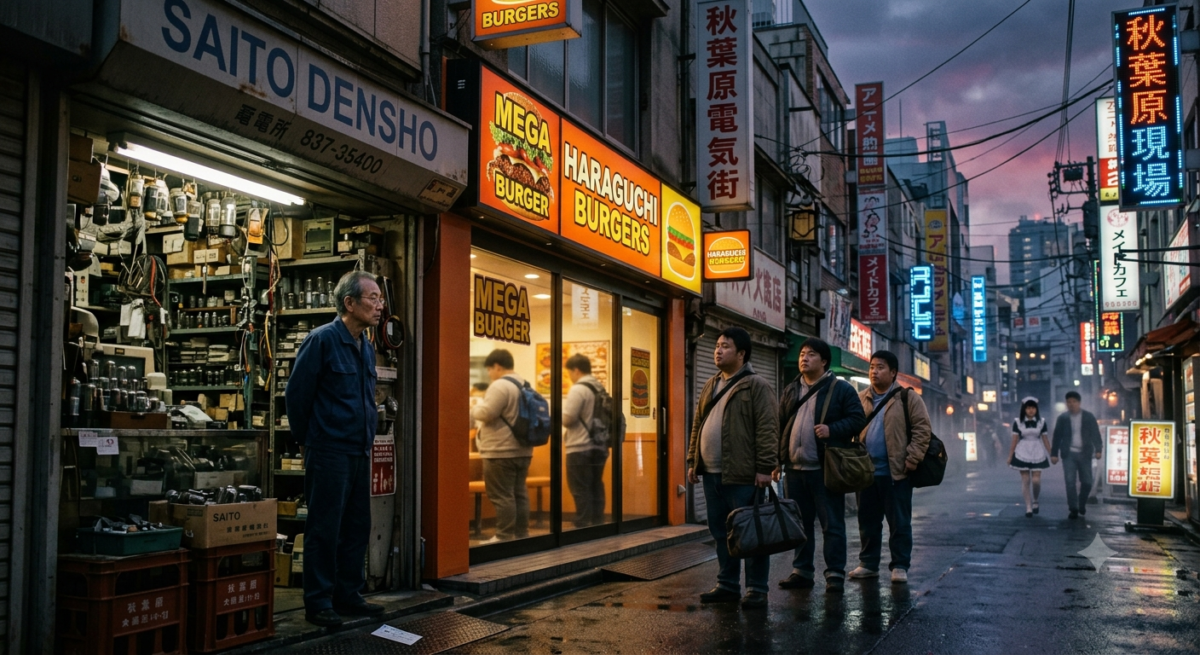
Right after the war, I started a retail business selling electronic components in Akihabara. The shop’s name was “Saito Densho (Electric Store).” The storefront was only about five meters wide, and though it had considerable depth, it was a dreary, unremarkable little shop where customers could barely squeeze past one another.
Haraguchi’s place, “Haraguchi Coffee”, was right diagonally across from Saito Densho. During my lunch breaks, I would invariably leave my shop to my student part-timers and head over to Haraguchi’s to have a cup of coffee.
“Then, what are you going to do with your shop?” Hariguchi asked me back.
“I rent the place from a landlord to do business. It’s not my own property. This shop ends with my generation.”
“I see.”
Within a week, renovations began on Haraguchi’s place, and Haraguchi Coffee transformed into a chain cafe with a mundane, commonplace name that you could find anywhere in Japan.
“How is it, being the manager of the new shop?”
“The foot traffic and sales have definitely increased. But the name, the interior, the menu, and the clientele have all changed. It doesn’t feel like my shop at all. On top of that, my son recently told me that maid cafes or ramen shops are all the rage in Akihabara these days, so he wants us to turn this into a ramen shop next.”
“And?”
“No way. I don’t want to be a ramen shop owner. I’d rather retire than do that. And a maid cafe is completely out of the question.”
Akihabara was going mad.
The major electronics stores with their massive, self-owned buildings couldn’t keep up with the times and went bankrupt one after another. Those spaces were partitioned and leased out as small tenants, and maid cafes and ramen shops began cropping up in a chaotic jumble. In the old days, there were no ramen shops in Akihabara. Even if there were, they were just ordinary Chinese restaurants. But once one became successful, every time an old component shop closed its doors, a maid cafe or a ramen shop would move in. Before anyone realized it, Akihabara had become a town of ramen shops.
The place next door to “Saito Densho” finally turned into a ramen shop as well. Originally, this too had been a component shop, but the owners kept changing rapidly; it sold imported games and merchandise for a while, but that also went under, and at last, it became an eatery.
Well, but Japan is a capitalist society, built on supply and demand. If Akihabara becomes a town of cosplay and ramen, so be it. It’s not something to get angry about over every little thing.
The ramen shop next door was constantly dead. After all, Akihabara was already overflowing with ramen shops, and the competition was fierce. I figured it wouldn’t last long, and sure enough, after six months, they started remodeling again. The new place was a strange establishment boasting “non-national B-grade gourmet cuisine.” I expected it to go bankrupt immediately too, but for some reason, customers started pouring in, and lines began to form right in front of my shop.
The clientele was utterly bizarre. They were all plump, in their twenties or thirties—maybe some were even older—and every single one of them wore poorly coordinated clothes, carried backpacks, and held tote bags. No matter how you looked at them, they were single men who clearly had no luck with women.
While peering at suspicious-looking magazines, they would critique the area, saying things like, “In Akihabara, this shop is like this, and that shop is like that.” They would wait patiently for about an hour, and then silently devour a massive, unappetizing dish—it was hard to tell if it was curry or a hamburger steak—without seemingly even tasting it. They would drink nothing but the free ice water and then leave.
I felt a chill run down my spine.
Where on earth did this breed of people sprout from? Why, and since when, had this town become like this?
Before long, another component shop on the same street went under, and this time, a strange bar opened up. A place that served alcohol. Such establishments used to be mostly over toward Showa-dori Avenue and were rarely found inside the electric town itself. Seeing such a business encroach upon the electric town made me shudder.
Akihabara used to empty out by eight o’clock in the evening, as the flow of customers hunting for electronic parts dried up, leaving the streets deserted. But this bar stayed open long after I closed my shop, and it served alcohol during the day too. Maids would swarm in with male customers to drink together.
I had a bad premonition. In all likelihood, these girls were accompanying customers to work or hanging out with them after hours. Without anyone noticing, Akihabara was morphing into a red-light district. Moreover, it was on the verge of becoming a sleepless castle for degenerates, unique not just to Japan, but to the entire world.
“Saito, my son says he wants to turn this shop into a burger joint.”
Haraguchi spoke to me in a low voice during my usual lunch break while I was drinking coffee.
“Huh. What are you going to do?”
“I’ve had enough. This town isn’t the Akihabara I used to love. I’m washing my hands of it for good.”
After that, as usual, the shop was remodeled again, turning into a burger joint with a seemingly normal atmosphere. When I went in thinking I’d grab a coffee, I was shocked by the menu, and shocked all over again when I saw what the people around me were actually eating. The signature item of the shop was something called a “Mega Burger.” It reminded me of the movie Super Size Me.
McDonald’s super-sized hamburgers had caused quite a stir at one time, but this hamburger was several times larger than that. On top of that, it was infinitely customizable—you could scale up to a Double Mega Burger, a Double Mega Bacon Burger, and so on. Apparently, if you just asked, they would even serve an unimaginably massive size called the “Giga Burger.” The portions of french fries and fried chicken were also absurd.
At this rate, Japanese people could no longer mock Americans. Even America, the superpower of obesity, probably hadn’t resorted to such ridiculous, reckless excesses.
Akihabara was supposed to be the world’s most cutting-edge cyber-metropolis. It was supposed to be a futuristic city leading the world. If it were games, anime, or personal computers, that would still be fine. If it became a town where technology and art were cherished, so be it.
But now, it was about to be occupied by ghouls addicted to fats and carbohydrates. They didn’t seek flavor; they sought nothing but raw calories. What was even more astonishing was that, despite Akihabara falling into such a dire state, the mass media, far from criticizing it, actually glorified and hyped it up on variety shows featuring competitive eating.
Now, dozens of meters of obese youths formed lines in front of my storefront, while maids and their clients walked past them, arm in arm. I had to be having a nightmare. This had to be a waking dream.
But it was no dream. Akihabara had become a town that stoked the worldly desires of otaku and exploited them. They were being abused without even realizing it.
Haraguchi’s burger joint prospered. There were many foreigners too. It was said that people were now coming all the way to Akihabara even from the United States—the land of gluttony and obesity—just to challenge themselves with the competitive eating options. Regardless of nationality, and even if they couldn’t speak the same language, those kinds of people seemed to hit it off immediately. It felt like the end of the world.
One day, a young man who looked like a businessman came into my shop. He was a good-looking guy, smartly dressed in a suit. He was the type of person who rarely stepped into my store.
“Nice to meet you. I am with this company,” he said, handing me a business card. The name printed on it was “Shinji Haraguchi.”
“I heard that you have been close friends with my father for a long time.”
“What? Are you Haraguchi’s son?”
“Yes, I am.”
“Did you come here for some specific reason?”
“Yes. To put it bluntly, I took over my father’s business and changed it into a burger shop this time. Thanks to everyone, it has been highly successful, and I am thinking of opening a second location.”
“And?”
“After considering various properties, we determined that your shop, Mr. Saito, which is very close to our main branch, would be the most convenient for us. That is why I have come to speak with you.”
“What? You’re telling me to give up this shop? You want me to quit?”
“I am well aware that it is highly disrespectful of me to say such a thing, but you, Mr. Saito, like my father, are at quite an advanced age. Upon your relocation, we would like to offer you a generous compensation package in lieu of a retirement bonus. Please consider it an expression of gratitude toward someone who has known my father for so long, and accept it without hesitation.”
“Is this your own arbitrary decision? Or did you consult with your father before coming here?”
“My father has completely retired now, and all management decisions are made by me individually.”
“I look upon this electric town being gradually encroached upon by eateries and adult entertainment businesses with great bitterness. I can still work. I have no intention of quitting this shop.”
“Is that so? I understand. I came today merely to introduce myself, but if you happen to change your mind, please feel free to call the number on that card at any time.”
With that, Haraguchi’s son bowed with polite insolence, climbed into a black car parked in the coin-operated lot in front of the shop, gave instructions to his driver, and drove away.
It was that very evening when I received a phone call from my landlord.
“About the space I’m renting to you—the lease is up for renewal in six months, right? I’m sorry, but the economy has been bad lately, so I’m going to have to raise the rent.”
“What did you say? Even now, we are barely turning a profit. If you raise the price any further, our Saito Densho will go into the red.”
“Actually, I’ve received a very good offer. A tenant has appeared who is willing to pay double what you pay now.”
“Could that tenant by any chance be a man named Haraguchi?”
“I can’t disclose a customer’s privacy. At any rate, if you can’t agree to the rent increase, you’ll just have to move out within six months.”
The landlord hung up unilaterally.
I could do nothing but stare at Haraguchi’s business card, which I had thrown into the trash can.
In the year 2020, public order and morals in Akihabara degenerated to an extreme degree, becoming unbearable for ordinary citizens. However, it would be a waste to simply regulate the otaku industry, which contributed significantly to the Japanese economy. To the citizens of Tokyo, what happened to the otaku or how they were exploited was of no concern. Furthermore, some researchers harbored a desire to witness how the otaku culture, which had developed primarily around the town of Akihabara, would transform in the future.
“Just as they once moved Yoshiwara from Higashi-Nihonbashi to the outskirts of Asakusa, and just as they recently moved the Tsukiji Market to Toyosu, let us relocate and isolate Akihabara.”
The Tokyo Metropolitan Assembly passed a resolution to that effect.
It so happened that the Tokyo Olympics had ended, and the former sites were languishing with no purpose, so “New Akihabara” was constructed around the Ariake Big Sight.
In this way, the otaku were granted a place to live out their lives as a distinct minority group.
THE END
This is an older piece of mine that I wrote back in 2014. In a way, Akihabara has changed even more drastically than I ever imagined.