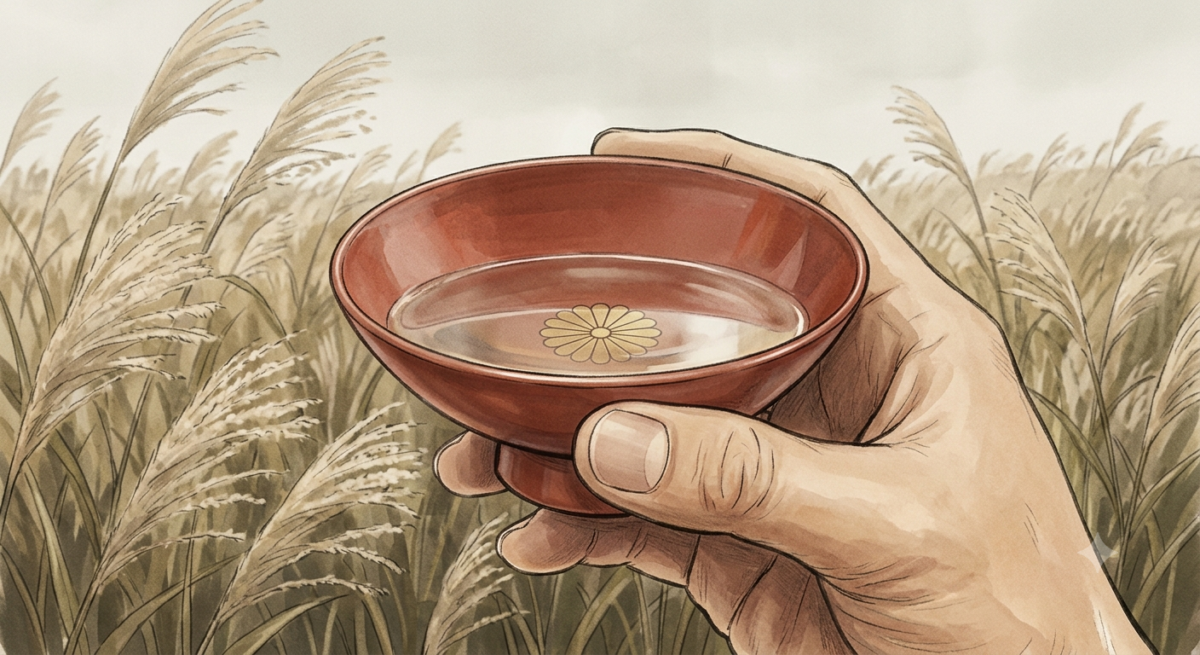
Yoshiteru reluctantly took a single sip, but whether it was refined sake, cloudy doburoku, new brew, or aged liquor, a man who could not drink simply could not drink. He idly toyed with the imperial cup in the palm of his hand, utterly at a loss. The Emperor caught sight of his lonely demeanor and called out to him.
“Are you a Major? That means you must be the Captain of the Imperial Guards who recently took over the post.”
From the rank insignia embroidered onto the shoulders and collar of his military uniform, it was immediately apparent that Yoshiteru held the rank of Major.
“Yes, Your Majesty. Just as you say, I am Major Hishijima Yoshiteru of the Imperial Army, who was appointed Captain of the Imperial Guards last month.”
Yoshiteru offered a textbook military salute to the Emperor.
“I see. So you are indeed the Yoshiteru who made me stop the rabbit hunts,” the Emperor said, a knowing smirk playing upon his lips.
“You honor me, Sire,” Yoshiteru replied, feigning composure.
“Yoshiteru is a fine name. If I recall correctly, the thirteenth Ashikaga Shogun—famed as a master swordsman—wore the same name.”
“It is exactly as Your Majesty says.”
Ashikaga Yoshiteru was a Shogun of the Ashikaga clan during the Eiroku era—around the same time the historic Battles of Kawanakajima took place. Moreover, as a direct disciple of the legendary sword saint Tsukahara Bokuden, he was a rare, anomalous existence among the successive Ashikaga shoguns, who were typically known for their effeminate, courtier-like lifestyles. At the mere age of thirty during his reign, he fell victim to a rebellion plotted by the Miyoshi and Matsunaga clans, who despised direct shogunal rule. Yoshiteru wielded his own sword, fought valiantly, and ultimately took his own life.
“Your drink does not seem to have advanced at all from earlier. Are you weak to alcohol?” the Emperor asked.
“I am, Your Majesty.”
“Then in place of drinking, compose a poem.”
“I, Hishijima, am terribly awkward with poetry. I am a coarse, single-minded warrior of no accomplishments. I beg your imperial indulgence to excuse me.”
“How can there be a man who cannot compose a poem? Since ancient times, even the samurai have composed waka. Is it not merely a matter of arranging syllables in five-seven-five-seven-seven? Give it a try.”
Yoshiteru was plunged into despair. To an Emperor who had composed waka as naturally as breathing since the moment he could understand the world, poetry was simply something one did. How on earth could Yoshiteru convince such an Emperor otherwise?