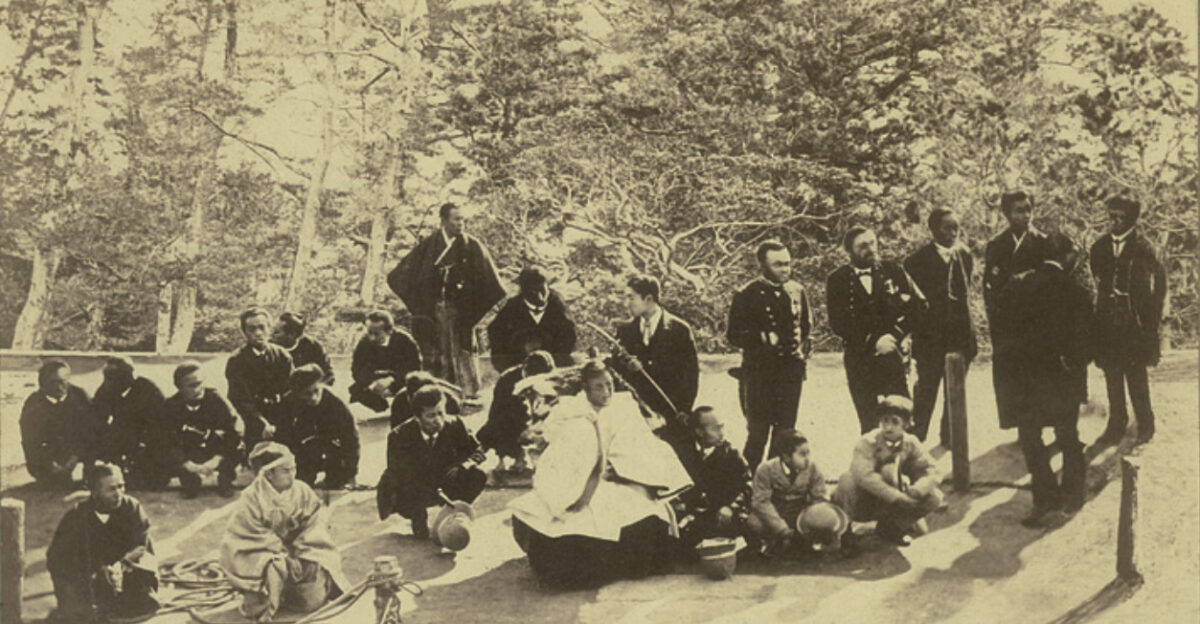
It was in September of the fourth year of Keio (1868)—just five days before the name of the era was officially changed to Meiji—that the Emperor entered Edo Castle and renamed the city Tokyo Prefecture. The magnificent Honmaru Palace of Edo Castle had already been lost in the Great Bunkyu Fire of 1863. Although the fire had also spread to the Nishinomaru Palace, it was barely managed to be rebuilt. However, this too was destroyed by an accidental fire in 1873. For this reason, the Emperor was using the temporary Akasaka Palace, located on the site of the former Kii Domain residence, as the Imperial Palace at the time.
A court chamberlain named Tominokoji Hironao, who had been left in charge of the Akasaka Palace, widened his eyes in anger upon receiving the news from the Emperor.
“Once again, those men from Satsuma and Choshu have instigated His Majesty into doing something utterly pointless. How can an Imperial excursion for the Chrysanthemum Festival be conducted in such a wretched, unseemly manner?”
The Kangiku no Sechie (The Chrysanthemum Feast)—also known as the Choyo Festival, which had become one of the Five Seasonal Festivals during the Edo period—was an imperial court event originally held on the ninth day of the ninth lunar month. However, due to the abolition of the lunar calendar in 1873 and the nation’s numerous tribulations, the tradition had recently been left in neglect. As a side note, this festival would later become the official “Chrysanthemum Viewing Party” in 1878, and after World War II, it would be revived as the autumn “Garden Party” (Enyukai).
Although the Tominokoji family held the lowest lineage rank among the high-ranking court nobility (Dojo-ke), Hironao’s dedicated service during the marriage of Princess Kazunomiya and his accompaniment during her journey eastward to Edo had been recognized. At the tender age of twenty-one, he was appointed Secretary for National Affairs and promoted to the Upper Fourth Rank. However, he incurred the displeasure of the reactionary court nobles surrounding Emperor Komei, and fell from power along with Iwakura Tomomi, being ordered to shave his head and enter confinement. He was eventually pardoned under the general amnesty following Emperor Komei’s demise, and was created a viscount after the Restoration.
Little is known about Tominokoji Hironao. Though he is often labeled as a faction leader for the union of Court and Shogunate (Kobugattai) or as a Shogunate supporter (Sabaku-ha), he likely held no particular ideological convictions. Following the custom of low-ranking court nobles, he was simply a man who devoted himself entirely to acting as a steward for the imperial family, serving them with meticulous care.
Hironao loaded a horse-drawn cart with the red wine and glasses that the Emperor favored daily, Western foods such as cheese, cakes, and ham, imperial cups to be bestowed upon the subjects, red-and-white striped curtains, and court ladies, and transported them to the Toyama residence. Hironao instructed his attendants to surround the chrysanthemum display and the banquet seats with the curtains. Yoshiteru grew increasingly disillusioned by the sheer ostentatiousness of it all.
Hironao handed a cup to Yoshiteru, the Captain of the Imperial Guards. It was a round, flat sake cup, made of black lacquer and adorned with the Imperial Chrysanthemum Crest in gold dust.
“Lord Tominokoji, unfortunately, I do not drink,” Yoshiteru said.
“Fool!” Hironao scolded Yoshiteru to his face. “When you receive an Imperial command, fail not to scrupulously obey!”
Shosho Hyakkin (Reverently obey the Imperial Command). It was a phrase everyone recognized, the famous opening line of Article 3 of Prince Shotoku’s Seventeen-Article Constitution.
“This is a cup graciously bestowed by the Emperor himself! Who in their right mind would refuse such an honor?”
It is not a direct command from the Emperor, Yoshiteru thought, wiping away the spit Hironao had sprayed with the hand towel tucked into his waist. It is merely a court noble telling me to drink alcohol from a cup with a chrysanthemum crest.
Can a nation really be protected by scoundrels who use the Emperor’s authority as a shield to humiliate his ministers? How satisfying it would be to bring my sword down right through the skull of this anachronistic, pale-faced, powdered creature with his blackened teeth.
In all likelihood, a sinister fury was laid bare upon Yoshiteru’s face. Hironao must have sensed the dangerous aura as well.
“Yoshiteru, just touch your lips to the cup. Accept it,” said Tesshu, who was seated next to Yoshiteru once again.
“Tetsutaro-san, I am the Captain of the Imperial Guards. I have a duty. If I let my men drink, we will not be able to serve if something should happen to His Majesty.”
Yoshiteru was accustomed to calling Yamaoka Tesshu by his given name, Tetsutaro.
Ignoring Yoshiteru, Hironao proceeded to hand cups to the Imperial Guards one after another. Next, court ladies dressed in white kosode robes and scarlet hakama skirts poured sake into each cup. The attire of these court ladies was to the Emperor’s particular liking.
The scent of alcohol, capable of numbing the brainstem, filled the air. The savory aroma of the hot refreshments tickled the nose, causing saliva to pool in the mouth. The collars and sleeves of the court ladies wafted the scent of cosmetic powder all around, while the flames of the bonfires flickered in the gathering dusk.
The soldiers looked happily back and forth between the cups filling with sake and the white-powdered, red-lipped faces of the court ladies.