Asakusa Rokku (District 6) was designated as a national urban park by the Meiji government. Isn’t it wild that the entire grounds of Senso-ji Temple were repurposed as a public park just to serve a developing nation in Asia? Wouldn’t that be considered an insult to Buddhism? Either way, the Meiji period in Japan was truly an intense era.
There was a pond called Hyotan-ike (Gourd Pond) in Rokku, though its history was not particularly long. It was actually an artificial pond, dug to obtain the soil needed to reclaim the surrounding wetlands when Senso-ji Temple was being developed as an urban park.
There is little doubt that Hisago-dori Street also derives its name from this pond, as hisago is the traditional Japanese word for hyotan (gourd).
It is said that many wisteria trellises once surrounded Hyotan-ike. After World War II, when ownership of the Senso-ji grounds was returned to the temple from the national government, the temple filled in the pond to fund its post-war reconstruction. In its place, they built an entertainment complex called Shinsekai—a name that likely took inspiration from the famous district of the same name in Osaka, home to Tsutenkaku Tower.
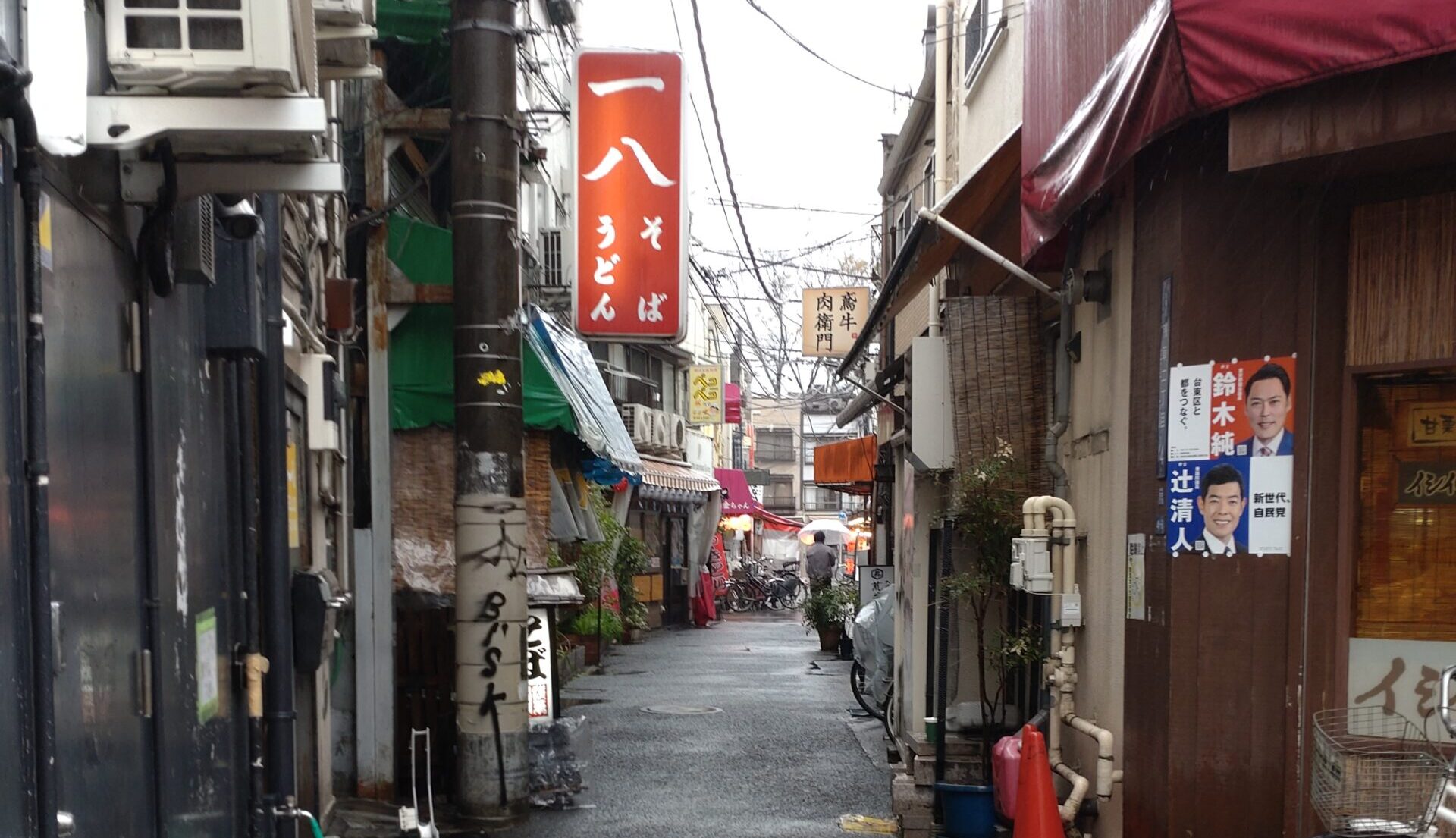
Additionally, the area between Hyotan-ike and the temple was developed into streets such as Hatsune-koji Alley and Nishisando Shopping Street, which were then leased to private vendors. Hatsune-koji Alley also used to feature wisteria trellises to provide shade, though these were reportedly removed quite recently. Since the name “Hatsune-koji” already existed in the Negishi area, it is likely that Asakusa borrowed the name from there.
Hyotan-ike (Japanese Wikipedia)
On Saturday morning around 7:00 AM, walking along the Rokku Broadway shopping street in front of the Asakusa off-track betting facility (WINS Asakusa), the streets are still sparse with people and the air feels crisp and free of tobacco smoke. Yet, there is an unmistakable tension in the air. Teams of two or three people, wearing cold-weather coats over their uniforms and clearly on duty, patrol the street. From an ambiguous building called the Asakusa Park Hall Building—which looks like a hotel or an office building—a group of nearly twenty individuals dressed like police officers file out and walk toward the betting facility across the street. They are likely not police officers, but security guards for the off-track betting center. Having likely stayed overnight in Asakusa, this marks the start of their shift. A two-day weekend spree of frenzy is about to begin. Next to the A1 exit of the Tsukuba Express station, the bento shop Delica Pakupaku has stacks of boxed lunches arrayed in front, fully prepared for customers arriving from 7:00 AM.
By around 9:00 AM, horse racing fans start arriving in droves. They form long queues from deep underground at the Tsukuba Express station, carried up by escalators to spill out onto the street.
I have no idea what makes horse racing so fascinating. I’ve asked various people why they love it so much, but I still don’t get it. For starters, hardly anyone seems to be making money from it. While there might be a handful of professional gamblers moving large sums of physical cash under the radar of the National Tax Agency, they are a tiny minority; the vast majority gathering here are undeniably losing money. Stocks offer a much better chance of profit—in fact, with the right approach, there are reliable ways to profit from the stock market. That doesn’t exist in horse racing, which is driven largely by chance. If you’re looking for a gambling option with higher predictability, even pachinko is a better bet. You simply can’t consistently profit from horse racing.
A woman I met at a bar once told me, “Drinking can ruin your health, but horse racing gives you the same high without damaging your body.” That actually made sense to me.
Is there any inherent necessity for an off-track betting center to exist in Asakusa? Shibuya has one as well, but I wonder if the scene is similar there. Has anyone ever considered relocating these facilities out of Shibuya or Asakusa?
This grim, smoke-filled, and shady atmosphere lingers throughout the area—from Kuramae to Asakusa and down to Sanya—until late Sunday night.
Many establishments in Asakusa display betting tickets. On weekends, most shops broadcast the races live. Countless people set up tables and chairs in the alleyways to watch the races. During tournament season, they switch to grand sumo broadcasts instead.
Is finding horse racing exciting some kind of bug in Homo sapiens? Whether Aryans or Mongolians, those who mastered horse riding expanded trade, won wars, and left behind vast lineages. Perhaps the genes inclined toward horsemanship outcompeted the rest, leaving us subconsciously and inexplicably captivated by horse racing today.
It turns out the Asakusa Park Hall Building is an office building housing JRA offices, a bicycle parking lot, and other facilities. That figures. The second floor and basement indeed house a mysterious bicycle parking area. It is reportedly free, but I wonder if daily commuters are allowed to use it. The Tsukuba Express station also has bicycle parking, though that one charges a fee. Since the Asakusa area is flat, an immense number of people ride bicycles around here. Their riding manners are hardly exemplary—in fact, it’s extremely dangerous. The only saving grace is the complete lack of steep slopes.