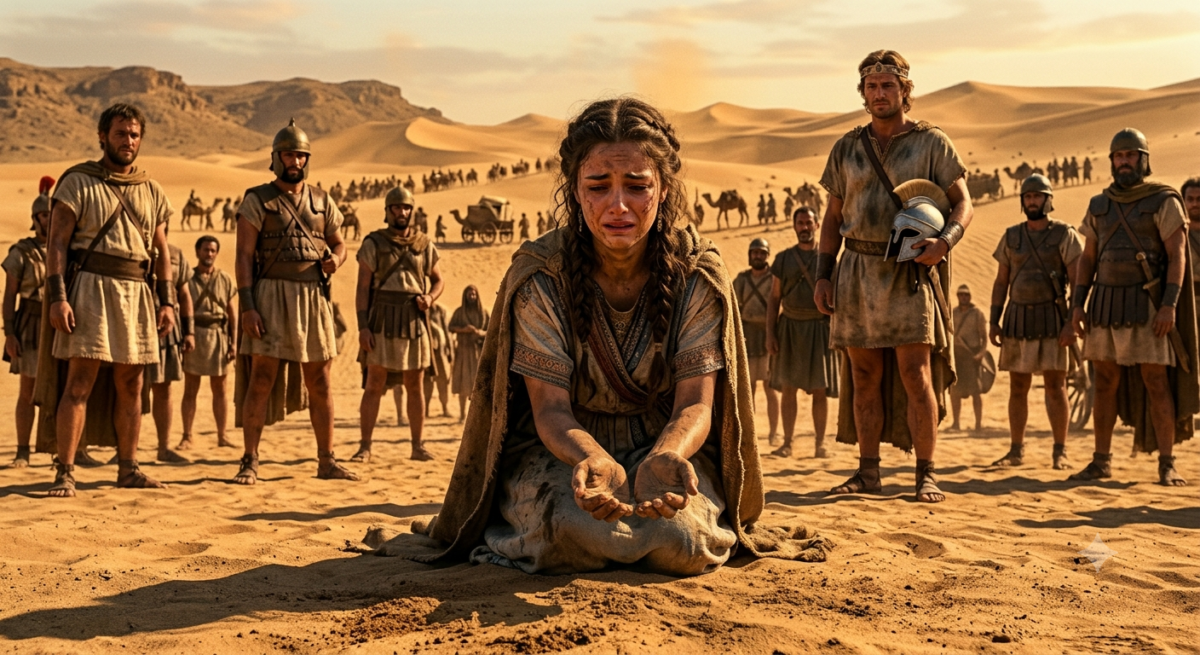
We were sinking into the deep desert. We had nothing to do but walk on the sand. Crossing from one dune to another, I felt as if everything were recurring forever, every scene just like one I had seen before. It gradually emptied my mind, stripping away my emotions and sensations.
“Go west, and we will reach the end of this desert. All you have to do now is keep moving forward,” King encouraged the soldiers.
I asked him, “Excuse me, my Lord. I have several questions in my mind that I cannot resolve on my own. May I ask for your wisdom?”
“What is it? Tell me.”
“Why do you love to keep wandering in this dangerous world? Why won’t you settle peacefully in a city, instead of encamping in the wild fields? You are never at ease. How can you bear it?”
“Ha ha! Simply because I am a king. I ascended the throne because my thoughts and feelings differ from yours. It is quite natural.”
“I think I understand, but could you explain it a little more simply for me?”
“What you find difficult is rather easy for me, and what you find easy is conversely difficult for me. I cannot tolerate what brings you happiness, but your pain is my pleasure. If you find pain in pleasure, or if pain pleases you, it means you have gained brotherhood with kings.”
It was a riddle to me.
“All right,” King continued, “keep what I am about to confess to you strictly in your mind. If I stay in my court—in the palace of Pella, Babylon, or Susa—my men are released from military service and return home. Everyone sleeps well and has a good time with his family. But the court is NOT my home; it is the most dangerous BATTLEFIELD for me. Everyone there is my enemy.
We are now on our way to world conquest. I am happy simply because everybody needs me. Every soldier lives a desperate life, and in that life, he truly needs me. I am required only on the battlefield. If I lived in Macedonia, nobody would need me, and everyone would start trying to kill me. Even my father, Philip II—he didn’t die in battle. He was killed at his daughter’s wedding ceremony. Of course he had many bodyguards, but he was stabbed by one of his own. Why?
Because he was a king. Then who made the bodyguard kill my father? I do not know yet. Some say my mother had him killed.
Hence, I dislike festivals, theaters, courts, and city crowds. They are horrible, deeply unsettling to me, and never entertain me. Do you see?
I feel as though everyone in a city could be an assassin—whether it’s a city I captured yesterday or my sweet old hometown.
No matter where I stay, I can never rest. A battlefield is the only place I can sleep soundly, because if I die, everyone dies on the battlefield with me. So, they desperately keep me alive. That alone keeps me safe and sound.
The more dangerous the situation, the more obedient the soldiers are to me. I can hold them in my grip at once if I gather them in a garrison. But if I release them to their hometowns, I cannot know what they are doing. Someone will scheme to kill me.”
“On a battlefield, you might also be killed by enemies, assassinated by your bodyguard, or handed over to the enemy, like the Persian kings or generals.”
“Yes, I will die if I lose. That is natural. A king is safe as long as he is on the battlefield and keeps winning. Otherwise, he can die at any moment. Give up your life. Tame your death. Only then can you sleep and eat in peace. Fortunately, I have more than enough talent to defeat my enemies in battle.”
Hungry soldiers tried to catch whatever they could find creeping on the sand, like a beetle or a lizard, to eat.
One day, we found a dried bush in the rocky desert. There were many snails clinging to the stems. The soldiers even grilled and ate these creatures.
Though the sand was completely dry, the rocks sometimes became wet with night dew. Soldiers strove to suck and lick those tiny drops of water.
Some of the light-armed soldiers, straying away from the main army in search of water, found a small amount collected in a shallow cleft, or a meager spring.
Another day, a soldier found a small pool of water in a cave, collected as much as possible into his helmet, and brought it to his King.
“Is this all?”
“Yes, my Lord.”
“I would drink if we had enough water for every soldier. I am grateful that you gave this to me, but I cannot accept it. I cannot be the only one to drink. Since you found it, you may drink it.”
“Forgive me, but I cannot drink either while my Lord is thirsty.”
“Please. That is your water. Drink freely. Do not mind me.”
“Then give it to someone else, my Lord.”
“That is also impossible. If you do not drink it yourself, throw it away.”
The soldier began to tremble. “I can’t. I can’t do it.”
Of course, King was suffering from thirst. So was this soldier. Everyone was. Who could give up the water of life?
Thirst accelerates as time progresses. Dotted lights appear behind your eyelids. A cat crosses in front of you, or a rooster crows—things that cannot exist in the desert. Those are the signs that death is approaching. Eventually, we kill horses to drink their blood, and next, it will be the humans’ turn.
“Wait!” shouted Amastrie, riding a camel with her sister Raoxiana.
“Don’t, Amastrie!”
Pushing Apama aside and shaking Raoxiana off, she came forward, kicking up the burning sand.
“I’ll drink it if you’re going to waste it!”
Panting, she reached out her hand.
The whole army watched her and King, anticipating what would happen.
Her lips were cracked, and the whites of her eyes had turned a dull yellow. The freshness of her young skin was ruined.
King squinted at her with a faint smile and asked, “You want to drink this?”
“Yes.”
King took the helmet from the soldier and poured its water onto the ground, right before her eyes.
Amastrie knelt down and scooped up the wet sand with her palms. But it was quickly dried by the sun and wind, spilling through her fingers.
She gazed up at King for a moment, weeping softly.
The soldiers watched this incredible scene. Every soldier felt as if he were the sand soaking up that helmetful of water.
“We always share equally, right?” King placed the helmet back on the soldier’s head. A single drop of water ran down the soldier’s temple.
Ptolemy broke the silence.
“Listen, everyone! According to our desert guides, the distance to Kerman is only two hundred stadia. Keep this pace, and we will reach it before dawn. Evening is coming, but let us march through the night. In the green fields of Kerman, there are shaded trees, fruit orchards, and running irrigation channels filled with fresh water. The main force has already arrived and is waiting for us, preparing a delicious feast. Don’t get a stomachache by overeating! Cheer up, this is truly our final effort. Forward, Macedonian warriors!”
From the depths of the sand, a rumbling shout arose.
The soldiers, who had been as dry as fish bones, regained their energy. They stretched their limbs, their eyes flashed, and they began to move like puppets brought to life. I was astonished by the sight.
The whole army was united now to accomplish our goal. Calamity had forged us like steel. We had to get through this desert.
Seeing my stunned expression, King said bashfully, “Eumenes, you think I barely saved my dignity by not drinking that water, nor letting Amastrie drink it, don’t you?”
I must have been shedding tears. I wiped my face with my sleeves, regretting that I was wasting so much precious water from my body in this emergency.
“You invented that act on the spot,” I said.
“Invention? What do you mean?”
“Or you improvised. To the gods, at various places during our campaigns, you have sacrificed animals. We humans have sacrificed goats, donkeys, pigs, cows, horses, or camels. In myths, humans sometimes sacrificed other humans—not only enemies, but their own family members. We sacrifice our most precious animals to our most important gods.
Therefore, you sacrificed water to the god of the desert, because water is the most precious thing here. By doing so, you restored the spiritual strength of the entire army.
Water is the holiest blood, clear and colorless. The holy of holies. No animal or plant can live without it. You let the sand drink it. It means you offered the god of the sand the blood of sacrifice to pray for the safety of your soldiers. Do I understand you correctly?”
“Ha, ha!” King burst into laughter. “Amazing. It is not I, but you who are the genius at storytelling! You give me a grand reason after the fact for my unconscious, unintentional deed. I shall explain it that way in the future whenever I cross a desert and pour water on the ground.
But Eumenes, you are mistaken. You completely misunderstand me. Or rather, I successfully deceived you, just as I deceived the other soldiers.
I was simply terrified. I am always diligent in playing the role of a good king.
You have heard the story of Bessus. In Persia, a king never lives out his natural life, nor is he merely wounded or killed in battle; instead, he is often poisoned by someone close.
I do not drink unknown water. Nor do I eat food given to me. I eat the same food the soldiers eat. I reach out, grab it with my own hands, and eat it—that is the safest food. I drink the water the soldiers drink, sharing it from my own cup—that is the safest drink. Nobody can predict what food I will eat or what water I will drink. That is the safest way for me to dine. I have forgotten the taste of fine food and the aroma of wine since I became king. I cannot care about the things that please ordinary humans anymore. Eating and drinking are part of my battle. I eat and drink to maintain my body and to avoid being poisoned. As I told you before, everyone’s pleasure is my duty, whereas my pleasure is everyone’s burden.
Sleeping is also one of my tasks. Women are too. Love, as well. For me, ‘the most dangerous woman by whom I could be killed’ is not just a metaphor. Generally, a man can relax and sleep well with the woman he loves most. That is not the case for me. Every night I go to bed with my wife, I suspect she might kill me before I awaken. She probably won’t, but she possibly could. She might love me, but she might not.
Oh, Raoxiana—my beloved wife, yet I still cannot say I truly love her, nor that I truly trust her. Yes, I must pretend to love her, but I cannot answer clearly if asked, ‘Would you truly have no regrets if she killed you?’ I am not sure. Raoxiana wants to die soon. That is true. But I am also thinking of my death at all times. Always. I do not know what tomorrow holds for me, any more than a dying patient does.
The soldiers mistakenly believe on their own accord that I am a familiar, intimate king who always shares hardships with his Hetairoi. But in truth, my situation is vastly different from theirs.
And if a soldier offers me unpoisoned water with no evil intent, I still will not drink it unless it is proven safe by authority. I know it is extremely dangerous to drink raw water pooled in a suspicious cave. As a commander, I can never afford to get sick or die from drinking such water.
I am truly sorry for Amastrie. I did a terrible thing to her. But thirst is merely a temporary suffering. It is useless if she quenches her thirst only to die from poisoned water.
If I had thrown away the water offered by a soldier for no reason, the men would have resented me. I feared that critical moment. Hence, I had to perform as a merciful, self-controlled king who shares all hardships with his companions. That was complete fiction—a role-play involving poor Amastrie. A king must be an idol, always playing his part.
Eumenes, take care of Amastrie. I fear I have left a deep spiritual scar on her, just as I did on Raoxiana. However, because she is also a member of the royal clan, she must overcome such hardships all her life. She must learn to survive on her own. She will encounter more and more calamities in the future.
Keep what I have just said strictly to yourself. Do not tell Amastrie, nor anyone else.
I do not know why, but something suddenly made me confess this to you, Eumenes.”
Oh, Basileus!